

Moving forward from projects that have been stalled for years.
Combating waste must become an urgent task from the central to local levels, and the spread of this spirit has begun to show results in many localities, even in projects that have long been stalled or left unfinished.
In Hanoi , Phung Khoang Park, a project notorious for its delays, has been urgently completed and temporarily handed over before the Lunar New Year to be ready for the New Year's fireworks display. The completion of construction is expected to soon move into the final stages.
In Ho Chi Minh City, Metro Line 1, another notorious project that delayed completion, also managed to start serving the people there in the final days of 2024.
These are just two of many delayed projects that have caused construction costs to escalate, resulting in significant waste, while the local people themselves do not benefit from these projects.
Such wastefulness has long been embodied in countless official documents and explanatory reports, then calmly persisting without any satisfactory explanation or definitive accountability from any organizations or individuals. Worse still, this wastefulness, coupled with the idle resources and projects, is openly displayed to the public, inevitably raising the question of whether living with wastefulness has become commonplace!
During a group discussion at the recent National Assembly session, General Secretary To Lam expressed his frustration, citing the second facilities of Bach Mai and Viet Duc hospitals in Ha Nam province as a "typical example" of the waste of public resources. According to the General Secretary, if these two projects had been privately funded, they would certainly have been operational long ago.
Spreading the spirit of the 500kV power line to "revive" stalled projects.
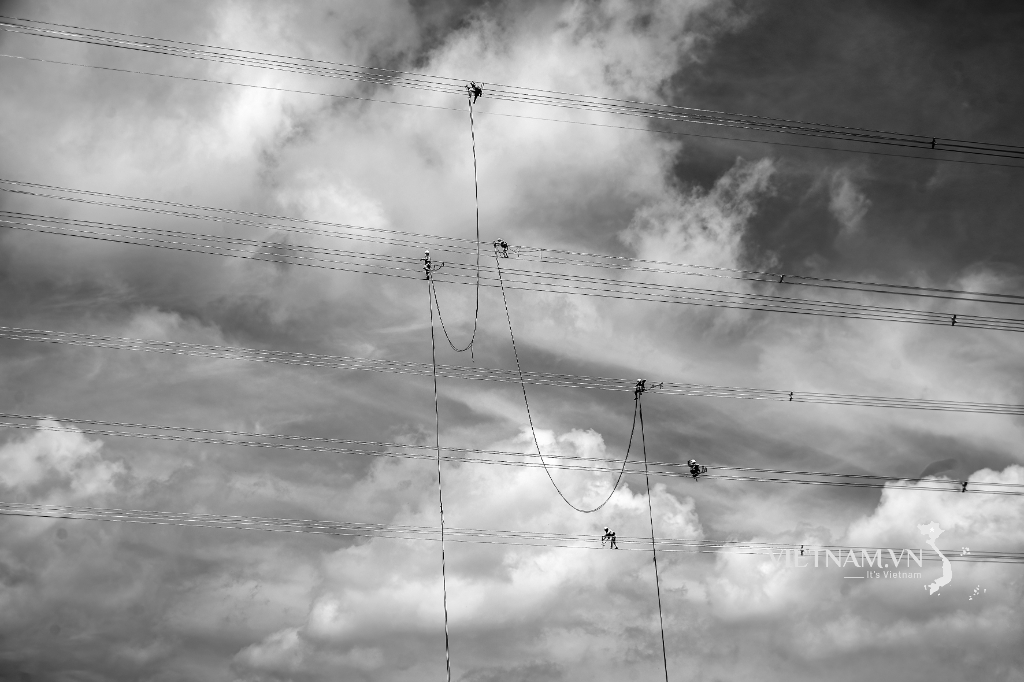
The fact that the 500kV circuit 3 transmission line project will be fully constructed and completed in 2024 is something few people would have thought possible, considering the long-standing reality of many key national and local projects.
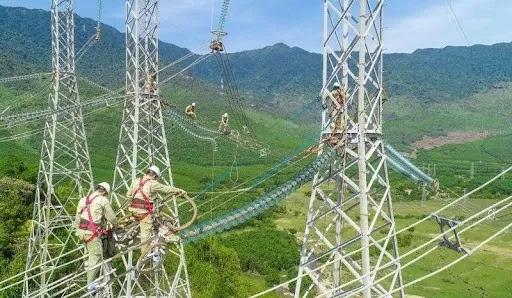 |
| The completion of the 500kV circuit 3 transmission line serves as a lesson in decisive action to avoid wasting resources. (Illustrative image.) |
But what seemed impossible became possible thanks to the decisive involvement of central and local leaders, and the concerted efforts for the benefit of the country and the grassroots. Here, the spirit of "thinking first, doing" and "not retreating" overcame inertia in thinking and ingrained habits in action, bringing about a style of management and handling that resolved bottlenecks, leaving no room for waste to persist.
The good news is that following General Secretary To Lam's directive in his article "Combating Waste," in Hanoi, Ho Chi Minh City, and many other localities, projects that had been delayed due to numerous reasons have begun to revive, promising a new life that will benefit the economy, the community, and the people.
The logic here is that if a large, complex project like the 500kV power line could be completed in what could be considered a record time, then there is no reason why other projects should accept prolonged construction times and delays in becoming operational simply because of procedures and mechanisms arising during the operation and management process.
We have witnessed many large-scale investment projects, some worth trillions of dong, that had been dormant, being revived and playing a clear, positive role in socio-economic development thanks to the focused and decisive removal of bureaucratic obstacles. One such project is the Thai Binh 2 Thermal Power Plant, a name that for a long time evoked associations with stagnation, deadlock, and countless difficulties, the most challenging of which were legal issues.
Through utmost effort and determination, the plant's completion progress finally overcame the "mountain" of difficulties regarding capital and mechanisms, driven by a spirit of determination and hope to bring electricity from the plant into the national power grid.
Reflecting on the new life of such projects suddenly reveals that, it turns out, the relationship between combating wastefulness in construction projects in particular, and resources in general, and removing institutional bottlenecks – the bottleneck of all bottlenecks – has never been closer than now. This can be considered a mandate of life and development. Any decisive action to combat wastefulness starting now is absolutely necessary and unavoidable.
In his article "Combating Waste," General Secretary To Lam emphasized the solution of building a culture of saving and combating waste in agencies and organizations; encouraging the people to strengthen the practice of saving and combating waste, creating a habit of valuing state assets, the people's efforts, the collective contributions, and the efforts of each individual. |
![[Photo] Prime Minister Pham Minh Chinh receives the Governor of Tochigi Province (Japan)](/_next/image?url=https%3A%2F%2Fvphoto.vietnam.vn%2Fthumb%2F1200x675%2Fvietnam%2Fresource%2FIMAGE%2F2025%2F12%2F16%2F1765892133176_dsc-8082-6425-jpg.webp&w=3840&q=75)


![[Photo] Prime Minister Pham Minh Chinh receives Lao Minister of Education and Sports Thongsalith Mangnormek](/_next/image?url=https%3A%2F%2Fvphoto.vietnam.vn%2Fthumb%2F1200x675%2Fvietnam%2Fresource%2FIMAGE%2F2025%2F12%2F16%2F1765876834721_dsc-7519-jpg.webp&w=3840&q=75)
![[Image] Leaked images ahead of the 2025 Community Action Awards gala.](/_next/image?url=https%3A%2F%2Fvphoto.vietnam.vn%2Fthumb%2F1200x675%2Fvietnam%2Fresource%2FIMAGE%2F2025%2F12%2F16%2F1765882828720_ndo_br_thiet-ke-chua-co-ten-45-png.webp&w=3840&q=75)
![[Live] 2025 Community Action Awards Gala](/_next/image?url=https%3A%2F%2Fvphoto.vietnam.vn%2Fthumb%2F1200x675%2Fvietnam%2Fresource%2FIMAGE%2F2025%2F12%2F16%2F1765899631650_ndo_tr_z7334013144784-9f9fe10a6d63584c85aff40f2957c250-jpg.webp&w=3840&q=75)


























































Comment (0)