

Despite proactive planning in developing appropriate production strategies, localities in the northern region faced numerous adverse weather conditions such as drought, water shortages, severe cold spells, and frost damage during the 2023-2024 winter-spring crop season. In particular, Typhoon No. 3 caused damage to hundreds of thousands of hectares of rice in many localities, resulting in a significant decrease in rice yield and production compared to 2023.
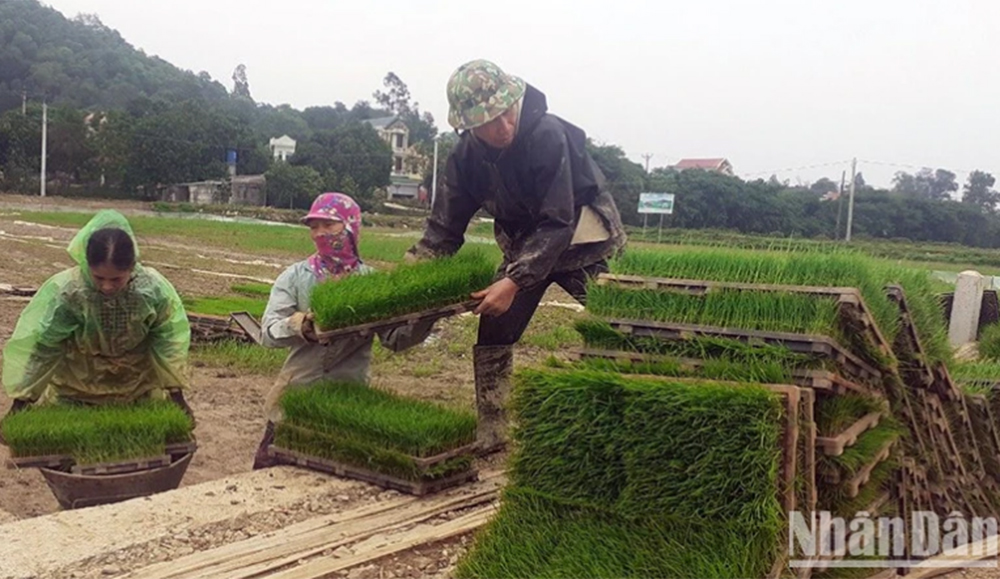 |
Preparing seedlings for the transplanting machine at the Tan Thanh Town Agricultural Service Cooperative, Thanh Liem District (Ha Nam Province). |
According to Nguyen Thi Thu Huong, Deputy Director of the Department of Crop Production ( Ministry of Agriculture and Rural Development ): "In 2024, localities in the northern region planted 2.228 million hectares, a decrease of about 18,000 hectares compared to 2023. Statistics show that rice yield reached approximately 57.3 quintals/hectare, a decrease of 1.3 quintals/hectare compared to the plan, and production reached approximately 12.766 million tons, a decrease of 288,000 tons compared to the plan and a decrease of 355,000 tons compared to 2023.”
One of the reasons for the decrease in rice yield and production is the unfavorable weather conditions, which have greatly affected crop production, especially rice cultivation in northern localities. In particular, Typhoon No. 3 affected rice production in 26 out of 31 northern localities.
One of the reasons for the decrease in rice yield and production is the unfavorable weather conditions, which have greatly affected crop production, especially rice cultivation in northern localities. In particular, Typhoon No. 3 affected rice production in 26 out of 31 northern localities.
According to the Department of Irrigation, the prolonged hot weather in April, coupled with rainfall 35 to 46% lower than the multi-year average, caused drought and water shortages for crops in several provinces such as Yen Bai, Lai Chau, Son La, and Dien Bien .
In addition, two periods of heavy rain occurred in the Northern region. From July 16th to 20th, 62,936 hectares of rice fields were flooded. From September 6th to 11th, due to the influence of Typhoon No. 3 and its aftermath, total rainfall ranged from 350 to 450 mm, causing damage and flooding to 284,472 hectares of rice fields and 61,114 hectares of other crops.
Additionally, in September in the North Central region, typhoons No. 3 and No. 4, the post-typhoon circulation, and the influence of a low-pressure trough caused flooding and damage to over 4,000 hectares of rice fields.
According to the Department of Agriculture and Rural Development of Ha Nam province, although all levels, sectors, and localities had proactively prepared production plans, extreme weather conditions affected agricultural production in the area in 2024.
The high prices of agricultural supplies such as hybrid rice seeds, land preparation machinery rental, water pumps, and labor costs are affecting farmers' incomes. According to data reported by the Provincial Statistics Department, in the 2024 crop season, the entire province planted 28,222 hectares, but due to the impact of typhoon No. 3, more than 7,100 hectares of rice were affected, including 1,024 hectares completely destroyed; the estimated rice yield for the crop season was 55.4 quintals/hectare, a decrease of 2.52 quintals/hectare, and the production reached 150.6 thousand tons, a decrease of 16,074 tons compared to the 2023 crop season.
In Bac Ninh province, in 2024, approximately 57,314 hectares of rice were planted. Due to the impact of typhoon No. 3, which caused heavy rain and strong winds, the flowering and pollination process was affected, resulting in a high percentage of empty or partially filled rice grains.
Rain and floods also inundated many rice-growing areas, reducing yields and production for the whole year. According to statistics, in 2024, the average rice yield of the province is estimated at 60 quintals/hectare, a decrease of 4 quintals/hectare, with a production of 344,065 tons, a decrease of 31,166 tons compared to 2023.
According to the Department of Crop Production, in 2025, the northern region is expected to cultivate approximately 2.205 million hectares, striving for an average yield of 58.8 quintals/hectare and a total production of 12.960 million tons.
To ensure the goals in agricultural production in general, and rice cultivation in particular, Deputy Minister of Agriculture and Rural Development Hoang Trung suggested that localities should focus on and accelerate the planting and care of winter crops to compensate for the damage caused by Typhoon No. 3. For rice production throughout the year, it is necessary to strictly adhere to the production plan, especially regarding seed structure and planting schedule; closely monitor and ensure sufficient irrigation water supply; guide farmers on advanced farming methods to reduce input materials, and fulfill commitments on safe, economical, and emission-reducing production…
According to the National Center for Meteorological and Hydrological Forecasting, severe cold weather is likely to occur over a wide area in the Northern region of Vietnam towards the end of 2024.
Farmers are focusing on planting rice for the 2024-2025 winter-spring crop on an area of 1.052 million hectares, so it is necessary to flexibly adjust the planting time accordingly; absolutely do not sow seedlings or direct seeds during periods of severe cold, when the temperature is below 15°C; prepare means and tools to protect seedlings from the cold using plastic covers, and maintain sufficient water on the field surface to keep the seedlings warm…
The Department of Irrigation assesses that water resources for this winter-spring crop production will face difficulties due to the lowering of water levels in the downstream Red River system caused by excessive sand mining; the saline intrusion in the downstream area has tended to increase in recent years, especially in the downstream area of the Thai Binh River, affecting the water intake capacity of irrigation works belonging to the Da Do and Tien Lang irrigation systems...
To ensure water supply for agricultural production throughout the year, according to Nguyen Manh Hung, Head of the Operation and Irrigation Management Department (Department of Water Resources), ministries, sectors, localities, and farmers need to strengthen monitoring and specialized forecasting of water resources, water quality, and saltwater intrusion.
Based on this, timely information and warnings should be provided to relevant agencies, localities, and people in affected areas to proactively implement appropriate response measures; at the same time, a suitable plan for agricultural production, drought prevention, water shortage control, and saltwater intrusion prevention for the winter-spring crop should be developed.
Local authorities need to effectively implement on-field irrigation to ensure the capacity for water distribution and storage; and accelerate the construction and completion of water intake projects currently under investment to ensure they are operational in time to supply water for the winter-spring crop production.
In addition, it is necessary to urgently restore irrigation works and the system of canals in the fields, ensuring the capacity to channel and distribute water for production; to disseminate information and guide people on measures to store water and use water efficiently and economically, and to thoroughly prevent water loss and waste...
(According to NDO)
Source: http://baoyenbai.com.vn/12/343291/Chu-dong-khac-phuc-kho-khan-tr111ng-san-xuat-lua-nam-2024.aspx




















![[Photo] Reception to welcome General Secretary and President To Lam and his wife on their State visit to the Philippines](https://vphoto.vietnam.vn/thumb/1200x675/vietnam/resource/IMAGE/2026/06/01/1780295488620_vna-potal-chieu-dai-chao-mung-tong-bi-thu-chu-tich-nuoc-to-lam-va-phu-nhan-tham-cap-nha-nuoc-toi-philippines-8798060-7855-jpg.webp)


































































Comment (0)