

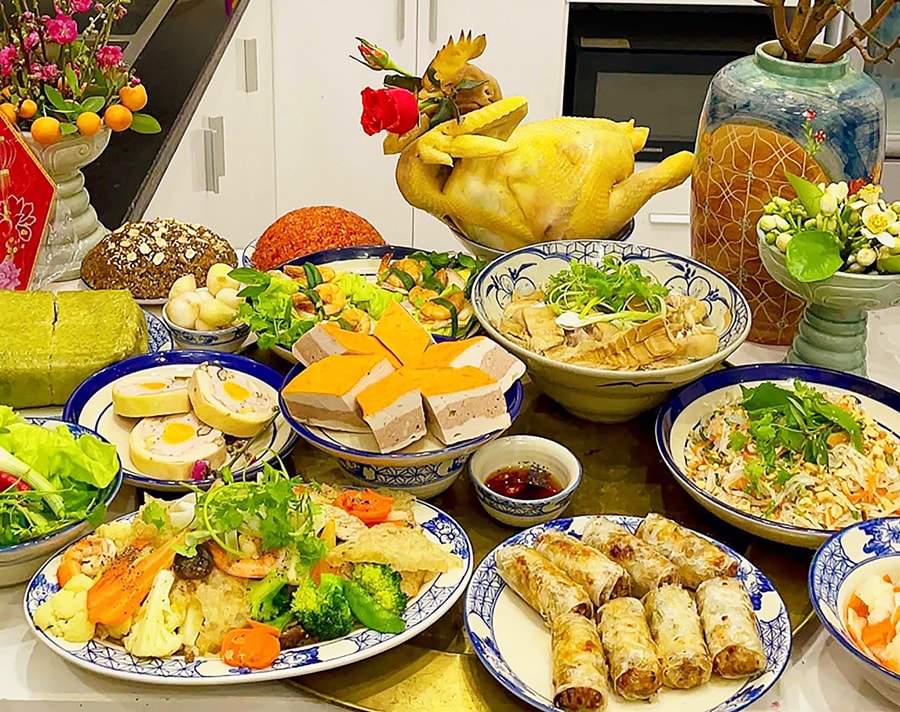
Sacred and solemn
Although the Gregorian New Year is eagerly awaited worldwide , the Vietnamese Lunar New Year remains a crucial milestone marking the beginning of a new year and new opportunities for families, communities, and the entire nation. Tet is a time for family reunions, for friends to meet, exchange greetings, catch up on each other's lives, and wish each other well.
The word "eat" in "eating Tet" (Tet feast) emphasizes the significant meaning of the Tet meal and feast in the family. The Tet feast, with its many delicious dishes, meticulously prepared and carefully crafted, subtly conveys wishes for prosperity, happiness, and good fortune through its blend of flavors, aromas, and colors.
The ingredients and produce used to prepare the Tet feast are important, but the most crucial element is the solemn "soul" of the meal. The ingredients must be fresh and delicious, the preparation must follow proper rituals, and all dishes must be beautifully presented. The head of the family, along with his wife, children, and grandchildren, maintain a respectful yet refined attitude when offering sacrifices, lighting incense, and sharing the meal. The conversations surrounding the Tet feast also focus on beautiful, simple, and familiar things, avoiding anything far-fetched or fantastical.
In Northern Vietnam, and Hanoi in particular, especially during Tet (Lunar New Year), the number of bowls and plates on a feast table is "fixed" – 4, 6, or 8. A small feast table has 4 bowls and 4 plates – the number 4 symbolizes the four pillars, the four seasons, and the four directions. A large feast table has 6 bowls and 6 plates or 8 bowls and 8 plates – numbers symbolizing prosperity and wealth. This relates to spiritual and religious elements in cuisine . Traditionally, feasts were served on red lacquered wooden or copper trays, along with bowls with curved rims and plates decorated with plum blossom motifs. Sometimes, large feast tables would be stacked two or three times high. The idiom "high tray, full feast" refers to such large feast tables.
In the past, all the Tet dishes were cooked by grandmothers and mothers themselves, and in doing so, they taught their granddaughters and daughters culinary skills, embodying the essence (in modern terms) of the word "Công" - the first of the Four Virtues of a woman: Công, Dung, Ngôn, Hạnh, before the girl went to her husband's home. Hanoi people don't crave excessive amounts; each dish is just right, with only a little added or subtracted, thus creating a refined culinary culture of Thang Long - Hanoi, contributing to the elegance of the ancient capital and the modern capital.
Complete and sophisticated
From the 15th day of the 12th lunar month onwards, the Tet atmosphere gradually spreads through the streets, alleys, and neighborhoods of Hanoi. But it is only after the ceremony honoring the Kitchen God that families truly prepare to bid farewell to the old year and welcome the new. The Kitchen God is considered the patron deity of the family hearth, ensuring a year of warmth, prosperity, and abundance. A warm hearth is the most complete and concrete manifestation of a happy, prosperous, and harmonious family life. The offerings to the Kitchen God usually include sticky rice with chicken, fried spring rolls, boiled pork trotters, mushroom soup, bamboo shoots, and sweet stewed sweet soup. But for Hanoians, and people in Northern Vietnam in general, the most important Tet feasts are the offerings for the year-end ceremony on the afternoon of the 30th and the offerings for the new year on the morning of the 1st day of Tet.
The Tet feast is different from the ancestral commemoration feast – it has more dishes and is prepared in a more elaborate and sophisticated way. Besides the usual chicken, pork, bamboo shoots, and vermicelli, there are also ham, sausage, pork skin, beef stew with ginger, braised fish, jellied meat, pork head cheese, and, of course, green sticky rice cakes. Besides the much larger platter of five fruits compared to the usual offerings on the 15th and 1st days of the lunar month, there are also many kinds of candies, cakes, jams, and various desserts: sweet soups, honey-flavored sweet soups, etc. Distinguished culinary artist Pham Thi Anh Tuyet, a native of Hanoi, added: “For wealthy families in the past, the Tet feast would be a ‘eight-dish feast – eight bowls, eight plates.’ The eight bowls included: braised pig's tongue bamboo shoots with pork trotters, meatball soup, squid cooked with shredded kohlrabi, mushrooms, translucent grouper fish maw, whole braised bird, and stewed chicken. The eight plates included: boiled chicken, pork sausage, cinnamon-flavored pork sausage, salted eggs, pickled onions, sticky rice cake, pineapple stir-fried with chicken gizzards, and braised black carp. Even wealthier families might add a bowl of fins or bird's nest… The dishes were also often varied.”
Besides traditional Tet dishes like pickled onions and green sticky rice cakes, a typical Tet feast usually includes a bowl of stewed potatoes with chicken heads, necks, and wings; a bowl of vermicelli soup with chicken offal; and a bowl of meatball soup with chicken feet and broth – the meatballs consist of kohlrabi, carrots, and jicama thinly sliced into beautiful flower shapes. The kohlrabi and carrots are cut into flower shapes and cooked until tender, adding color to the soup. Shrimp and pork tenderloin are added to the broth beforehand to enhance the sweet and fragrant flavor. Bamboo shoot soup is made with pork leg and bamboo shoots. In the center of the bamboo shoot soup is a large square piece of pork belly, scored into four corners so that when simmered, the meat will split open at the four corners. Fresh onions, both bulb and stem, are blanched in the soup to retain their white color and green leaves, and then carefully drizzled over the pork to decorate the bowl like a flower. The Tet feast may also include a bowl of stewed whole bird or braised chicken. Many wealthy families also add abalone and shark fin dishes for a more substantial and luxurious meal.
The dishes typically include boiled chicken, fish stewed with galangal or dried beef stew, and a salad. In the characteristic cold of winter, Hanoi's feast also features special dishes that help combat the chill, such as stir-fried pork sausage or jellied meat. And, of course, a plate of red sticky rice with gac fruit is indispensable, symbolizing good fortune. Desserts might include lotus seed jam, kumquat jam, ginger jam, or sweet soup... Each dish is served in a small bowl or plate, creating a diverse, harmonious, and visually appealing presentation. These desserts also serve as a kind of "medicine" in a form of "culinary therapy," helping to balance the yin and yang and the five elements in each dish.
Nostalgia and Continuation
During the subsidy period, socio-economic life was still very difficult, and the vast majority of Hanoi families celebrated Tet (Lunar New Year) frugally with what they received from ration coupons. Historian Dr. Ngo Vuong Anh shared: “Although the Tet feast back then wasn't as lavish as it is today, it was very warm, evoking nostalgic feelings. The Tet of our generation bears unique imprints, colors, and details that no other era possesses, of course, but regardless of the colors, Tet is always beautiful to everyone. The flavor of Tet in the past is perhaps like fine wine aged in oak barrels; the longer it ages, the better and more precious it becomes.”
Regardless of the era, the Tet feast always revolves around solemn and dignified "Tet constants" that need to be understood and preserved. The Tet feast in each family embodies the cherished feelings in the selection and preparation, the meticulousness and abundance of the ingredients, and the spirit of respect and harmony when sharing the meal. This was true of the people of Thang Long (Hanoi) in the past, and remains true of the people of Hanoi today. Contemporary Hanoians eat Tet feasts, cherishing and preserving the "soul" of the traditional Thang Long Tet feast. Although the dishes on the Hanoi Tet feast today have undergone modern "variations" due to cultural exchange and adaptation, the spiritual essence of the thousand-year-old culinary culture of the capital city remains a subtle yet powerful undercurrent.
Source: https://hanoimoi.vn/co-tet-thang-long-ha-noi-733676.html
![[Photo] General Secretary and President To Lam receives Amazon's Senior Vice President David Zapolsky](https://vphoto.vietnam.vn/thumb/1200x675/vietnam/resource/IMAGE/2026/05/22/1779466547770_a1-bnd-3513-6601-jpg.webp)





















































Comment (0)