

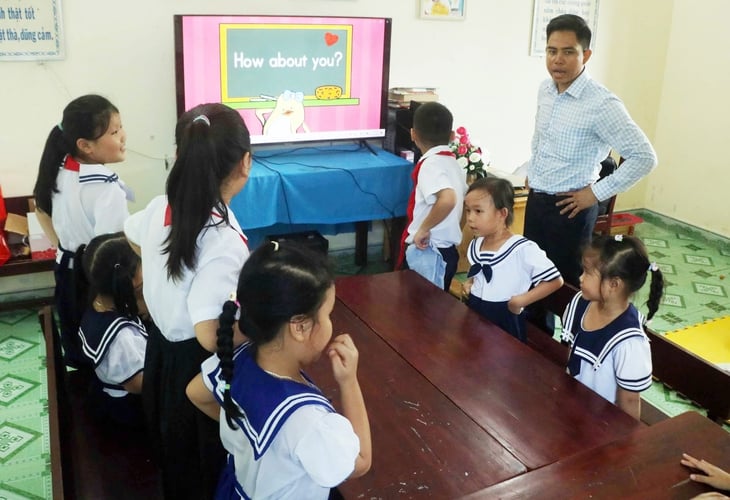
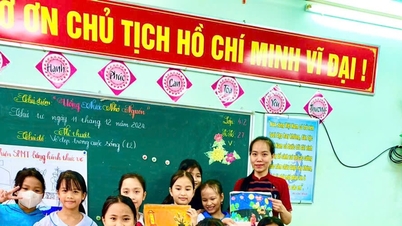
Teacher Cao Van Truyen and his English class at Truong Sa Town Primary School - Photo: TRONG NHAN
In a small classroom located in the town of Truong Sa, the third-grade English lesson begins with cheerful melodies emanating from the television screen on the wall.
A fun English class in the middle of the ocean.
With only about ten students and their teacher gathered in a circle, they sang and danced along to English children's songs. The sounds of "Hello! How are you?" and "Let's sing together!" echoed clearly through the TV speakers, making the classroom unusually lively. Every child eagerly joined in, singing along and dancing excitedly.
"Previously, English or music lessons were often taught 'without' anything. Without a TV or computer, we could only learn through books, or the teacher would download a few songs to his phone and play them for the students," shared Mr. Cao Van Truyen, one of the two teachers at Truong Sa Town Primary School.
Starting from the 2024-2025 school year, a computer and a television have been officially provided to the school. This change, though small, brings about a big difference. "For English lessons, students now not only hear pronunciation from one person but also experience many different voices through learning videos . Lessons also become more visual and lively with images, colors, and interactive activities right on the screen," said Mr. Truyen.
Besides English, arts subjects like music and fine arts have also been "freed up." "Previously, music lessons mainly involved memorizing lyrics and singing from memory. Now, the students get to listen to real music, see musical instruments, and view illustrations directly on television, which is invaluable for a primary school on a remote island like Truong Sa," the teacher added.
Sitting carefully at her small desk, Le Thi Kim Duyen, a third-grade student at Truong Sa Primary School, said she really enjoys learning English. "Before, we only had books and notebooks to learn. Now, with TV, I get to see many beautiful pictures and listen to fun songs. What I like most is when the whole class stands up and sings along. I even teach it to my younger sibling at home!" Duyen said with a bright smile.
Typing, getting acquainted with the digital world.
Starting from the 2024-2025 school year, Da Tay A Primary School in Truong Sa island district will officially put into use its first computer system for teaching and learning.
Mr. Luu Quoc Thinh, the teacher in charge of the class, said that the computers have become a valuable tool, especially in introductory computer science lessons. "The students are guided step-by-step to learn how to type, get familiar with the mouse, keyboard, and basic computer operations. From being initially surprised, now every student is eager to go to the computer to practice typing and file manipulation," Mr. Thinh said.
According to the teacher, despite the difficult conditions, especially the fact that the electricity was only available during certain hours of the day, that first piece of technology truly brought a new "life" to the classroom.
Nguyen Thanh Phong, a student at Da Tay Island Primary School, shared: "I really enjoyed it when the teacher showed me how to type and open images! Later, I want to study really hard to become a computer engineer."
Not only primary schools, but also preschools on the island are benefiting from new technologies. Mr. Ung Van Tuan, the preschool teacher, said that he officially left the mainland to work on the island in June 2023. Having been accustomed to teaching at the primary level, caring for and teaching preschool children was a completely new experience for him.
"Therefore, I proactively brought along documents, pictures, and videos from the mainland, copied onto USB drives. Because the island has no internet, we used an old but effective method: showing videos on the TV to create a lively learning atmosphere for the children," Mr. Tuan said.
Despite being on a remote island, the children here still have access to the world through animated clips, English songs, life skills lessons, and music lessons filled with laughter. "Seeing the children so enthusiastic in each lesson, we feel that all our efforts are worthwhile," Mr. Tuan said emotionally.
Expectations continue to narrow the gap.
Currently, most islands in the Spratly Archipelago only have 2G network access, making it completely impossible to access the internet or use online platforms like on the mainland. Mr. Phan Quang Tuan, a teacher at Sinh Ton Primary School, shared that despite the difficult conditions, teachers and students still strive to make each lesson as lively and effective as possible.
"We hope for more investment in equipment, software, and digital learning content suitable for the lack of internet access so that students on the island can have closer access to knowledge than their peers on the mainland," said Mr. Tuan.
To keep the game from going off track.
Each year, Mr. Le Xuan Hanh, a teacher at Truong Sa Town Primary School, takes a short summer break when he returns home, coinciding with the school holidays. Besides resting, Mr. Hanh takes advantage of the time to visit schools on the mainland, meet colleagues, and collect the latest review materials and test questions suitable for the 2018 General Education Program.
"The new curriculum has changed quite a bit, from the way tests and assessments are conducted to the way questions are formulated. If we don't keep up, students on the islands will be at a great disadvantage," the teacher shared. He carefully copied the exam questions onto a USB drive, marked them by subject and grade level, and brought them along on his ship back to Truong Sa.
Thanks to this, students on remote islands still have access to knowledge that closely follows the curriculum, keeping pace with their peers on the mainland. "With a little more initiative and dedication, geographical distance will no longer be a barrier to their learning," Mr. Hanh said.
Source: https://tuoitre.vn/cong-nghe-den-lop-hoc-truong-sa-20250614084654332.htm
![[Photo] Prime Minister Pham Minh Chinh receives the Chinese Ambassador to Vietnam](https://vphoto.vietnam.vn/thumb/1200x675/vietnam/resource/IMAGE/2026/04/05/1775397481797_ndo_br_dsc-5512-jpg.webp)





















































Comment (0)