

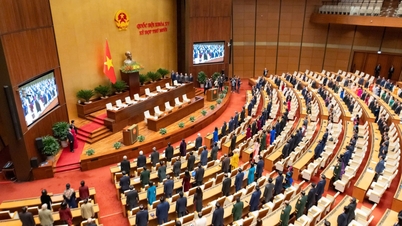
Continuing the agenda of the 10th session, on October 30th, the National Assembly discussed in the plenary hall the situation regarding the implementation of the State budget in 2025, the State budget estimates, and the plan for allocating the central budget in 2026; the results of implementing the National Assembly's resolutions on the 5-year plan for the period 2021-2025 on medium-term public investment; national finance and public borrowing and debt repayment.
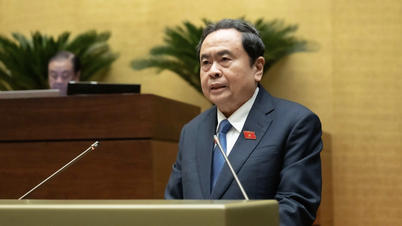
Participating in the discussion, delegate Thach Phuoc Binh (Vinh Long delegation) said that, in the context of the country entering a pivotal stage of the 2026-2030 socio -economic development plan, the task is to expand fiscal space, mobilize and effectively utilize resources outside the state budget.
Mr. Binh argued that two important resources that have not been exploited adequately are the state's off-budget financial fund and gold resources, the accumulated assets of the population.
"Both are large capital reserves of the economy, one in the public sector, the other in the private sector, but both lack a synchronized, transparent, and effective management and mobilization mechanism," Mr. Binh said.
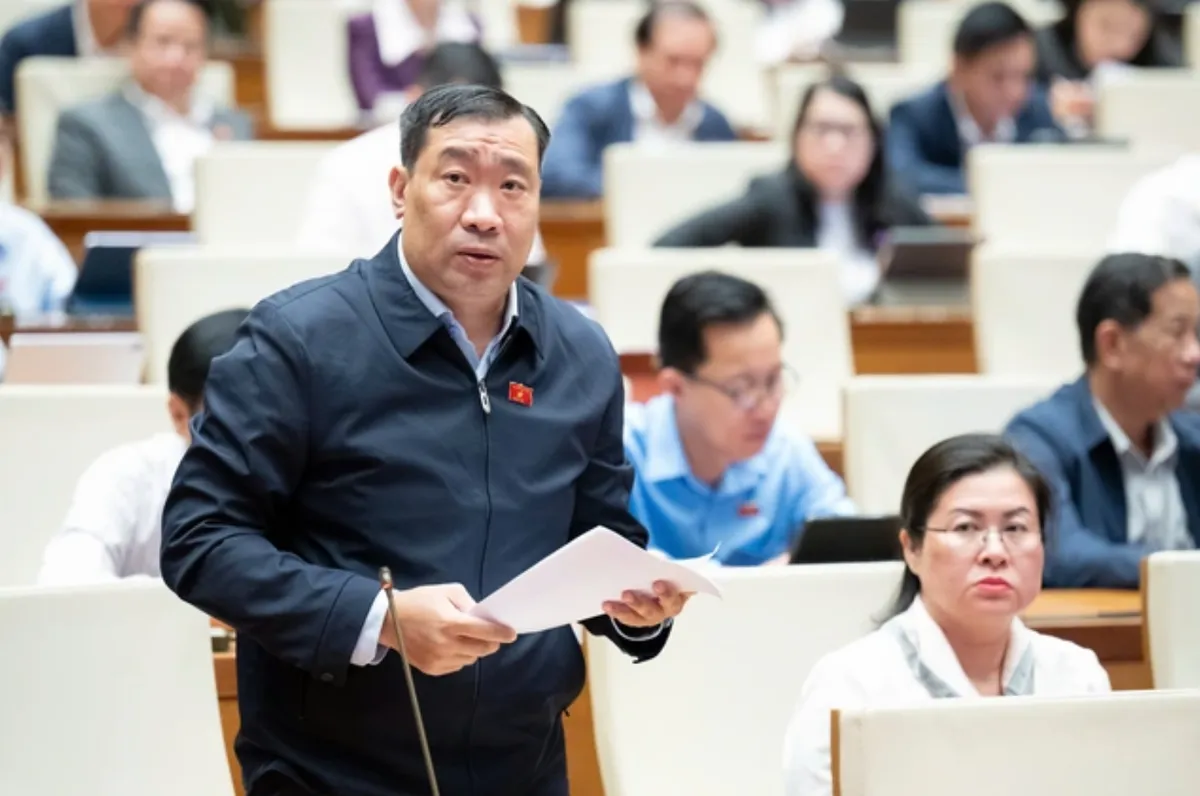
Delegate Thach Phuoc Binh ( Vinh Long delegation)
Most of the gold remains untouched in the vault.
Regarding mobilizing gold resources held by the people – transforming static assets into a driving force for the economy – Mr. Binh stated that, according to the World Gold Council, Vietnamese people currently hold approximately 400 to 500 tons of gold, equivalent to 35 to 40 billion USD – accounting for nearly 8% of GDP. Each year, Vietnam consumes an average of 55 tons of gold, placing it among the highest-consuming countries in the region.
"However, the vast majority of this gold remains in vaults – a huge resource that has yet to be converted into capital for the economy," Mr. Binh said.
According to the delegate, in 2024 and the first few months of 2025, there were times when the difference between domestic and international gold prices exceeded 14 million VND/ounce, and even reached 20 million VND/ounce.
"This reflects market instability and speculative hoarding. Although the State Bank has intervened by auctioning gold bars, this is only a short-term solution. The root cause remains the lack of a transparent, modern, and safe market mechanism for the people," Mr. Binh said.
From there, delegates proposed five specific groups of solutions to mobilize and financialize gold held by the people.
Firstly, stabilize the gold market, narrowing the price difference between domestic and international gold to below 5 million VND/ounce within 6 to 12 months; control speculation, and increase supply through controlled gold imports.
Secondly, the establishment of a National Gold Exchange is a breakthrough institutional step, allowing people to deposit physical gold into standardized custody facilities, receive electronic certificates for trading, pledging, or exchanging. Through this, the State can manage the flow of real gold while still ensuring the ownership rights of the people.
Thirdly, develop gold-backed financial products such as issuing gold depositary certificates, gold investment funds, and gold bonds backed by physical gold in storage. People can contribute gold or invest in VND, earning profits based on gold prices, transforming static capital into dynamic capital.
Fourth, encourage the conversion of gold into VND through policies such as free custody, preferential interest rates, or the issuance of government bonds denominated in gold, specifically for those selling physical gold.
Fifth, ensure system security and information transparency, strictly prohibit banks from mobilizing or lending in gold, and publish a national gold bulletin periodically so that people have access to complete information, building confidence in the market.

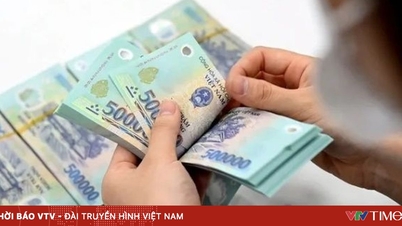
(Illustrative image)
According to delegate Thach Phuoc Binh, if only 10 to 15% of the gold held by the public were channeled into the financial system, equivalent to 5 to 7 billion USD, it would be a valuable source of capital for infrastructure development, digital transformation, and technological innovation, without the need to increase public debt.
He stated that it is impossible to mobilize the people's resources without transparent and efficient management of state resources, and it is impossible to tap into the people's capital without building trust that that capital will be used effectively, safely, and profitably for the country.
Trillions of dong are "lying idle" in public finance funds.
Regarding the management and use of off-budget state financial funds, Mr. Binh cited Government Report No. 947 dated October 17, 2025, stating that by the end of 2024, the country had 22 off-budget state financial funds with a total surplus of 1.59 trillion VND, projected to increase to 1.78 trillion VND by 2026. This is a very large figure, equivalent to nearly 35% of the national GDP, demonstrating a significant financial scale within the public finance system.
However, according to Mr. Binh, the operation of these funds still has many shortcomings. "First of all, the legal framework is not unified, as there is currently no single law regulating the entire fund system. Each fund is established and operated according to its own decree or decision. This leads to overlapping, lack of transparency, difficulty in supervision, and difficulty in evaluating the effectiveness of capital utilization," Representative Binh said.
Furthermore, the operational efficiency of many funds is low, or even loss-making. In 2025 alone, seven funds reported negative capital levels, highlighting the urgent need for review, restructuring, and improvement of the legal framework to enhance the efficiency of managing and utilizing these public financial resources...
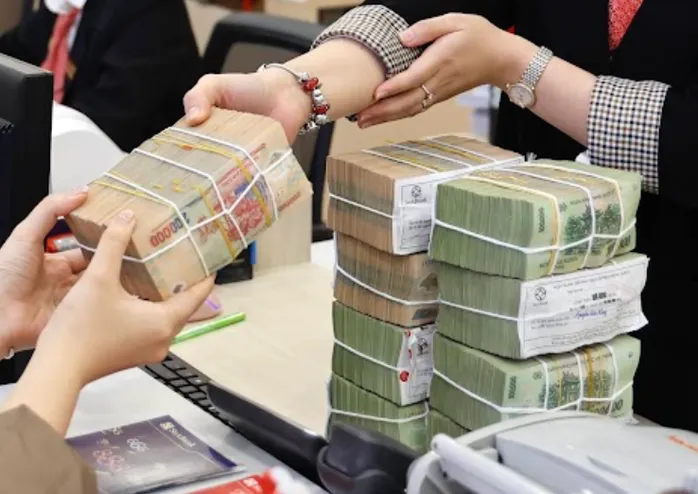
By the end of 2024, the country had 22 off-budget state financial funds with a total capital of approximately 1.59 trillion VND, projected to increase to 1.78 trillion VND by 2026.
Mr. Binh proposed that the National Assembly assign the Government to develop a comprehensive plan on mobilizing and managing resources from non-budgetary state financial funds, integrating two pillars: institutionalizing non-budgetary state financial funds in a transparent and efficient manner, and establishing a mechanism for mobilizing financial resources from the population in a safe, modern, and integrated way.
"This is not just a matter of financial technology, but a strategic institutional reform that will help expand fiscal space, increase the self-reliance of the economy, and strengthen social trust – the most important foundation for the country's sustainable development," said delegate Thach Phuoc Binh.
Source: https://vtv.vn/dai-bieu-quoc-hoi-hien-ke-huy-dong-500-tan-vang-trong-dan-100251030185919412.htm
![[Image] The tenacious fighting spirit of Vietnamese women's football](/_next/image?url=https%3A%2F%2Fvphoto.vietnam.vn%2Fthumb%2F1200x675%2Fvietnam%2Fresource%2FIMAGE%2F2025%2F12%2F17%2F1765990260956_ndo_br_4224760955870434771-copy-jpg.webp&w=3840&q=75)

![[Live] 2025 Community Action Awards Gala](/_next/image?url=https%3A%2F%2Fvphoto.vietnam.vn%2Fthumb%2F1200x675%2Fvietnam%2Fresource%2FIMAGE%2F2025%2F12%2F16%2F1765899631650_ndo_tr_z7334013144784-9f9fe10a6d63584c85aff40f2957c250-jpg.webp&w=3840&q=75)
![[Photo] Prime Minister Pham Minh Chinh receives Lao Minister of Education and Sports Thongsalith Mangnormek](/_next/image?url=https%3A%2F%2Fvphoto.vietnam.vn%2Fthumb%2F1200x675%2Fvietnam%2Fresource%2FIMAGE%2F2025%2F12%2F16%2F1765876834721_dsc-7519-jpg.webp&w=3840&q=75)
![[Image] Leaked images ahead of the 2025 Community Action Awards gala.](/_next/image?url=https%3A%2F%2Fvphoto.vietnam.vn%2Fthumb%2F1200x675%2Fvietnam%2Fresource%2FIMAGE%2F2025%2F12%2F16%2F1765882828720_ndo_br_thiet-ke-chua-co-ten-45-png.webp&w=3840&q=75)
![[Photo] Prime Minister Pham Minh Chinh receives the Governor of Tochigi Province (Japan)](/_next/image?url=https%3A%2F%2Fvphoto.vietnam.vn%2Fthumb%2F1200x675%2Fvietnam%2Fresource%2FIMAGE%2F2025%2F12%2F16%2F1765892133176_dsc-8082-6425-jpg.webp&w=3840&q=75)













































![[Live] Closing Ceremony and Award Presentation for the "Impressive Vietnam Tourism" Video/Clip Creation Contest 2025](https://vphoto.vietnam.vn/thumb/402x226/vietnam/resource/IMAGE/2025/12/17/1765974650260_z7273498850699-00d2fd6b0972cb39494cfa2559bf85ac-1765959338756946072104-627-0-1338-1138-crop-1765959347256801551121.jpeg)















Comment (0)