

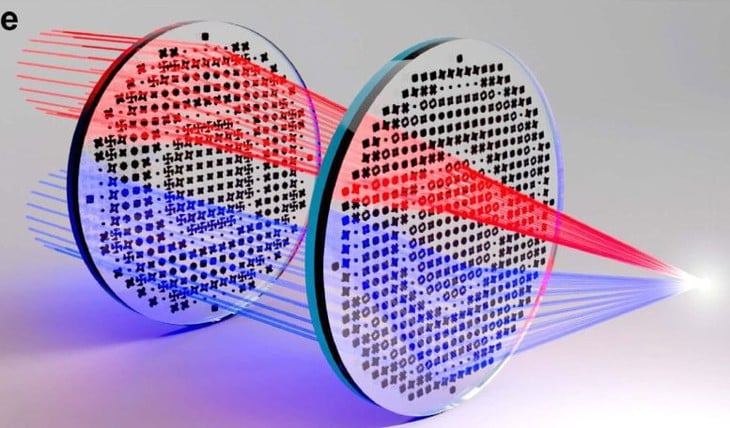
Researchers have developed a multi-layered metal lens design that can focus multiple colors simultaneously, breaking the fundamental limitations of single-layer lenses. - Photo: Optics Express
Instead of relying on a single layer of metamaterial, the research team stacked multiple layers, overcoming the fundamental limitation of metal lenses in focusing multiple wavelengths of light simultaneously.
The algorithm-based method has created sophisticated nanostructures in the shape of four-leaf clovers, fan blades, or squares, offering higher efficiency, scalability, and independence from light polarization.
Joshua Jordaan, lead author from the Australian National University and ARC Centre of Excellence for Metatransformative Optics (TMOS), said: "This design has many characteristics that are well-suited for practical devices. It is easy to fabricate thanks to its low geometric ratio, individual layers can be manufactured separately and then assembled, it is polarization-independent, and it has the potential for scalability using existing semiconductor technology."
Metal lenses are only a fraction of the thickness of a human hair, many times thinner than traditional optical lenses. They can produce focal lengths that conventional lenses cannot achieve.
Initially, the research team attempted to focus multiple wavelengths using a single layer but encountered physical limitations. Switching to a multilayer structure, they used an inverse optimization algorithm to find suitable hypersurface shapes, based on dual electromagnetic resonance (Huygens resonance), which increased accuracy and facilitated mass production.
These nanostructures are about 300 nanometers high and 1,000 nanometers wide, enough to create optical phase maps, allowing light to be focused into arbitrary patterns. "We can even focus different wavelengths into different locations to create color routers," said Jordaan.
However, the multilayer approach is currently only feasible for a maximum of about 5 wavelengths, as it requires ensuring the structure is large enough for the longest wavelength without causing diffraction at shorter wavelengths.
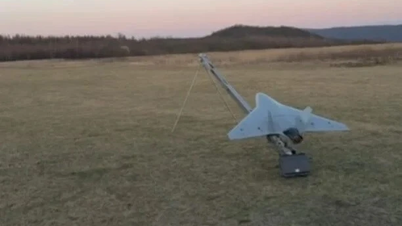
Within that scope, the research team believes that metal lenses will offer significant benefits to mobile imaging systems. Jordaan emphasized, "Our design is ideal for drones or Earth observation satellites, as we have strived to make them as compact and lightweight as possible."
The research results were published in the journal Optics Express .
Source: https://tuoitre.vn/dien-thoai-drone-sap-co-camera-mong-nhu-soi-toc-2025092508534341.htm


![[Photo] General Secretary and President To Lam presides over a meeting on preparations for the review of one year of operation of the three-tiered government system.](https://vphoto.vietnam.vn/thumb/1200x675/vietnam/resource/IMAGE/2026/06/02/1780391821195_a1-bnd-4595-9717-jpg.webp)














































































Comment (0)