

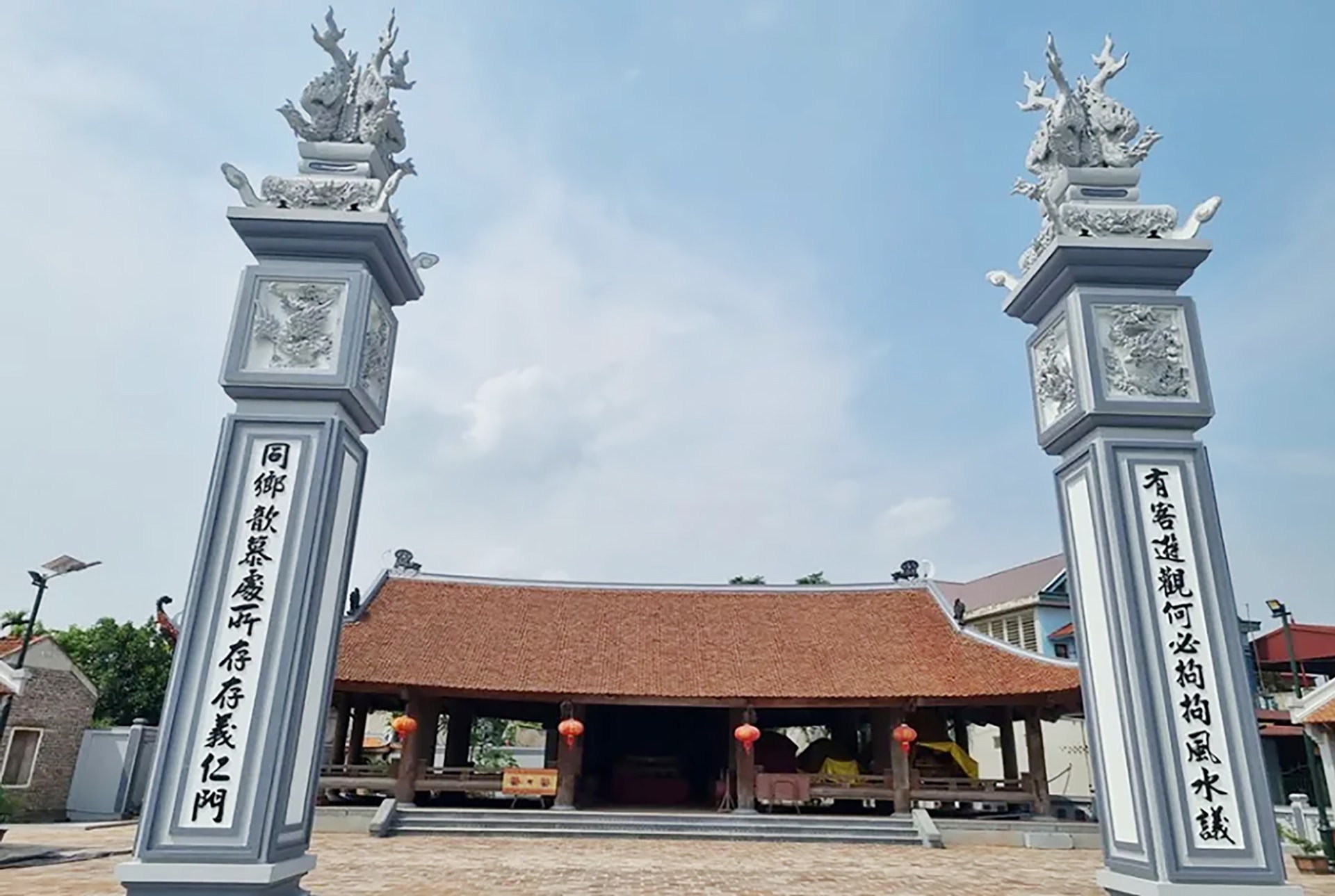
According to legend, the temple was built during the Tran Dynasty and is dedicated to Nguyen Dao Thong, the father of Zen Master Nguyen Dao Hanh. He is revered by the villagers as the tutelary deity for his contributions in reclaiming barren land, teaching the people to cultivate rice and raise silkworms, and laying the foundation for the prosperity of the Chu Minh region. Legend also says he was a descendant of Zen Master Dai Dien, a lineage deeply connected to Buddhism and the spirit of enlightenment.
The temple has a traditional "Đinh" shaped architectural style, facing southwest. The complex includes the main structures: the ceremonial gate, the main hall, the sanctuary, the left and right wings, and a crescent-shaped pond, creating a harmonious whole between architecture and nature. The ceremonial gate consists of four pillars. The two main pillars are intricately carved, topped with phoenix statues. The two auxiliary pillars are decorated with kneeling mythical creatures, showcasing a distinctive ancient artistic style.
The main hall – the center of the communal house – has a five-bay, two-aisle structure, notable for its four soaring curved roofs and open architecture, without enclosed walls or doors. The six truss systems inside are crafted in the "upper truss, overlapping beams" and "lower beams and armrests" styles, along with intricately carved eaves and rear beams depicting dragons, fairies riding dragons, and female singers – all reflecting the style of the Late Le Dynasty. The adjacent sanctuary, with its simple architecture, houses the dragon throne, ancestral tablets, and traditional religious artifacts such as the eight treasures, ornate archways, and ceremonial palanquin.
Over its long history of existence and service to religious life, many parts of the temple have deteriorated. Since 2021, the Ba Vi district government has undertaken restoration and renovation work on the structure. In April 2024, the temple was inaugurated with a more spacious and dignified appearance, contributing to the revival of a sacred cultural space closely associated with the lives of the local people.
Currently, Vinh Phe communal house still preserves many valuable artifacts: two dragon thrones, ancestral tablets from the Nguyen dynasty, a set of eight precious wooden objects, a Tho Ha ceramic incense burner from the 18th century, and 12 royal decrees from the Quang Trung dynasty (1793) to the Khai Dinh dynasty (1924). These are vivid proofs of the enduring existence of a cultural institution throughout the centuries, affirming the cultural depth of the villages in the Chu Minh area.
The Vinh Phe communal house festival takes place annually from March 11th to 13th. With rituals such as palanquin processions, offerings, folk songs, Quan Ho singing, and traditional games like tug-of-war, stick pushing, and archery, the festival not only expresses gratitude to ancestors but also contributes to the preservation and promotion of traditional cultural values.
In 2004, Vinh Phe communal house was classified as a national historical and architectural monument.
Source: https://hanoimoi.vn/dinh-vinh-phe-704171.html


![[Image] Ho Chi Minh City simultaneously commences construction and breaks ground on 4 key projects.](/_next/image?url=https%3A%2F%2Fvphoto.vietnam.vn%2Fthumb%2F1200x675%2Fvietnam%2Fresource%2FIMAGE%2F2026%2F01%2F15%2F1768472922847_image.jpeg&w=3840&q=75)


Comment (0)