

A wide variety of products, attracting customers in every season.
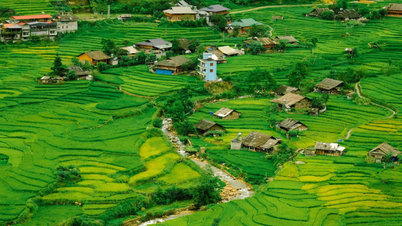
In early November, Sa Pa (Lao Cai province) was shrouded in fog. The rain alternated between a gentle drizzle and a torrential downpour, making the weather both cold and unpleasant. Even when it wasn't raining, hair was always damp, and shoes and clothes were constantly dirty from splashes of mud. However, the effects of the intensifying cold front couldn't deter tourists . From the old town center to the summit of Fansipan, the area remained bustling with visitors, mostly international tourists. Hoang Lam, an employee at a hotel in the center of Sa Pa, said that this year there was more rain than usual, with heavy rain from morning till night on some days. The cold front also arrived earlier. The weather wasn't ideal for mountain exploration tours, but hotels in Sa Pa were almost always fully booked. Occupancy rates consistently exceeded 70%, primarily with tourists from India, South Korea, and other Southeast Asian countries.
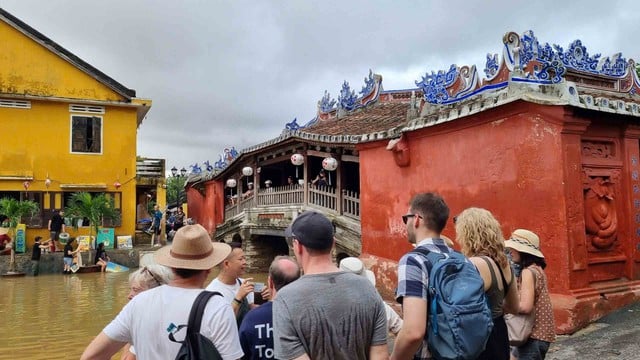
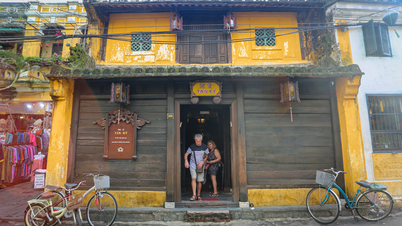
With floodwaters receding, international tourists visit the ancient town of Hoi An ( Da Nang ) on November 1st.
PHOTO: NGOC THOM
Not only Sa Pa, but many tourist destinations across the country have recorded a sharp increase in international visitors even amidst the stormy weather. According to newly released data from the General Statistics Office, in October, the number of international visitors to Vietnam reached 1.73 million, an increase of 13.8% compared to the previous month and a significant increase of 22.1% compared to the same period in 2024. This is the highest number of international visitors to Vietnam in a single month ever recorded. Overall, in the first 10 months of 2025, the number of international visitors to Vietnam is expected to reach nearly 17.2 million, an increase of 21.5% compared to the same period in 2024.
Looking at the structure of international visitors to Vietnam in October, Chairman of the Board of Directors of Vietravel Corporation Nguyen Quoc Ky commented: The pillar of growth continues to be the strong return of traditional markets such as China and Russia, and the acceleration of the Indian market. In absolute terms, China remains the leading market with over 433,000 visitors to Vietnam last month, accounting for about 25% of the total number of visitors.
According to Mr. Nguyen Quoc Ky, Vietnam possesses many advantages to "gain the upper hand" with this tourist market. Firstly, because the Chinese government is increasingly focusing on stimulating consumer spending, their holidays are longer. Chinese people currently have three peak holiday periods during the year: Lunar New Year, International Labor Day, and National Day (October 1st). In between, there is summer, and Chinese people prefer Vietnam's beaches much more than their own. Therefore, Chinese tourists visit Vietnam throughout the year, and October was one of the long holiday periods that allowed them to travel to Vietnam in large numbers.

International tourists on Fansipan, the "roof of Indochina," amidst dense fog in early November 2025.
PHOTO: LE NAM
The second favorable factor is the unstable political situation in Thailand, and the Chinese government's discouragement of tourism to Thailand has led to a surge in tourists flocking to Vietnam. This is further supported by a series of promotional programs from the Vietnam National Tourism Administration and Vietnamese tourism businesses; the resumption of flights by airlines, both regular and charter; the reopening of all land border crossings and the only available train route; and increasingly convenient cross-border payment options.
Similarly, the Indian market is also experiencing strong growth thanks to increasingly frequent direct flights and innovative market promotion strategies such as film diplomacy. Meanwhile, Korean tourists still prefer Vietnam but are shifting their destinations. Phu Quoc and Quy Nhon are expected to be "hot" spots for Korean tourists in the near future.
"Overall, China, India, and South Korea will continue to play a leading role in the inbound tourism market from now until the end of the year and into 2026. These tourist groups have diverse tastes, while we possess a rich product system, ranging from temperate to tropical climates. Traveling from North to South, tourists can enjoy unique and attractive experiences at any time. Even during rainy and flood seasons, there is still room to create alternative products, so Vietnam can attract tourists in any season. For example, when Hoi An was hit by a storm and tourists couldn't go anywhere else, Vietravel organized hand-rowed boat tours in the old town. Tourists were still captivated as usual. That's why, despite the storms, tourists still come to us in large numbers, and Vietnam still maintains its advantage in attracting visitors," Mr. Nguyen Quoc Ky observed.

From the perspective of the aviation industry – a key force in connecting and promoting international tourist flows – a representative from Vietnam Airlines, the national airline, assessed that in the first 10 months of 2025, Vietnam's international tourism market continued to experience positive growth. The total number of international passengers by air increased by approximately 13.4% compared to the same period last year, demonstrating Vietnam's increasing attractiveness on the regional tourism map. Markets in Europe, India, China, Hong Kong, and Southeast Asia all recorded strong growth, with many routes achieving an average seat occupancy rate of nearly 82%. Notably, in October, international passengers on Vietnam Airlines flights increased by over 26% compared to the same period in 2024, marking the highest growth rate since the beginning of the year.
This result reflects the growing appeal of Vietnam as a destination, along with international tourists' confidence in the quality of service and operational capacity of Vietnam's aviation industry. Despite the impact of floods in many areas, the number of international visitors to our country has maintained a strong upward trend.
"Many passengers planned their trips well in advance, willing to adjust their schedules instead of canceling their flights, demonstrating their affection and trust in a safe, friendly destination with the ability to provide stable services even in unfavorable weather conditions. The close coordination between the aviation, tourism, and local authorities in service, information, and flexible response has helped tourists always have a fulfilling journey, contributing to affirming the image of Vietnam's tourism as increasingly professional and sustainable," a representative from Vietnam Airlines commented.
Creating momentum for growth next year.
In 2025, Vietnam's tourism industry aims to welcome 22-23 million international visitors. In August, the Government issued Resolution No. 226 on growth targets for various sectors, fields, and localities, and key tasks and solutions to ensure national growth in 2025 reaches 8.3-8.5%. The Government set a target of at least 25 million international visitors for the whole year to contribute to the overall economic growth target. Despite continuously setting visitor records in recent months, experts believe the 25 million visitor target is unlikely to be achieved.

International tourists at the Ponagar Tower National Special Monument (North Nha Trang, Khanh Hoa), November 10.
PHOTO: BA DUY
Mr. Nguyen Quoc Ky predicted that, under the most optimistic conditions, Vietnam could welcome approximately 23.5 million international tourists this year. Objective factors include the start of the peak inbound tourism season in November, and the upcoming stable weather after the biggest storms of the year. The Northeast Asian market will continue to grow strongly, coupled with the influx of European tourists during the holiday season. However, due to the relatively late implementation of the relaxed visa policy, its full potential has not yet been realized this year. In the coming period, if special preferential policies on visas, airfares, cross-border payments, tax exemptions, and stronger promotional programs are quickly implemented, tourism could accelerate in the last two months of the year, welcoming over 23.5 million tourists. This will be the foundation for strong tourism development next year.
Mr. Pham Ha, Chairman and CEO of LuxGroup, also believes that despite many efforts, Vietnam will find it difficult to reach 25 million international tourists this year. He estimates the number will be in the range of 21-23 million. The reason is that the policies on visa liberalization, enhanced promotion and advertising, and investment in product innovation have only just been implemented and have not yet had enough impact to create a breakthrough. In addition, the changes are still general and not truly decisive. For example, the visa policy has been opened but in a piecemeal fashion, with slight adjustments every few months and short extension periods. The restructuring of products and promotion and marketing still mainly rely on businesses, and the role of industry management agencies is not yet profound enough to create a strong, transformative change. Meanwhile, competitors like Thailand, when transforming their image, do it very quickly and strongly, synchronizing many solutions, so the results will be clearer and faster.

Foreign tourists visit the War Remnants Museum (Xuan Hoa Ward, Ho Chi Minh City) on November 10th.
PHOTO: NHAT THINH
"Actually, there's a more important issue than the number of 23 million or 25 million visitors: quality. How much tourists spend, whether it impacts the local economy, and whether they return – these are the most important things to consider. To achieve this, we need a long-term strategy with a plan of 5 years or more, with specific goals. This includes identifying strengths, developing action programs, and decisively addressing the inherent bottlenecks in the industry. From mechanisms to infrastructure, products, and promotion, change must be faster, stronger, and measurable through each policy. At that point, we won't need to chase after tens of millions of visitors as we do now; tourism will naturally develop strongly and sustainably, both in quantity and quality," Mr. Pham Ha suggested.
Develop long-term plans to adapt to climate change.
Although not suffering extremely heavy losses and being able to flexibly change itineraries, it is undeniable that increasingly unpredictable natural events are negatively impacting Vietnam's tourism industry. For example, the Hue - Hoi An - Da Nang route, the "backbone" of tourism in Central Vietnam, has had to be temporarily suspended due to successive prolonged periods of heavy rain and flooding, as it could not guarantee a safe route for tourists. Even with the possibility of changing itineraries, tourists' experiences are not fully preserved, and travel businesses are struggling to handle unexpected situations and risks.
According to Mr. Pham Ha, the tourism industry needs to develop a systematic strategy to adapt to climate change. Businesses need to proactively develop scenarios to respond to complex weather patterns, such as changing itineraries to avoid rainy and stormy days, changing destinations, switching from road travel to river tours or vice versa, etc. In addition, they should proactively develop "green" product lines, Net Zero tours, using electric vehicles, and guiding tourists to immerse themselves in nature and be more responsible towards it. These tours are both environmentally friendly and innovative, reducing the burden on many traditional destinations while providing new and unique experiences, allowing tourists to experience local culture more deeply.
Sharing the same view, a representative from Vietnam Airlines stated that in the context of climate change and increasingly complex extreme weather trends, Vietnam's tourism industry needs a long-term strategy to adapt and develop stably. Diversifying tourism products to suit weather conditions, such as cultural tourism, culinary tourism, indoor resorts, or conferences and events, will help maintain year-round appeal and minimize the impact of natural disasters. As a component of the industry, Vietnam Airlines is also continuing to promote green transformation and sustainable tourism development through the use of sustainable aviation fuel (SAF), participation in IATA's CO₂ Connect initiative, and aiming for Net Zero 2050. Simultaneously, it is promoting comprehensive digital transformation in operations and passenger services, helping to improve forecasting and warning capabilities, and supporting passengers with flexible itinerary changes, ensuring safety and the best possible experience for international tourists.
"Vietnam Airlines believes that, with a sustainable tourism development orientation, adaptation to climate change, and the support of the entire industry, Vietnam will continue to affirm its position as a safe, friendly, and attractive destination, worthy of being the image of a dynamic, hospitable, and sustainable country in the eyes of international friends," a representative of Vietnam Airlines said.
Besides policies to restore people's livelihoods, the tourism industry also needs quick, strong, and direct policies to recover after storms and floods. In the long term, it is necessary to clearly redefine what institutions and policies are needed for a key industry like tourism. We currently only have general institutions that serve as a kind of support system. For tourism to develop strongly and sustainably, it needs a set of policies that are specifically designed, direct, and implemented quickly.
Chairman of the Board of Directors of Vietravel Corporation , Nguyen Quoc Ky
International tourists flock to Nha Trang for winter holidays.
Despite the rainy weather, international tourists, especially Russians, are flocking to Nha Trang (Khanh Hoa) for their winter holidays, marking the beginning of a vibrant peak tourist season at the end of the year.
In October, accommodation establishments in Khanh Hoa province served approximately 461,000 international visitors, a 28% increase compared to the same period last year. Tourist attractions and beaches were overflowing with international tourists, demonstrating Nha Trang's strong appeal even during the rainy season.
Statistics from the Department of Culture, Sports and Tourism of Khanh Hoa province show that from the beginning of the year to the end of October, Khanh Hoa welcomed more than 14.8 million visitors, an increase of 16.1% compared to the same period in 2024. Of these, international visitors are estimated at more than 4.6 million, an increase of 17.6%, reaching 88.5% of the annual plan; domestic visitors are more than 10.2 million, an increase of 15.4%. Total tourism revenue reached nearly 60,319 billion VND, an increase of 20.1%, reaching 90.8% of the annual plan.
Ba Duy
Source: https://thanhnien.vn/du-lich-but-toc-bat-chap-mua-bao-185251110232353772.htm
![[Photo] Conference on the transfer and reception of Party organizations and Party members between the Party Committee of the Government and the Party Committees of the Central Party Agencies](https://vphoto.vietnam.vn/thumb/1200x675/vietnam/resource/IMAGE/2026/04/01/1775036784472_ndo_br_bnd-2620-jpg.webp)




![[Photo] Conference announcing the Politburo's Decision on organizational and personnel matters](https://vphoto.vietnam.vn/thumb/1200x675/vietnam/resource/IMAGE/2026/04/01/1775017881825_bnd-2410-1472-jpg.webp)





































































Comment (0)