

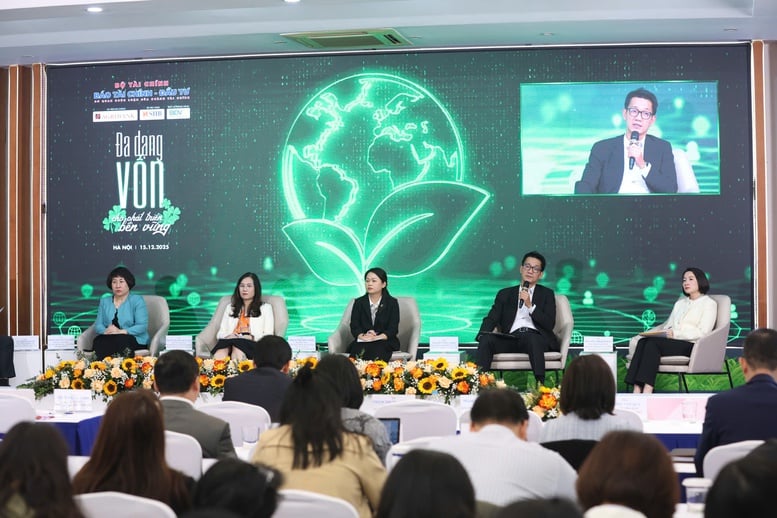
Workshop "Diversifying Capital for Sustainable Development" - Photo: VGP
We need $700 billion in investment for sustainable development by 2050.
Information from the Ministry of Finance at the "Diversifying Capital for Sustainable Development" workshop indicates that, in a carbon neutral scenario, the total long-term investment needs for Vietnam's green and sustainable economic development by 2050 are estimated at approximately US$670-700 billion. Of this, the capital needed for climate change adaptation alone amounts to about US$368 billion, equivalent to 6.8% of GDP annually. This figure demonstrates the enormous need to mobilize financial resources in the long term.
Mr. Nguyen Ba Hung, Chief Economist of ADB Vietnam, stated that the challenge of securing capital for sustainable development lies not only in the scale of mobilization but also in the efficiency of capital utilization. According to him, the synchronized development of various capital mobilization channels such as government bonds, corporate bonds, the stock market, and public-private partnership financial instruments are initiatives implemented by many countries.
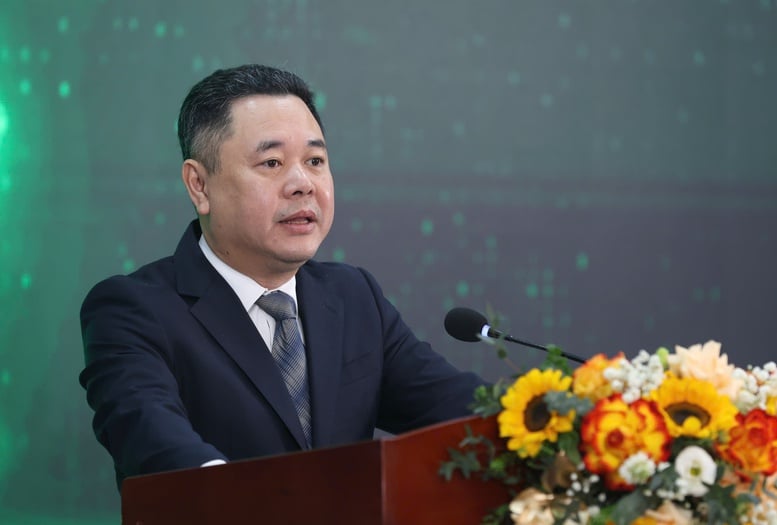
Deputy Governor of the State Bank of Vietnam Nguyen Ngoc Canh - Photo: VGP
Speaking at the conference, Deputy Governor of the State Bank of Vietnam, Nguyen Ngoc Canh, said that by November 30, 2025, the total outstanding green credit in the entire system is estimated to reach approximately 750 trillion VND. The average growth rate from 2017 to the present has reached over 21% per year, higher than the overall credit growth rate of the economy.
According to the Deputy Governor, commercial banks are currently the largest source of capital, accounting for approximately 88% of the total outstanding green credit. The green capital mobilized by banks is mainly through the issuance of green bonds and international loans. Citing IFC data, the value of green bond issuances in Vietnam is expected to exceed US$1.5 billion during the period 2020-2025.
Based on the above practical experience, Deputy Governor Nguyen Ngoc Canh outlined five key areas to promote the diversification of capital sources for sustainable development.
Firstly, it is necessary to clarify the conditions under which the capital market can become an effective channel for capital mobilization, supplementing bank credit in financing green projects, energy transition, and sustainable development.
Secondly, it is necessary to implement solutions to develop a green capital market, encouraging the issuance of sustainable financial instruments such as green bonds, sustainable bonds, and shares of companies practicing ESG. At the same time, it is essential to enhance the capacity of businesses and investors in accessing, utilizing, and effectively monitoring these capital flows and financial products.
Thirdly, it is necessary to summarize the practical implementation of green credit in the banking sector, evaluate the results achieved, draw lessons learned, and determine the next direction to enhance the role of the banking system in leading and spreading green credit flows in the economy.
Fourth, refine the mechanisms and preferential policies to attract more private sector capital into green and sustainable growth projects. In this, the State plays a regulatory role by improving the legal framework, enhancing transparency, and ensuring the safety and stability of the financial system.
Fifth, strengthen close coordination among state management agencies, financial institutions, businesses, capital markets, and international partners to effectively mobilize, allocate, and utilize financial resources for the country's green growth and sustainable development goals.
An interest rate subsidy of 2% per year is expected for green projects.
Ms. Pham Thi Thanh Tung, Deputy Director of the Department of Credit for Economic Sectors (State Bank of Vietnam), added that although green credit has a high growth rate, its proportion currently only accounts for nearly 5% of the total outstanding credit in the entire economy, while the total outstanding credit has reached approximately 18.2 million billion VND.
Regarding incentive mechanisms for green projects, Ms. Pham Thi Thanh Tung stated that Resolution 68 on the development of the private economy has identified the policy of providing interest rate support for green projects.
Following the Politburo 's directive, the State Bank of Vietnam is coordinating with the Ministry of Finance to submit to the Government a decree providing a 2% annual interest rate subsidy from the state budget for private enterprises and business households borrowing from banks to implement green and circular economy projects.
According to Ms. Tung, the draft decree is expected to be submitted to the Government for consideration and promulgation in the near future and could be implemented from the beginning of 2026. The budget support will be allocated to localities. For the policy to be effectively implemented, there needs to be synchronization between the decree on interest rate support, the support mechanisms through the fund, and the Prime Minister's decision on the list of green and circular economy projects.
According to Ms. Pham Thi Thanh Tam, Deputy Director of the Department of Financial Institutions (Ministry of Finance), the outstanding balance of green corporate bonds is expected to reach approximately US$1 billion by October 2025. Ms. Tam stated that this is one of the long-term capital mobilization channels for green projects. The Ministry of Finance is currently researching a pilot project for issuing green service bonds, which is expected to be submitted to the Government in 2026.
From the perspective of commercial banks, Mr. Vuong Van Quy – Deputy Head of the Credit Policy Department of Agribank, said that the demand for capital for sustainable development, especially in the agricultural and rural sectors, is increasing. The transition to green agriculture, a circular economy, and meeting ESG standards requires significant financial resources.
According to Mr. Quy, Agribank has identified green growth as one of the key tasks in its business strategy. As of the third quarter of 2025, Agribank's green credit outstanding reached VND 28,355 billion with nearly 40,000 customers. Of this, renewable and clean energy accounted for over 53%, sustainable forestry over 24%, and green agriculture over 21% of the bank's total green credit outstanding.
Agribank also implements preferential credit packages for high-tech agriculture, clean agriculture, and credit programs serving green projects, contributing to the implementation of the National Strategy on Green Growth for the period 2021-2030.
Mr. Minh
Source: https://baochinhphu.vn/du-no-tin-dung-xanh-khoang-750000-ti-dong-du-kien-ho-tro-lai-suat-2-nam-cho-du-an-xanh-102251215163424259.htm
![[Image] Leaked images ahead of the 2025 Community Action Awards gala.](/_next/image?url=https%3A%2F%2Fvphoto.vietnam.vn%2Fthumb%2F1200x675%2Fvietnam%2Fresource%2FIMAGE%2F2025%2F12%2F16%2F1765882828720_ndo_br_thiet-ke-chua-co-ten-45-png.webp&w=3840&q=75)
![[Live] 2025 Community Action Awards Gala](/_next/image?url=https%3A%2F%2Fvphoto.vietnam.vn%2Fthumb%2F1200x675%2Fvietnam%2Fresource%2FIMAGE%2F2025%2F12%2F16%2F1765899631650_ndo_tr_z7334013144784-9f9fe10a6d63584c85aff40f2957c250-jpg.webp&w=3840&q=75)
![[Photo] Prime Minister Pham Minh Chinh receives Lao Minister of Education and Sports Thongsalith Mangnormek](/_next/image?url=https%3A%2F%2Fvphoto.vietnam.vn%2Fthumb%2F1200x675%2Fvietnam%2Fresource%2FIMAGE%2F2025%2F12%2F16%2F1765876834721_dsc-7519-jpg.webp&w=3840&q=75)

![[Photo] Prime Minister Pham Minh Chinh receives the Governor of Tochigi Province (Japan)](/_next/image?url=https%3A%2F%2Fvphoto.vietnam.vn%2Fthumb%2F1200x675%2Fvietnam%2Fresource%2FIMAGE%2F2025%2F12%2F16%2F1765892133176_dsc-8082-6425-jpg.webp&w=3840&q=75)

















































![[Photo] Prime Minister Pham Minh Chinh attends the Vietnam Economic Forum 2025](https://vphoto.vietnam.vn/thumb/402x226/vietnam/resource/IMAGE/2025/12/16/1765893035503_ndo_br_dsc-8043-jpg.webp)
























Comment (0)