

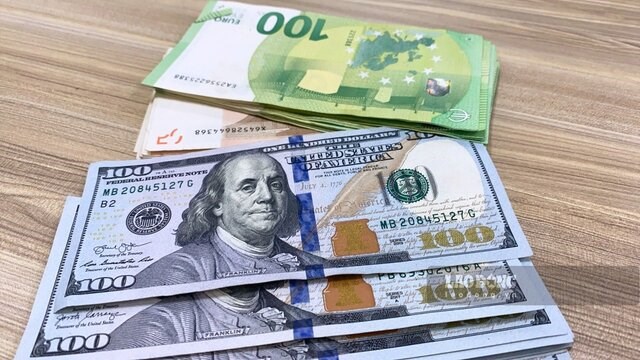
What is the exchange rate of 1 USD to VND today?
The central exchange rate is listed by the State Bank of Vietnam at 23,930 VND/USD.
The black market USD exchange rate today is 24,060 - 24,430 VND (buy - sell).
Today's USD exchange rate at Vietcombank is listed at 24,060 VND - 24,430 VND (buying rate - selling rate).
The current Euro exchange rate at Vietcombank is 25,897 VND - 27,319 VND (buying rate - selling rate).
The current exchange rate for the Japanese Yen is 159.13 VND - 166.45 VND (buying rate - selling rate).
The current exchange rate for the British Pound is 29,866 VND - 31,137 VND (buying rate - selling rate).
The exchange rate for the Chinese Yuan today is 3,321 VND - 3,463 VND (buying rate - selling rate).
Today's USD exchange rate
The US Dollar Index (DXY), which measures the fluctuations of the US dollar against six major currencies (EUR, JPY, GBP, CAD, SEK, CHF), recorded a level of 103.11 points.
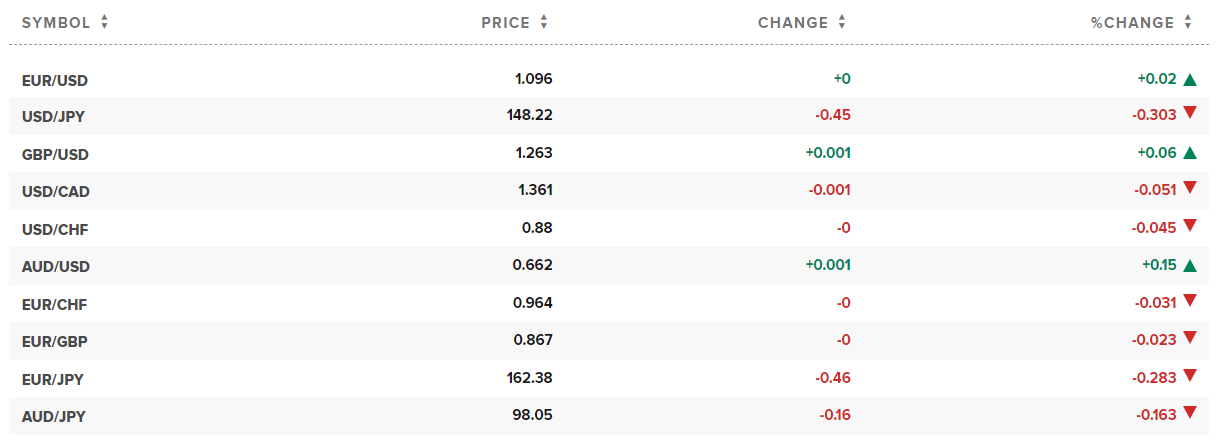
The US dollar fell to its lowest level in three months against a basket of currencies today, driven by weaker-than-expected new real estate sales in the US, while the market assesses that the Federal Reserve may begin cutting interest rates in the first half of next year.
Specifically, new home sales in the US fell 5.6% to 679,000 units in October. This figure was lower than the 723,000 units that experts had previously predicted.
The USD Index, a measure of the greenback against a basket of currencies, was last at 103.11. This is its lowest level since August 31st. In November, the USD fell by more than 3% – its worst performance in a year.
The USD has been under significant pressure as the market assesses that the Fed has completed its interest rate hike cycle. According to the CME FedWatch tool, there is approximately a 25% chance that the Fed could begin cutting interest rates as early as March 2024. This probability increased to nearly 45% in May.
Kyle Rodda, a financial market analyst at Capital.com, said: “Slowing growth, peak interest rates, rate cuts next year, and cancellations of long positions… These are the drivers of the weakening USD. The USD is likely to continue to fall.”
This week, the market is focusing on the core US Personal Consumption Expenditures (PCE) price index – the Fed's preferred measure of inflation – to confirm whether inflation in the US is slowing down.
PCE kicks off a series of other important economic events this week, including China's Purchasing Managers' Index (PMI) data and the OPEC+ decision.
According to Reuters, after postponing its policy meeting until this Thursday, OPEC+ is considering deeper oil production cuts.
The Australian dollar quickly reached a new three-and-a-half-month high at 0.66105 AUD/USD. Data released Tuesday morning showed that domestic retail sales in October fell compared to the previous month.
The New Zealand dollar also temporarily reached its highest level since August 10th at 0.61055 NZD/USD before slipping back to 0.61005. The Reserve Bank of New Zealand will hold its monetary policy meeting on Wednesday. The institution is expected to keep interest rates stable at 5.50% for the fourth consecutive time.
Elsewhere, the yen held steady at 148.10 JPY/USD. The recent weakening of the dollar continues to give the Japanese currency some advantages.
Although the Fed's work may be complete, expectations are growing that the Bank of Japan will eventually move away from its loose monetary policy. More than half of the experts surveyed by Reuters predict the BOJ will take further action at its April 2024 meeting.
Tony Sycamore, a market analyst at IG, wrote in a note: "The USD still holds a significant advantage over the Yen. We think a sharp pullback is unlikely unless the JPY/USD breaks through support in the 146.50-146.30 range."
Source


![[Photo] Commemorating the unwavering friendship between Vietnam and Laos](/_next/image?url=https%3A%2F%2Fvphoto.vietnam.vn%2Fthumb%2F1200x675%2Fvietnam%2Fresource%2FIMAGE%2F2026%2F01%2F27%2F1769518372051_ndo_br_1-jpg.webp&w=3840&q=75)

![[Photo] The General Secretary attends the groundbreaking ceremony for the construction of the Truong Ha Primary and Secondary Boarding School.](/_next/image?url=https%3A%2F%2Fvphoto.vietnam.vn%2Fthumb%2F1200x675%2Fvietnam%2Fresource%2FIMAGE%2F2026%2F01%2F28%2F1769604498277_vna-potal-tong-bi-thu-du-le-khoi-cong-xay-dung-cong-trinh-truong-pho-thong-noi-tru-tieu-hoc-va-trung-hoc-co-so-truong-ha-8556822-jpg.webp&w=3840&q=75)


![[Photo] National Assembly Chairman Tran Thanh Man meets with former leaders of the National Assembly from various periods.](/_next/image?url=https%3A%2F%2Fvphoto.vietnam.vn%2Fthumb%2F402x226%2Fvietnam%2Fresource%2FIMAGE%2F2026%2F01%2F28%2F1769601014034_anh-man-hinh-2026-01-28-luc-18-50-04.png&w=3840&q=75)


![OCOP during Tet season: [Part 3] Ultra-thin rice paper takes off.](/_next/image?url=https%3A%2F%2Fvphoto.vietnam.vn%2Fthumb%2F402x226%2Fvietnam%2Fresource%2FIMAGE%2F2026%2F01%2F28%2F1769562783429_004-194121_651-081010.jpeg&w=3840&q=75)


![OCOP during Tet season: [Part 2] Hoa Thanh incense village glows red.](/_next/image?url=https%3A%2F%2Fvphoto.vietnam.vn%2Fthumb%2F402x226%2Fvietnam%2Fresource%2FIMAGE%2F2026%2F01%2F27%2F1769480573807_505139049_683408031333867_2820052735775418136_n-180643_808-092229.jpeg&w=3840&q=75)
![OCOP during Tet season: [Part 1] Ba Den custard apples in their 'golden season'](/_next/image?url=https%3A%2F%2Fvphoto.vietnam.vn%2Fthumb%2F402x226%2Fvietnam%2Fresource%2FIMAGE%2F2026%2F01%2F26%2F1769417540049_03-174213_554-154843.jpeg&w=3840&q=75)






Comment (0)