

REDUCE DEPENDENCE BUT DO NOT UNDERESTIMATE THE ROLE OF TEXTBOOKS
Ms. Pham Thai Le, a teacher at Marie Curie Secondary and High School ( Hanoi ), positively assessed the empowerment of teachers in teaching under the new curriculum, especially the right to choose teaching materials outside of textbooks that are appropriate for the lesson objectives and the students they are teaching. However, this also forces teachers and students to read more and research more, which serves as a motivation for both teachers and students to change.
Ms. Le also shared that reducing reliance on textbooks, while seemingly simple, requires a long process and a willingness to innovate. Initially, for safety reasons, instead of relying entirely on a single textbook, teachers will choose teaching materials from multiple textbooks, and this should be seen as a positive sign.
Having multiple textbooks gives teachers more choices. For example, depending on the content, and even the grade level, each textbook has different strengths and weaknesses. While schools may select a main list of textbooks, if teachers rely solely on that textbook without researching, exploring, and incorporating material from other textbooks or texts into their lessons, both teachers and students will have to accept both the advantages and disadvantages of that textbook.
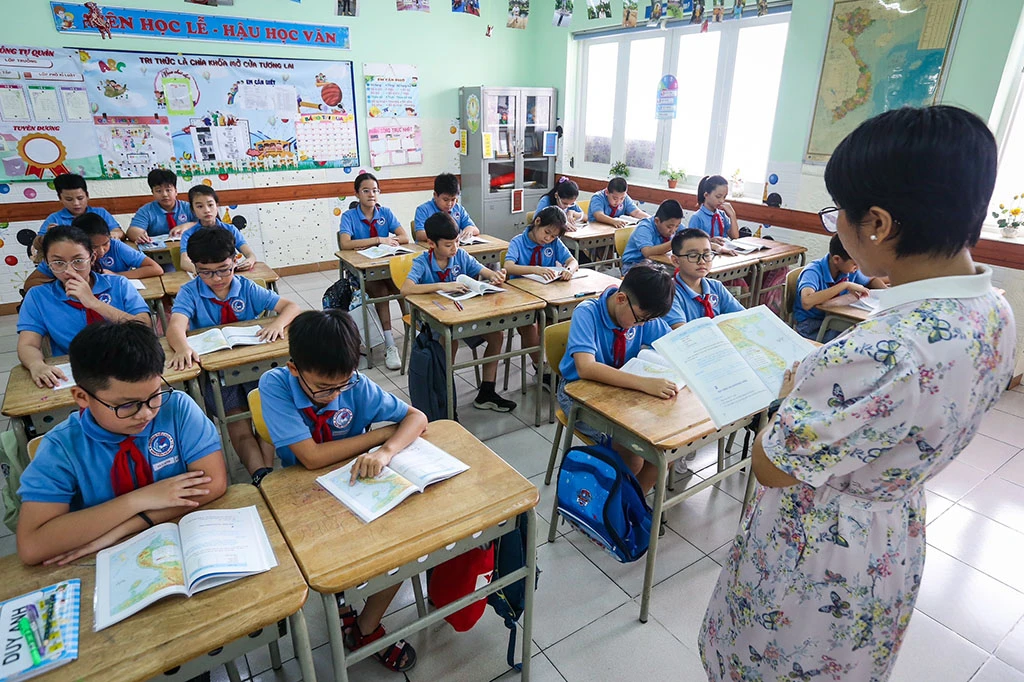
According to the Minister of Education and Training, textbooks are learning materials, and can also be special learning materials, but teachers need to use textbooks proactively and not be dependent on them.
Therefore, according to Ms. Le, teachers must carefully study different textbooks and learning resources to select and encourage students to read and learn appropriate authors and works, including those not included in the textbooks. Teachers must act as a "filter," evaluating what is included in their lessons before incorporating it into the lesson plan.
However, Ms. Le also emphasized that one should not be extreme in "breaking away" from textbooks in the teaching process because, no matter how things change, textbooks remain a special resource for schools. "We shouldn't be dependent on textbooks in the sense that even if we find some content uninteresting or inappropriate, we still rigidly teach it to students because we think textbooks are 'the law'; but there are contents and works that the textbook authors have chosen that are already very good, so the teacher's task is to convey that content to students in the most accessible and understandable way, rather than searching for other materials outside of the textbook to prove innovation," Ms. Le said.
" Teach the way," not "teach the thing."
Having taught literature for 20 years, Ms. To Lan Huong from Nguyen Sieu Secondary and High School (Hanoi) assesses the 2018 General Education Program as a transformation in the thinking of each subject. The program completely changes the rote learning approach and the mindset of "what you learn, you'll be tested on." Previously, students studied five literary works, and teachers reviewed them based on those five works. For example, if the teacher taught The Tale of Kieu , the exam would be based on The Tale of Kieu ; if the teacher taught The Ferryman of the Da River , the exam would be based on The Ferryman of the Da River … This became a rut for teachers. In the 2018 General Education Program, Ms. To Lan Huong believes that the literature subject has undergone a significant change, focusing on "teaching how" rather than "teaching what," with four skills: listening, speaking, reading, and writing – a complete shift from before.
"Previously, the focus was solely on reading comprehension, followed by exams, tests, and analyzing pre-existing question types. Teachers and students diligently studied like that from grade 6 to grade 12, meticulously focusing on how to write those essays. But now, students learn and develop all four skills: listening, speaking, reading, and writing," Ms. Huong said.
Ms. To Lan Huong added that teachers teach students how to read, listen, speak, and write, and when assessing, the materials are not in the textbook. Therefore, the materials taught by the teacher only serve as a reference, clarifying the reading skills for different genres, while students will have to "battle" with a completely new work. The test results between the new and old curricula will also be very different. Therefore, students may find it difficult and confusing in grade 10, but this will no longer be the case in grade 11. This is a significant change, although in the early years, students' scores may not be as safe as before.
Ms. Nguyen Thi Nhiep, Principal of Chu Van An High School (Hanoi), also believes that change requires a persistent process. Based on her observations at various schools, when first introduced to the new curriculum, teachers participating in training still tend to cling to specific textbooks when asking questions and raising concerns. Many teachers fear omitting certain content from the textbook, fearing that their students will be left behind if exams include that specific section. Some teachers also believe that the lesson sequence in the textbook must be followed exactly. Only when their mindset is "freed" do teachers gradually understand that textbooks are just one important resource among many different learning materials to use in teaching.
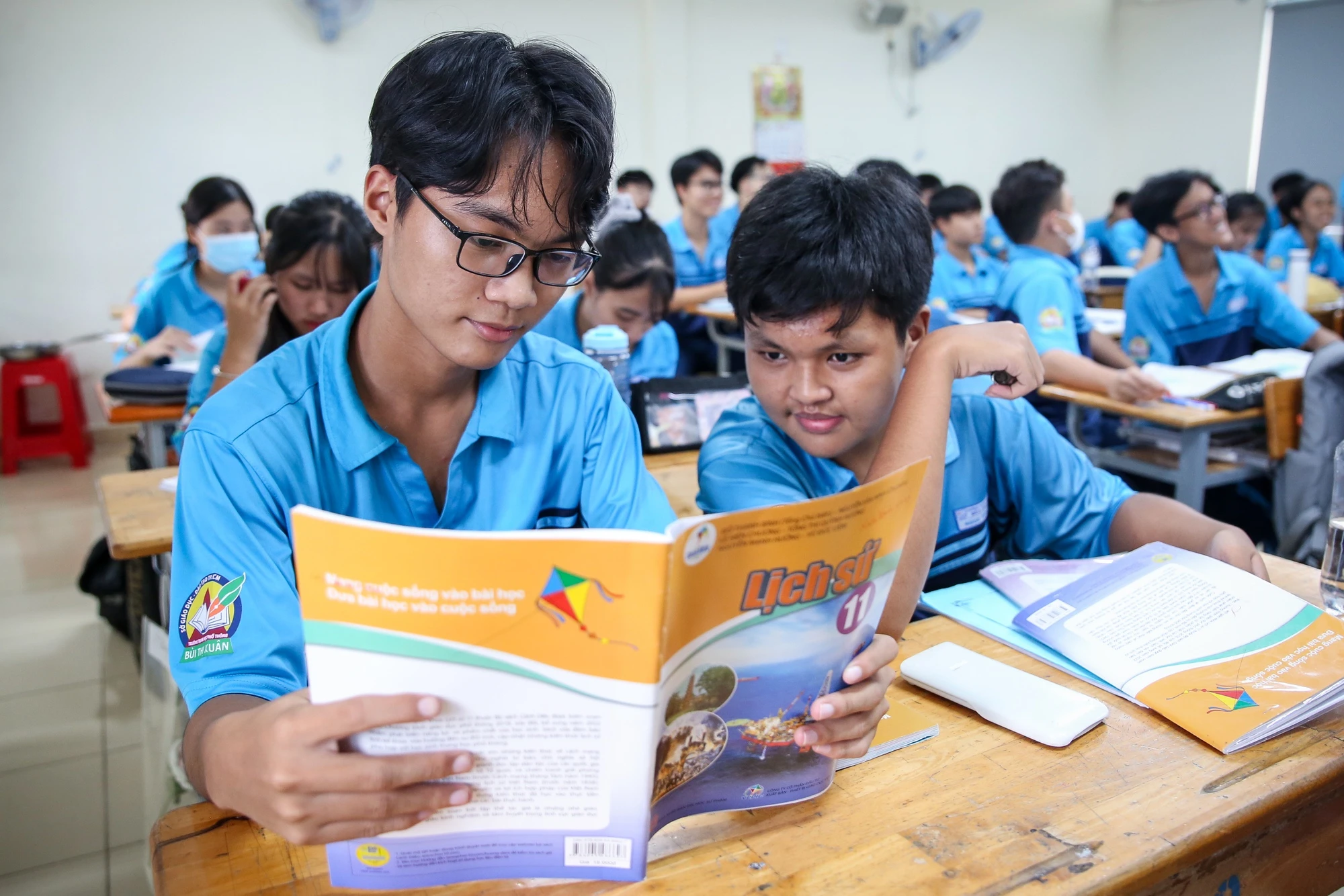
Having multiple sets of textbooks will give teachers more options when choosing teaching materials.
Teachers must be trained to gain a deep understanding of the curriculum.
A primary school teacher in Thanh Xuan District (Hanoi) said that for a long time, teacher training has usually been carried out by textbook publishing units. Meanwhile, to reduce dependence on textbooks, teachers need to be trained and educated to deeply understand the curriculum. "However, textbooks must be standardized regardless," this teacher emphasized.
Mr. Nguyen Anh Tuan, Head of the Natural Science Department at Nguyen Sieu Secondary and High School, also noted that the new curriculum lesson plans have fewer words and pages, but teachers have to work harder. Currently, training sessions focus on specific textbooks, but many teachers do not understand the curriculum.
Sharing this reality, Ms. Pham Thai Le pointed out that the less dependence on textbooks there is, the more precise and specific the curriculum must be, and the learning outcomes must be clear so that teachers can assess appropriately. For example, in the subject of Literature, when tests and exams require students to analyze and discuss a completely new work, the required learning outcomes must be very appropriate. Currently, the curriculum still contains overly comprehensive and rather heavy content, causing teachers who are inexperienced to worry whether their teaching, without relying solely on textbooks, has met the curriculum's learning objectives. (to be continued)
The ultimate goal of the policy of having multiple sets of textbooks has not yet been achieved.
Regarding the trend of implementing a program with multiple textbooks, Mr. Nguyen Dac Vinh, Chairman of the National Assembly's Committee on Culture and Education, shared with Thanh Nien newspaper: "If the spirit of a program with multiple textbooks is correct, then in a lesson, teachers and students can use any textbook they want. Therefore, the right to choose which book to use should belong to the students and parents. Why should we have to choose this set or that set? If a set of books is not good, not attractive, or not easy to use, it should not be used. Currently, we have not yet reached the ultimate goal of using any book in a lesson. If students have already studied one book, then introducing another book creates a mismatch and is very difficult. Ideally, with a program with multiple textbooks, in a 5th grade math lesson, students can use any book regardless of where they sit. If there are five math textbooks on the market, and I have the means, I can buy all five for my child, what's wrong with that?"
Minister of Education and Training Nguyen Kim Son recently shared: "The major change this time is the unified national curriculum. Textbooks are learning materials, and they can be special learning materials, but we need to use textbooks proactively, not dependently. They are tools, and we are ready to use other sets of textbooks and other learning materials, using them flexibly and exercising our initiative."
According to Mr. Son, if we don't change our approach to textbooks, we won't achieve the crucial goal of innovation.
The head of the education sector also emphasized the role of principals in helping teachers reduce their dependence on textbooks: "If principals do not innovate, it is difficult to hope for innovation in that school. If principals do not change, the change of teachers will be very difficult and may lead to collapse."
Source link

![[Photo] Prime Minister Pham Minh Chinh receives the Governor of Tochigi Province (Japan)](/_next/image?url=https%3A%2F%2Fvphoto.vietnam.vn%2Fthumb%2F1200x675%2Fvietnam%2Fresource%2FIMAGE%2F2025%2F12%2F16%2F1765892133176_dsc-8082-6425-jpg.webp&w=3840&q=75)
![[Photo] Prime Minister Pham Minh Chinh receives Lao Minister of Education and Sports Thongsalith Mangnormek](/_next/image?url=https%3A%2F%2Fvphoto.vietnam.vn%2Fthumb%2F1200x675%2Fvietnam%2Fresource%2FIMAGE%2F2025%2F12%2F16%2F1765876834721_dsc-7519-jpg.webp&w=3840&q=75)

![[Live] 2025 Community Action Awards Gala](/_next/image?url=https%3A%2F%2Fvphoto.vietnam.vn%2Fthumb%2F1200x675%2Fvietnam%2Fresource%2FIMAGE%2F2025%2F12%2F16%2F1765899631650_ndo_tr_z7334013144784-9f9fe10a6d63584c85aff40f2957c250-jpg.webp&w=3840&q=75)
![[Image] Leaked images ahead of the 2025 Community Action Awards gala.](/_next/image?url=https%3A%2F%2Fvphoto.vietnam.vn%2Fthumb%2F1200x675%2Fvietnam%2Fresource%2FIMAGE%2F2025%2F12%2F16%2F1765882828720_ndo_br_thiet-ke-chua-co-ten-45-png.webp&w=3840&q=75)

































![[Photo] Prime Minister Pham Minh Chinh attends the Vietnam Economic Forum 2025](https://vphoto.vietnam.vn/thumb/402x226/vietnam/resource/IMAGE/2025/12/16/1765893035503_ndo_br_dsc-8043-jpg.webp)















Comment (0)