

 |
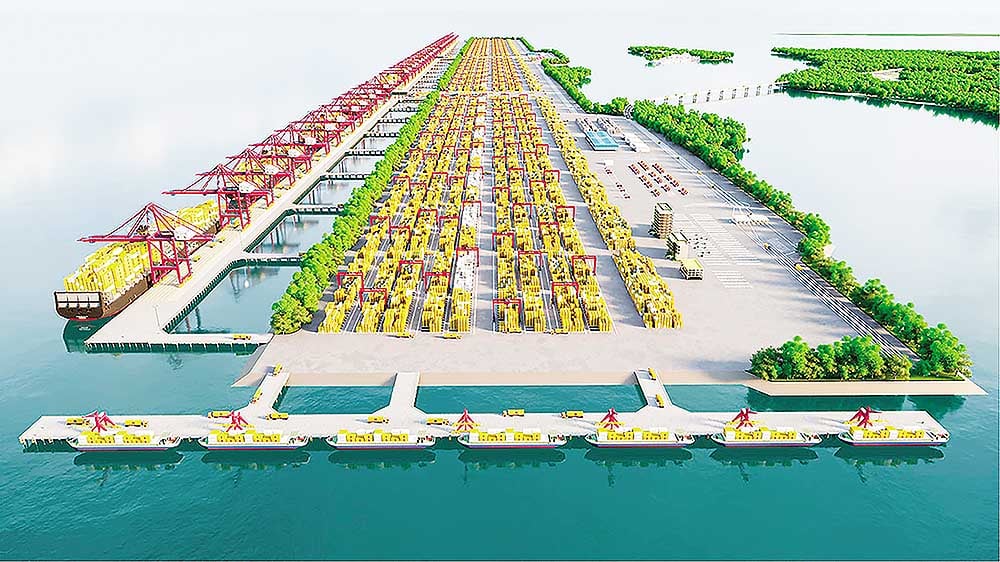
| Synchronized infrastructure projects create significant opportunities for M&A in the logistics sector. (Image: Rendering of the Can Gio International Mega-Port, expected to begin construction in 2026) |
A boost for the logistics industry.
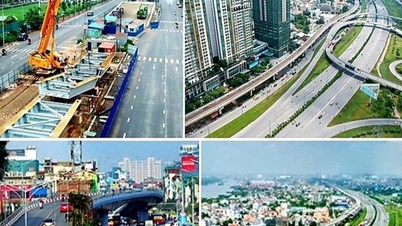
Vietnam is entering its most intensive public investment phase in the past decade with a series of key projects such as the North-South Expressway, Long Thanh Airport, Can Gio Port, and Lien Chieu Port. These projects are giving a boost to the logistics industry – a sector growing at 14-16% annually, contributing 4.5-5% to GDP, and ranking 43rd out of 139 in the global Logistics Performance Index (LPI).
Integrated infrastructure helps reduce logistics costs, which currently account for about 16% of GDP, higher than the world average (11%) and regional countries such as Singapore (8%) or Malaysia (12%).
Cost optimization not only improves profit margins for businesses but also fuels a wave of M&A, as logistics assets are revalued based on their new exploitation potential.
Areas with key infrastructure such as Lach Huyen Port (Hai Phong Free Trade Zone - FTZ), Lien Chieu Port (Da Nang FTZ), or Cai Mep - Thi Vai Port (formerly Ba Ria - Vung Tau area, currently proposed for development into an FTZ), have attracted investors from Japan, Singapore, South Korea, and China seeking opportunities to expand their networks amidst shifting supply chains and investment barriers in the US, causing capital to flow back to Asia.
Furthermore, Decision No. 2229/QD-TTg dated October 9, 2025, approving the Strategy for Logistics Development until 2035, with a vision to 2050 and the orientation for sustainable development of the national logistics ecosystem "Smart - Modern - Green - Digital - Competitive - Efficient," has strengthened market confidence and encouraged domestic mergers and acquisitions to increase scale and competitiveness.
It can be said that public investment not only paves the way for physical infrastructure, but also opens the door for a wave of strategic M&A, bringing Vietnam's logistics closer to regional standards.
Key segments shaping M&A flows in the logistics sector.
On its journey to becoming a "mega-industry," the wave of public investment and synchronized infrastructure development is reshaping the priorities of both the market and investors in Vietnam's logistics sector. Along with the completion of the expressway system, deep-water ports, and international airports, M&A capital is strongly concentrated in segments that can directly leverage infrastructure advantages.
Warehousing and cold storage are experiencing strong growth, clearly benefiting from new infrastructure projects such as deep-water ports, international airports, and interregional highways, which shorten transportation cycles and improve logistics efficiency.
With the boom in e-commerce, exports, and the shift of supply chains away from China, this segment is set to become a focal point for investment in 2025. Ready-Built Factories (RBF) and Ready-Built Warehouses (RBW) are attracting significant investment due to their short deployment times, competitive rental costs, and modern construction standards, allowing businesses to expand production and warehousing without investing in new infrastructure.
Furthermore, multimodal transport and 3PL services have emerged as the "backbone" of connectivity, enabling businesses to integrate transportation, warehousing, and distribution within the same chain, effectively leveraging the North-Central-South economic corridors.
From the perspective of foreign investors, network advantages and rapid scalability are two top priorities. Corporations are accelerating M&A with domestic businesses that already possess land, operational infrastructure, and a stable customer network. This approach helps them shorten market entry time, avoid complex licensing procedures, and quickly scale up to capitalize on the growth momentum of the Vietnamese logistics market, where opportunities are opening up and infrastructure is being developed at the fastest pace in the region.
Unlocking a new wave of logistics M&A for domestic businesses.
Significant improvements in inter-regional connectivity in Vietnam, driven by substantial investments in expressways, deep-water ports, industrial corridors, and modern logistics centers, are creating a new wave of M&A opportunities for domestic logistics businesses.
These infrastructure upgrades significantly shorten transportation times between the three economic regions of North, Central, and South Vietnam, while strengthening connections with seaports and international gateways. As a result, domestic businesses, previously operating only within the region, now have the opportunity to expand nationwide and penetrate deeper into specialized, high-margin segments such as cold chain logistics, agricultural supply chains, industrial park delivery solutions, and integrated multimodal transport and transit services. These are all strategic areas in the context of Vietnam's shift towards high-value production, rapid increase in e-commerce, and strong growth in agricultural exports.
The ability to attract strategic or financial investors will depend on the company's operational strength and institutional readiness. Investors seek companies that have demonstrated excellent operational capabilities, maintained high-quality service on a large scale, and have standardized models that are easily scalable to other regions. Progress in digital transformation, such as real-time operational monitoring, modern warehouse management systems, route optimization, along with a reliable commitment to ESG and sustainability, will help the business stand out.
Equally important are transparent financial reporting, clear governance, and a professional management team. These factors help businesses pass the rigorous due diligence process of international strategic investors and private equity funds.
The South will lead the logistics M&A wave in 2026.
In 2026, the focus of logistics M&A deals in Vietnam will be in the Southern Key Economic Region, which currently handles nearly 50% of the country's total cargo volume.
The Cai Mep - Thi Vai deep-water port complex, capable of receiving 24,000 TEU vessels, along with the expressway, Ring Roads 3 and 4, Long Thanh airport, and the soon-to-be-completed railway connecting the port, will create a leap forward in multimodal transport efficiency. For investors, this represents a clear source of synergistic value – a key factor driving M&A.
Decision 370/QD-TTg dated April 4, 2025 also identifies this region as a major growth pole, setting a GRDP target of 8-8.5% per year and forming six key economic corridors, consolidating its role as a national logistics center.
The North maintains a firm second-place position, benefiting from port expansion, cross-border highways, advantages in cold chain logistics and trade linked with China, and attracting investment flows from South Korea, Japan, and China.
Central Vietnam is emerging as a new potential market, with the completion of the North-South expressway and the maturation of industrial clusters in Da Nang, Chu Lai, and Dung Quat, along with its strategic location on the East-West Economic Corridor. Although the scale of transactions is still small, this region is considered to have long-term potential.
Overall, the South will lead the M&A wave in logistics in 2026 thanks to its infrastructure advantages, market position, and clear support policies, while the North and Central regions will play a role in stabilizing and expanding new growth opportunities.
Four key strategies for attracting M&A capital.
To fully capitalize on the momentum from Vietnam's infrastructure expansion wave, logistics companies preparing for M&A need to focus on building operational and financial credibility, while adjusting their strategies to meet the expectations of global investors.
First, enhancing financial transparency and governance is key. A clear accounting system, independent audit reports, and adherence to international standards will help improve confidence and business valuation.
Secondly, operational standardization is necessary through ISO-certified processes, key performance indicators (KPIs), and unified service standards, in order to enhance seamless integration when collaborating with strategic partners.
Third, investing in digital transformation should be a top priority. Data-driven logistics management, automation, and smart warehousing not only increase operational efficiency but also attract strategic investors seeking scalable models and high-tech applications.
Ultimately, adopting green logistics models, such as low-emission vehicle fleets, renewable energy-powered warehouses, and transparent ESG reporting, will help businesses differentiate themselves in the market while aligning with the sustainable development goals of global logistics corporations.
These steps will help Vietnamese logistics businesses make the most of the new infrastructure, assert their position, and become strong contenders in the upcoming wave of M&A.
(*) CEO of Acclime Vietnam
Source: https://baodautu.vn/ha-tang---chat-xuc-tac-dinh-hinh-xu-huong-ma-logistics-d453638.html
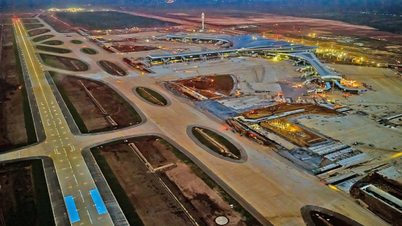
![[Photo] Two flights successfully landed and took off at Long Thanh Airport.](/_next/image?url=https%3A%2F%2Fvphoto.vietnam.vn%2Fthumb%2F1200x675%2Fvietnam%2Fresource%2FIMAGE%2F2025%2F12%2F15%2F1765808718882_ndo_br_img-8897-resize-5807-jpg.webp&w=3840&q=75)

















































































Comment (0)