

Over half a century searching for the graves of loved ones.
Over the past few days, the Ho Chi Minh City Police, in coordination with communes and wards, have been collecting DNA samples from relatives of fallen soldiers in the communes of Dat Do, Long Dien, Ho Tram, Hoa Hoi, Xuyen Moc, Phuoc Hai... and many wards: Thu Dau Mot, Dong Hoa, Phu Loi, Binh Duong, Chanh Hiep, Hoa Loi, Tan Khanh…
From early morning, at the DNA sample collection point at the Chau Pha Commune People's Committee, many relatives of fallen soldiers were present. Some were elderly people using canes, some in wheelchairs, and others were helped by their children and grandchildren. Their hands trembled as they filled out the information forms, their eyes dimmed by age but still shining with hope of finding their loved ones who had sacrificed their lives, after many years of waiting.
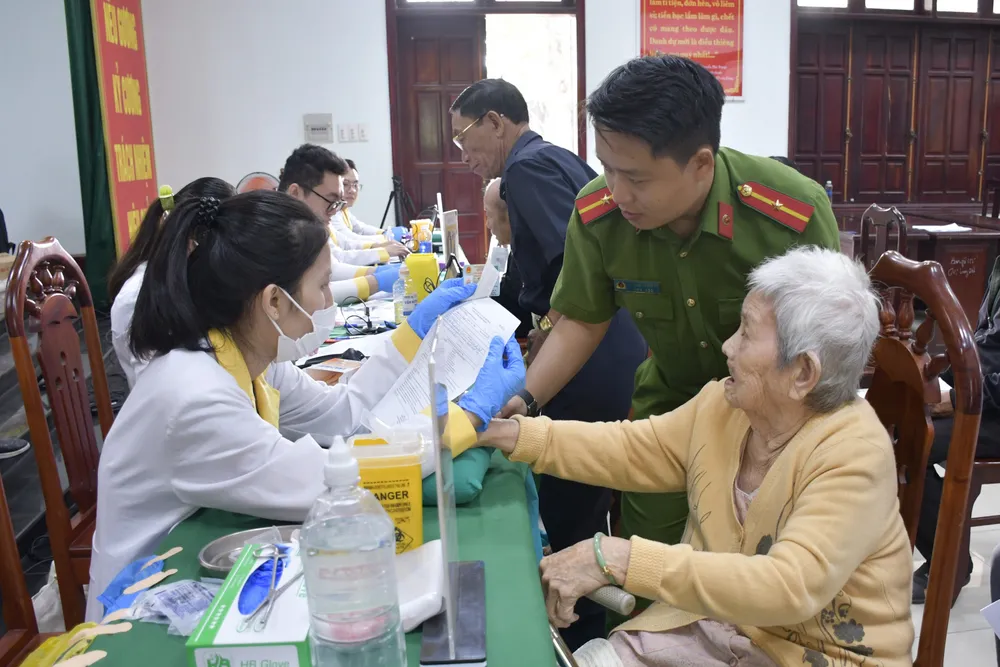
Sitting in the corner of the waiting room for her turn to have her sample taken, Mrs. Duong Thi Lan (91 years old, Chau Pha commune) emotionally recounted the story of her two younger brothers, martyrs whose graves her family has yet to find. Her eldest brother died in the Battle of Binh Gia in 1964-1965. The other brother fell in Phuoc Thai ( Dong Nai province) in 1975. More than half a century has passed, and Mrs. Lan's family has searched everywhere, revisited old death certificates, and followed every faint clue... But all they have found is a prolonged wait.
When the DNA collection process was explained to her, she clasped the police officer's hand tightly and slowly expressed, "This is my greatest remaining hope. My parents passed away without knowing where my child's grave is. Now it's my turn, I'm also nearing the end of my life... I just hope that before I close my eyes forever, I can know where my sibling is buried so that my family can light an incense stick here."
Not far away, Mr. Duong Chi Huan (77 years old, Chau Pha commune) patiently fills out the information on the DNA sample registration form. He is the only surviving younger brother of martyr Duong Van Vuong, whose family has been searching for his grave for over 50 years. Martyr Duong Van Vuong enlisted in 1965 and died on the battlefield in Cambodia. Since receiving the death certificate in 1976, Mr. Huan's family has not known where their relative's grave is located. "Even if it's just a small glimmer of hope, I don't want to miss it," Mr. Huan confided.
Extending hope
On January 20th, in Dat Do commune, Ho Chi Minh City Police, in coordination with relevant units, collected nearly 300 DNA samples from relatives of fallen soldiers in the communes of Dat Do, Ho Tram, Hoa Hoi, Xuyen Moc, and Phuoc Hai. The DNA collection process was carried out systematically and scientifically , prioritizing the elderly, those with weak health, and those who have spent decades searching for the graves of their loved ones.
Present at the DNA sampling site, Ms. Vu Thi Thom (73 years old, Long Dien commune) had her DNA sample taken to find her maternal uncle, Nguyen Thanh Son, who died in the Route 9 - Khe Sanh campaign in 1968. For nearly 60 years, her family only had a few brief lines from his death certificate. For Ms. Thom and hundreds of other relatives of fallen soldiers, each DNA sample is not only scientific data but also a thread of hope after many years of waiting. This is also an opportunity to shorten the verification and search process, gradually identifying and restoring the names of those who sacrificed their lives.
According to Lieutenant Colonel Ho Duc Thien, Deputy Head of the Administrative Police Department for Social Order (Ho Chi Minh City Police), the search, collection of remains, and identification of fallen soldiers is always considered a particularly important political task. Collecting DNA samples from the mothers and relatives of unidentified fallen soldiers carries profound political and social significance, demonstrating gratitude towards the older generation who sacrificed for the independence and freedom of the Fatherland. From these biological samples, DNA data will be compared and verified, opening up more opportunities for fallen soldiers to be correctly identified, returning to their families and hometowns after decades of separation.
“The Ho Chi Minh City Police Department calls upon and hopes that the relatives of fallen soldiers will continue to cooperate, provide complete and accurate information, and voluntarily participate in collecting biological samples according to instructions. The joint efforts of the families are a key factor in ensuring that this humane and compassionate journey soon achieves practical results,” Lieutenant Colonel Ho Duc Thien shared. The DNA sample collection program will continue to be implemented in the coming time. At each sample collection point, the stories of waiting and silent tears continue, as a reminder that today's peace was bought at the cost of so much loss, and the journey to bring the fallen soldiers home has not yet ended...
Ho Chi Minh City has reviewed nearly 30,000 cases of fallen soldiers, of which more than 12,500 cases lack information about their burial sites. From January 19th to January 23rd, the Ho Chi Minh City Police Department plans to collect more than 4,000 DNA samples from relatives of fallen soldiers whose graves have not yet been found.
Source: https://www.sggp.org.vn/hy-vong-tim-nguoi-than-tu-adn-post835266.html
![[Photo] General Secretary and President To Lam presides over a working session with the Central Policy and Strategy Committee on the development of the materials industry.](https://vphoto.vietnam.vn/thumb/1200x675/vietnam/resource/IMAGE/2026/05/21/1779359935432_a3-bnd-3129-1412-jpg.webp)



![[Photo] National Assembly Chairman Tran Thanh Man working with the Standing Committee of the Law and Justice Committee](https://vphoto.vietnam.vn/thumb/1200x675/vietnam/resource/IMAGE/2026/05/21/1779378929214_ndo_br_1-4610-jpg.webp)





























































Comment (0)