

Ho Chi Minh City – Ms. Trang, 32 years old, experienced uterine prolapse at 23 weeks of pregnancy, posing a risk of premature birth. Doctors performed a cervical cerclage procedure to prevent complications.
This is Trang's second pregnancy. Six years ago, she gave birth prematurely to her first child at 26 weeks, who suffered from cerebral palsy. This time, at 23 weeks, her cervix has prolapsed to 17 mm.
On September 26th, Dr. Nguyen Huy Cuong, a specialist in Obstetrics and Gynecology at Tam Anh General Hospital in Ho Chi Minh City, stated that the normal cervical length during pregnancy is approximately 30-50 mm. A cervical length of less than 25 mm before the 24th week of pregnancy is considered short and requires treatment to prevent the risk of miscarriage and premature birth. Cervical cerclage is usually performed between the 14th and 18th weeks of pregnancy. Ms. Trang's case was exceptional, performed at the 24th week of pregnancy.
Doctors anticipated a difficult intervention due to the large size of the fetus, the high risk of ruptured membranes, and the possibility of extremely premature birth and infection. The team used special sutures to stitch and tighten, keeping the cervix closed.
After the procedure, the fetus developed healthily. Ms. Trang had her stitches removed at the beginning of the 38th week of pregnancy. A week later, in mid-September, her water broke, and she went into labor, giving birth to a healthy baby.
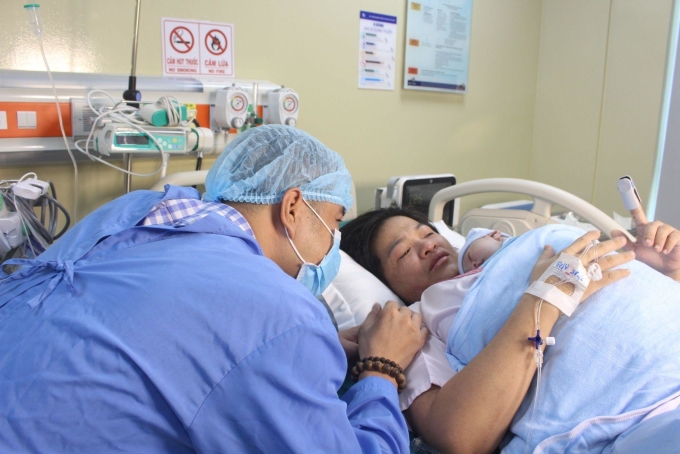
Ms. Trang's family welcomed their newborn child at Tam Anh Hospital. Photo: Tue Diem.
According to the World Health Organization (WHO), premature birth is the leading cause of death in children under 5 years old. Globally, an estimated 15 million premature babies are born each year, representing a rate of 1 in 10 newborns.
According to Dr. Cuong, cervical cerclage helps pregnant women maintain their pregnancy and is indicated for women with a history of two or more large miscarriages or premature birth before 28 weeks with characteristics of rapid, painless labor; women with risk factors such as cone biopsy or core biopsy of the cervix, cervical resection, cervical damage due to dilation and curettage accompanied by a history of premature birth before 36 weeks; short cervical length (less than 25mm) at gestational age under 24 weeks or changes over time during examinations.
After the procedure, pregnant women are usually monitored in the hospital for 2-3 days, rest at home, avoid strenuous work, and refrain from sexual intercourse.
The Tam Anh General Hospital system in Ho Chi Minh City recorded more than 10 cases of threatened premature birth due to a short cervix in August out of a total of 400 births. All cases of cervical cerclage resulted in healthy babies born at 35-38 weeks of gestation.
Tue Diem
| Readers can post questions about women's health and physiology here for doctors to answer. |
Source link


![[Photo] Solemn bathing ceremony and Buddha procession in Hue](https://vphoto.vietnam.vn/thumb/1200x675/vietnam/resource/IMAGE/2026/05/31/1780228263543_1-jpg.webp)
![[Photo] Admire the coral "masterpiece" amidst the million-year-old heritage of Dak Lak province.](https://vphoto.vietnam.vn/thumb/1200x675/vietnam/resource/IMAGE/2026/05/31/1780221235105_anh-man-hinh-2026-05-31-luc-16-53-27.png)
![[Photo] The General Secretary, President and his wife begin their state visit to the Philippines.](https://vphoto.vietnam.vn/thumb/1200x675/vietnam/resource/IMAGE/2026/05/31/1780230559452_anh-man-hinh-2026-05-31-luc-19-28-11.png)






















![[Video] Sunset at Lap An Lagoon – Where the sun sets over the fishing nets](https://vphoto.vietnam.vn/thumb/340x192/vietnam/resource/IMAGE/2026/05/31/1780192137701_beach-landscape-sea-water-nature-grass-745871-pxhere-com.jpeg)










































![[Photo] Admire the coral "masterpiece" amidst the million-year-old heritage of Dak Lak province.](https://vphoto.vietnam.vn/thumb/402x226/vietnam/resource/IMAGE/2026/05/31/1780221235105_anh-man-hinh-2026-05-31-luc-16-53-27.png)




































Comment (0)