

Is Vietnamese athletics only strong in long-distance races?
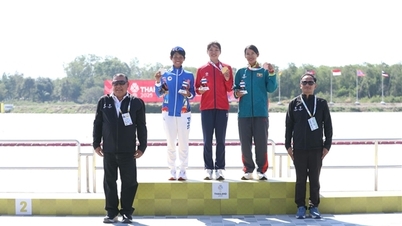
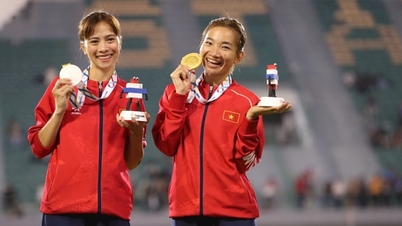
At the 33rd SEA Games in Thailand, the achievements of Vietnamese athletics were clearly depicted by two contrasting colors. On the one hand, we continued to dominate our strongest events, where willpower and endurance were celebrated. Consecutive gold medals were brought home from the 1,500m, 5,000m, 400m women's, and 4x400m relay events. Successes likened to "gold harvesting machines" like Nguyen Thi Oanh and the mixed men's and women's relay teams brought glory through unwavering determination.

However, on the other hand, there was a bitter failure, or more accurately, an undeniable decline, in short-distance sprints, events considered the benchmark for modern athletics. In the 100m and 200m races for both men and women, Vietnamese athletics came away almost empty-handed. Ngan Ngoc Nghia, who was once expected to win a medal in the men's 200m race, failed to surpass his own expectations. He finished 5th in the 200m final and didn't even qualify for the 100m, a greatly disappointing result.
The medal winners in short-distance events, Ha Thi Thu (bronze in the women's 100m) and Le Thi Cam Tu (silver in the women's 200m), were still far from achieving the gold medal threshold. This disparity has turned Vietnamese athletics into a severely unbalanced team. If we remove the achievements in long and middle-distance races, Vietnam's ranking on the overall medal table would plummet. We are currently relying on the strength of a select group of athletes, rather than the combined strength of a comprehensively developed athletics system.

Ngan Ngoc Nghia's best time in the 100m (approximately 10.35 seconds) is still a step away from the current SEA Games gold medal winning standard. Even the Thai prodigy Puripol Booson completed the event in 9.99 seconds. In the qualifying round, his time was even more impressive: 9.94 seconds. This is an unbelievable achievement for a Southeast Asian athlete, but Booson accomplished it. And this gap in speed athletics is too deep, too difficult to bridge.
Meanwhile, the Vietnamese women's 100m and 200m races were once a source of national pride at the SEA Games. "Queen of Speed" Vu Thi Huong dominated the region before 2015, winning numerous gold medals in both the 100m and 200m events. Following in her footsteps, Le Tu Chinh rose to prominence and continued this dominance, culminating in a double gold medal win in the 100m and 200m at the 29th SEA Games (2017).

However, after the brilliant era of Tu Chinh, Vietnamese women's athletics has yet to find an athlete capable of succeeding her. Tu Chinh has been absent or not performing at her best in recent SEA Games due to injury. The absence of these two icons has caused Vietnamese women's short-distance running to lose a solid foundation, leading to our inability to maintain the "gold standard" of victory in the 100m and 200m events.
At the 33rd SEA Games, although Vietnam still won medals (bronze in the women's 100m by Ha Thi Thu and silver in the women's 200m by Le Thi Cam Tu), these were isolated achievements, lacking the explosiveness and consistency necessary to win the championship. The absence of an athlete capable of dominating the race from the starting line like Tu Chinh or Vu Thi Huong is the clearest evidence of this shortcoming.
The generational gap was further exacerbated by the regrettable absence of Tran Thi Nhi Yen at the 33rd SEA Games. Nhi Yen was a promising young talent, having won a bronze medal in the 100m and a silver medal in the 200m at the 32nd SEA Games. Notably, she had participated in the Paris Olympics and was expected to win a gold medal in the women's short-distance events for Vietnam in the near future, at least at the 33rd SEA Games. However, due to focusing on her studies and other personal plans, Nhi Yen was unable to join the team for this important tournament. The absence of the athlete considered the number one in the women's short-distance events at that time dealt a heavy blow to the team's chances of winning a gold medal.
Why are Vietnamese athletes struggling in short-distance races?
Vietnam's strong athletics and sustained dominance in middle and long-distance events is not accidental, but stems from suitable physical characteristics combined with an effective training strategy. While sprint events demand explosive power, long-distance events emphasize endurance, pain tolerance, and flexibility – qualities that Vietnamese athletes demonstrate very clearly.
This is demonstrated not only through the excellence of successive generations of athletes, but also through the stable succession of talent. A prime example is the women's 1,500m race at the 33rd SEA Games. Nguyen Thi Oanh, the legendary "gold medal machine" and holder of the best record, voluntarily withdrew from the event to give younger athletes a chance. This was a confident strategy, demonstrating absolute faith in the next generation.

The facts have proven the correctness of this decision. The two young athletes entrusted with this responsibility, Bui Thi Ngan and Nguyen Khanh Linh, did not disappoint. They not only won both the gold and silver medals for Vietnamese athletics, but also demonstrated complete dominance over the remaining Southeast Asian competitors. The two athletes created a large gap, leaving the third-place competitor far behind and maintaining a consistent pace throughout the race.
This successful succession confirms that Vietnam possesses a rich pool of athletes with good potential and professional training to dominate endurance events. Their physical condition, while lacking the advantage of absolute explosive strength, provides a solid foundation for maintaining high speed and overcoming fatigue over extended periods. This is a valuable biological advantage, an asset that Vietnamese athletics needs to continue to fully exploit.
Meanwhile, in short-distance events, we face significant difficulties in finding athletes with the right qualities to accelerate and explode onto the scene. In men's events, we haven't found a suitable replacement for Ngan Ngoc Nghia, who is showing signs of declining form. In women's events, we also don't have many options.
Over the past five years, countries like the Philippines, Thailand, Malaysia, and Indonesia have increasingly used naturalized or foreign-born athletes, particularly in speed and technical events requiring explosive power. These athletes often come from athletics powerhouses such as the United States, Canada, or Jamaica, bringing with them a physical foundation and experience honed in more demanding environments. The goal of these competitors is clear: to fill the medal gap by bringing athletes who are close to or have reached Asian, or even Olympic, qualifying standards to compete in Southeast Asian competitions.
If Vietnam only focuses on long-distance running, we will forever remain an athletics team lacking depth and a voice on the international map. The challenge is not just finding a "speed version of Nguyen Thi Oanh," but building a training system capable of identifying and optimizing explosive potential.
The shortage of promising young athletes like Tran Thi Nhi Yen and the stagnation of Ngan Ngoc Nghia are forcing managers to change their strategy. There is a need for strong investment in speed training specialists, the use of sports science to analyze movement, and even consideration of more flexible policies to attract Vietnamese talent abroad. Vietnamese athletics cannot remain complacent with its status as a powerhouse in endurance. To reach new heights and assert its class, we must solve the problem of speed.
Even other aspects need improvement.
At the 18th Asian Games (2018), Vietnamese athletics achieved brilliant success with 2 gold medals and 3 bronze medals, ranking 7th overall thanks to the outstanding performances of Bui Thi Thu Thao (long jump) and Quach Thi Lan (400m hurdles). However, at the 19th Asian Games, the athletics delegation with 12 athletes came away empty-handed, for the first time after three consecutive successful Asian Games.
The modest goal of winning a medal was not realized. The greatest hope rested on the women's 4x400m relay team, the recent Asian champions, but they unfortunately missed out on a bronze medal. Other key athletes, such as "SEA Games Queen" Nguyen Thi Oanh (1,500m, 3,000m steeplechase), who swept gold medals at the Southeast Asian Games, and Nguyen Thi Huong (triple jump), showed a significant gap in skill level compared to the continental medal-winning athletes. Although we may have achieved great success in Southeast Asia, the lack of world-class talent and the increased number of naturalized athletes from our competitors at the continental level made even winning a bronze medal extremely difficult.
Source: https://cand.com.vn/van-hoa/khoang-trong-cua-dien-kinh-viet-nam-i791327/
![[Live] 2025 Community Action Awards Gala](/_next/image?url=https%3A%2F%2Fvphoto.vietnam.vn%2Fthumb%2F1200x675%2Fvietnam%2Fresource%2FIMAGE%2F2025%2F12%2F16%2F1765899631650_ndo_tr_z7334013144784-9f9fe10a6d63584c85aff40f2957c250-jpg.webp&w=3840&q=75)
![[Photo] Prime Minister Pham Minh Chinh receives the Governor of Tochigi Province (Japan)](/_next/image?url=https%3A%2F%2Fvphoto.vietnam.vn%2Fthumb%2F1200x675%2Fvietnam%2Fresource%2FIMAGE%2F2025%2F12%2F16%2F1765892133176_dsc-8082-6425-jpg.webp&w=3840&q=75)

![[Image] Leaked images ahead of the 2025 Community Action Awards gala.](/_next/image?url=https%3A%2F%2Fvphoto.vietnam.vn%2Fthumb%2F1200x675%2Fvietnam%2Fresource%2FIMAGE%2F2025%2F12%2F16%2F1765882828720_ndo_br_thiet-ke-chua-co-ten-45-png.webp&w=3840&q=75)

![[Photo] Prime Minister Pham Minh Chinh receives Lao Minister of Education and Sports Thongsalith Mangnormek](/_next/image?url=https%3A%2F%2Fvphoto.vietnam.vn%2Fthumb%2F1200x675%2Fvietnam%2Fresource%2FIMAGE%2F2025%2F12%2F16%2F1765876834721_dsc-7519-jpg.webp&w=3840&q=75)


































































Comment (0)