

"It is often said that the rise of sage emperors is due to the harmonious union of heaven and earth, the sacredness of mountains and rivers, and the timely convergence of harmonious energies." The inscription on the stele at the temple of King Le Dai Hanh encapsulates the illustrious historical figure whose legacy contributed to ushering in a new era in the glorious construction of the Dai Viet nation.
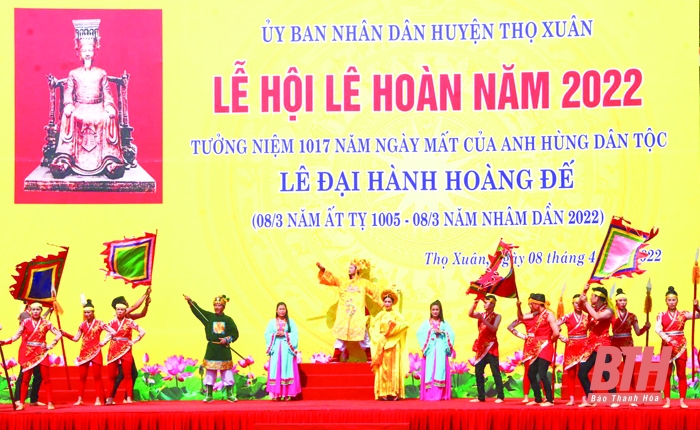
Military genius
The thousand-year history of our nation's founding and defense has proven a truth: whenever the homeland is in danger, a historical figure capable of shouldering the great mission of achieving independence and building a national foundation will inevitably emerge. Emperor Le Dai Hanh was such a historical figure. Le Hoan (941-1005) was born in Xuan Lap, Ai Chau (now Xuan Lap commune, Tho Xuan district). He came from a poor family and lost his parents early. A mandarin named Le took him in out of compassion. Le Hoan worked diligently and was diligently cared for and educated by the mandarin. Le Hoan was intelligent, quick to learn, ambitious, strong, and skilled in martial arts. At the age of 15 (956), he followed Dinh Lien, the eldest son of Dinh Bo Linh, in suppressing the rebellion of the Twelve Warlords. Thanks to his many achievements, he was trusted by Dinh Bo Linh and given command of 2,000 soldiers. With his talent, resourcefulness, and strategic thinking, and the trust placed in him by the soldiers, in 971, at the age of 30, he was appointed as the Commander-in-Chief of the Ten-Route Army under the Dinh Dynasty, giving him overall command of the ten armies in the country.
After suppressing the rebellion of the Twelve Warlords, the Dinh Dynasty had just begun to lay the foundation for nation-building when a great calamity suddenly struck. At the end of 979, King Dinh Tien Hoang and his eldest son, Dinh Lien, were assassinated by Do Thich. The court was forced to enthrone the six-year-old Dinh Toan as the successor to the Dinh Dynasty. General Le Hoan, the commander of the Ten Divisions, held regency. Seeing this, Dinh Tien Hoang's generals, Nguyen Bac, Dinh Dien, and Pham Hap, suspected that Le Hoan's power would be detrimental to the king. They raised an army, dividing their forces by land and sea to march towards the capital, Hoa Lu, in an attempt to overthrow Le Hoan, but were completely wiped out by him.
At that time, in the North, the Song Dynasty was in its prime. Upon hearing of the death of Emperor Dinh Tien Hoang, and with Dinh Toan succeeding at a young age, and with court officials fighting amongst themselves, the Song Dynasty seized the opportunity to invade Vietnam. Taking advantage of a petition from the Prefect of Ung Chau (present-day Nanning, Guangxi), Hou Renbao requested permission to attack Dai Co Viet. The Song Emperor appointed Hou Renbao as the Commissioner of Land and Water Transport in Giao Chau. Along with Sun Quanxing, Wang Suan, Chen Qinzu, Cui Liang, Liu Cheng, and Jia Shi, he led 30,000 troops from Jinghu (present-day Hunan and Hubei) by land and sea to invade Vietnam.
Faced with this urgent situation, Empress Dowager Dương Vân Nga and the generals unanimously agreed to enthrone Lê Hoàn as emperor. In 980, Emperor Lê Đại Hành ascended the throne, beginning the Early Lê Dynasty. Immediately after his coronation, the king quickly stabilized the court and prepared forces for the resistance against the Song Dynasty. On one hand, the king sent generals to lead troops in various directions to guard against the Song army; on the other hand, he sent messengers to the Song Dynasty, falsely claiming the letter was from Đinh Toàn requesting investiture, intending to delay the Song army. In March of the year Tân Tỵ (981), the Song army launched a massive invasion of our country. Hầu Nhân Bảo and Tôn Toàn Hưng led land troops to attack Lạng Sơn ; Trần Khâm Tộ attacked Tây Kết; Lưu Trừng led naval troops into the Bạch Đằng River. On the waterway, the king ordered stakes to be planted in the Bạch Đằng River, following the strategy of the former King Ngô. On the land route, he sent people to feign surrender to lure Hầu Nhân Bảo to Chi Lăng, where an ambush was set up and he was killed. The king commanded his troops to intercept Tran Kham To, inflicting a crushing defeat on his army, killing more than half of them. Their bodies littered the fields, and two enemy generals, Quach Quan Bien and Trieu Phung Huan, were captured alive. Thus, within just a few months, three large Song armies were routed by the king and his court of the Early Le Dynasty. Those fortunate enough to survive had to risk their lives to escape back across the border.
The resistance against the Song Dynasty was victorious, temporarily pacifying the northern border, but the southern border remained fraught with instability. Prior to this, in 979, Ngo Nhat Khanh (who had surrendered to Dinh Bo Linh but later fled to Champa and plotted revenge), along with the Champa king, led over 1,000 warships by sea to Dai An estuary, intending to capture Hoa Lu. A severe storm caused many ships to sink, and Ngo Nhat Khanh drowned. Although the Champa king survived, he harbored resentment and imprisoned two Le Dynasty envoys, Tu Muc and Ngo Tu Canh. After the successful resistance against the Song Dynasty, King Le Dai Hành personally led an expedition against Champa. The Champa king was killed in battle, and many fortresses were destroyed, thus securing the southern border.
It can be affirmed that when internal and external threats endanger the survival of the nation, the influential historical figure of the time, Le Hoan, was compelled to shoulder the mission of defending the country against invasion. Evaluating the king's campaigns against the Song and Champa, historian Ngo Si Lien commented: "The king was victorious wherever he fought, beheading the Champa king to avenge the humiliation of being a vassal and capturing the envoy, and shattering the Song army to thwart the king's sure-fire plan. He can be called the greatest hero of his time." Historian Le Van Huu added: "Le Dai Hanh killed Dinh Dien, captured Nguyen Bac, Quan Bien, and Phung Huan as easily as herding children or ordering slaves. In less than a few years, the country was pacified. His achievements in conquering the land were unmatched by even the Han and Tang dynasties!"
The person who laid the foundation for building a prosperous nation.
Besides his military talent, history also records much valuable information, helping future generations to learn more about King Le Dai Hanh's talents in economic development, culture, diplomacy , and more.
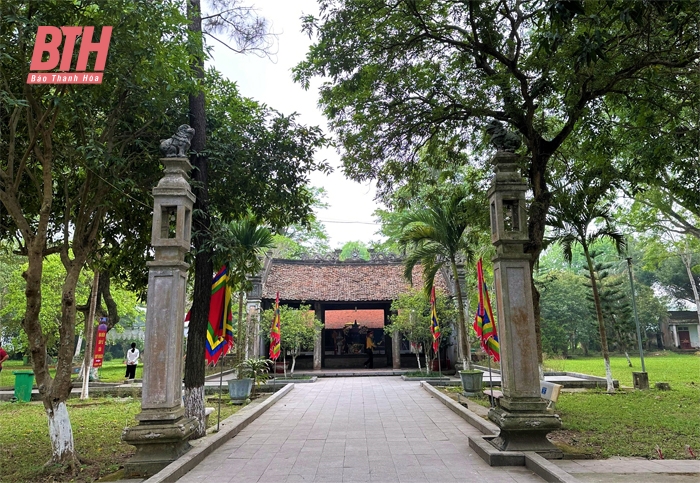
Immediately after the war against the Song Dynasty and the pacification of Champa, King Le Dai Hanh embarked on the task of revitalizing the country, laying the foundation for building a strong Dai Co Viet nation. Accordingly, the king reorganized the administrative apparatus from the local to the central level; changing the districts into prefectures, provinces, and counties, and appointing village chiefs and commanders in the basic units (today's villages and hamlets)... It is believed that, until then, King Le Dai Hanh was the first in history to show a conscious effort to concentrate power in the state apparatus from top to bottom, in both mountainous and lowland areas. Transportation and the economy under the Early Le Dynasty were also given attention. In particular, King Le Dai Hanh paid great attention to the development of agriculture. Old historical records state that in the spring of the 8th year of Dinh Hoi (987), "the king began plowing the fields at Doi Mountain, and found a small jar of gold, then plowed at Ban Hai Mountain, and found a small jar of silver, so he named it Kim Ngan field". With that action, Le Dai Hanh was the first king to initiate the plowing ceremony, aimed at encouraging agricultural production.
He was also the first king to order the digging of canals, connecting major rivers and creating a convenient waterway system, effectively supporting agricultural cultivation. Furthermore, handicrafts were encouraged; shipbuilding and bronze casting workshops were organized; and trade with neighboring countries was permitted. In addition, the king minted the Thien Phuc coin, the first coin in the history of our country. Taxation was also given attention... These are considered "evidence" showing the conscious effort to build a well-organized and sustainable state government under the Early Le Dynasty. In particular, the magnificent reconstruction of Hoa Lu Citadel truly laid the foundation for our country to enter a new era: the glorious Thang Long cultural period.
Furthermore, the diplomatic sphere under the reign of Le Dai Hanh also left many proud marks. It was characterized by independent and self-reliant diplomacy, employing policies that were both flexible and firm. After their defeat in 961, the Song Dynasty had to recognize Le Hoan as the ruler of Vietnam, essentially acknowledging the autonomy of Dai Co Viet. Numerous Song envoys visited to express their desire for friendly relations, always showing respect to the king. Although the king received the envoys openly, he always maintained a firm stance. For example, while acknowledging Vietnam as a small, distant country, he consistently showcased the military strength and the indomitable will of the Vietnamese people to the envoys. On one occasion, when a Song envoy demanded that the king kneel to receive the imperial decree, the king refused, citing a leg injury. To avoid the hassle and expense of receiving envoys, the king also suggested that the Song dynasty send envoys to the border to deliver a letter and inform the Hoa Lu court so that they could send someone to receive the Song emperor's decree. Notably, while emphasizing peaceful diplomatic relations, the king always maintained vigilance in the border region, ready to teach the invaders a lesson if necessary, thus deterring them from further aggression and encroachment.
It can be affirmed that the illustrious career of Emperor Le Dai Hanh, associated with the protection and construction of the nation, has left a brilliant mark on the history of the Vietnamese people. Even though more than a thousand years have passed since his death, many valuable lessons he left behind, from military strategy to consolidating power and developing the economy, culture, and society, have become the foundation for our nation to confidently move forward on its journey to realize its aspiration for prosperity.
Khoi Nguyen
This article uses some materials from the books "Concise History of Vietnam" (Hanoi Publishing House 2015); "Typical Kings, Emperors, and Meritorious Officials from Thanh Hoa in the History of the Nation" (Thanh Hoa Publishing House 2019); and "King Le Dai Hành and his hometown Trung Lap village" (Thanh Hoa Publishing House 2005).
Source


![[Photo] General Secretary and President To Lam presides over a working session with the Central Policy and Strategy Committee on the development of the materials industry.](https://vphoto.vietnam.vn/thumb/1200x675/vietnam/resource/IMAGE/2026/05/21/1779359935432_a3-bnd-3129-1412-jpg.webp)

























































Comment (0)