Once resonant amidst the stormy seas, echoing in prayers for favorable weather, the Ba Trao folk song is the voice of generations who have lived off the sea. However, in the whirlwind of modernity, this melody is gradually falling into oblivion, leaving a poignant void in the flow of Vietnamese culture.
Preserving the spirit of the sea in every song.
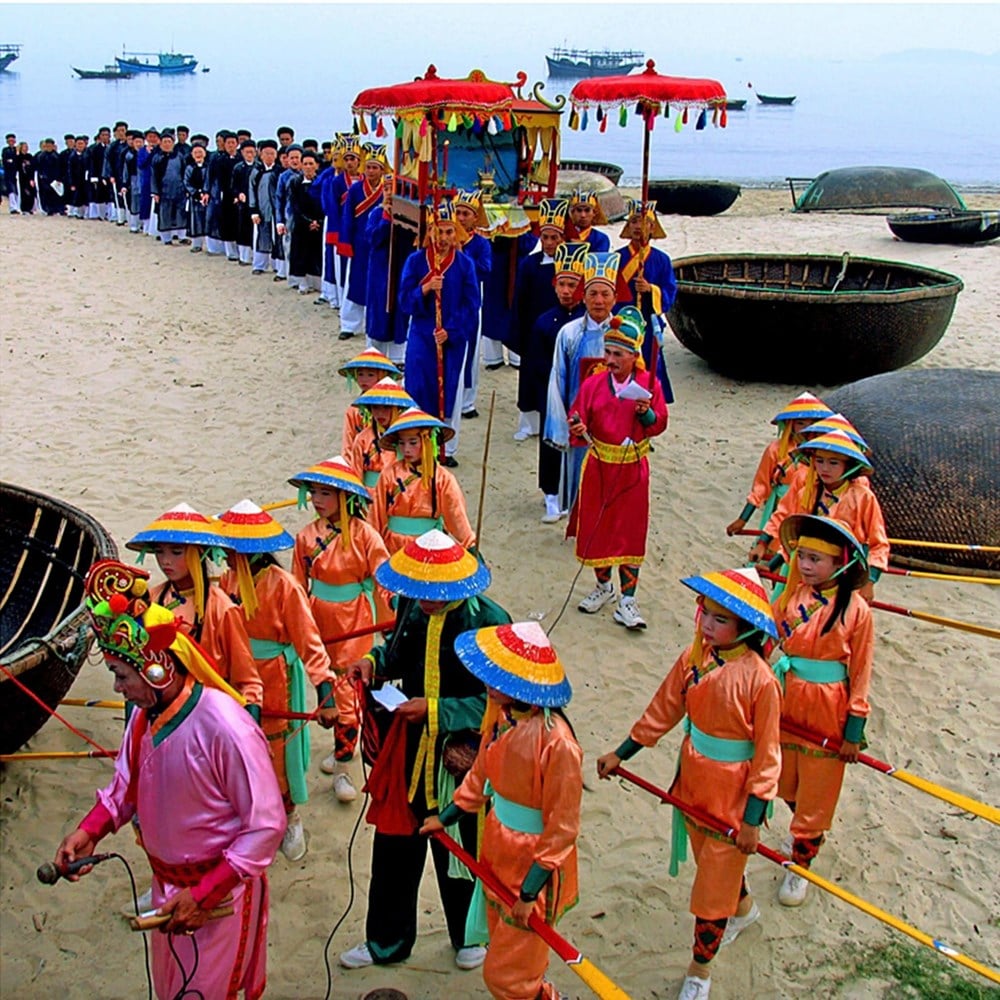
Every spring, amidst the lively drumming of the Fishing Festival, the melodies of the Ba Trao folk songs, once so vibrant, resonate, stirring the waves and stirring the water like a prayer for favorable weather and boats full of shrimp and fish. More than just a form of folk performance, Ba Trao singing is also a sacred ritual, expressing profound gratitude to the Whale God (Duc Ong) – the guardian deity who has saved fishermen from stormy seas. The absence of Ba Trao singing in the Fishing Festival is tantamount to losing a part of the sacred spirit of the sea.
Mimicking the image of a bamboo boat with a crew of 18-25 people, the "Ba Trao" performance vividly recreates the working life and beliefs of fishermen. The sound of oars splashing in the water, the drums, and the rhythmic singing in the roles of the bowman, sternman, and the "boatmen" cutting through the waves not only convey the spirit of the seafarers but also encapsulate the simple, sincere essence of life and the sea.
According to musician and researcher Tran Hong, "ba" means to grasp firmly, and "trao" means oar: "Gripping firmly on the oar amidst the storm" also means grasping firmly on hope and faith in life.
Recognized as a National Intangible Cultural Heritage since 2016, Ba Trao singing is gradually disappearing due to urbanization and changing lifestyles. In Da Nang, original Ba Trao singing troupes are dwindling, and many localities have to invite troupes from Hoi An to perform during the Fishing Festival. In Man Thai ward (Son Tra district), the Ba Trao singing troupe founded by Mr. Pham Van Du still exists, but it operates sporadically, lacking funding and support, only performing during the Fishing Festival or at funerals, where Ba Trao singing serves as a farewell to the deceased as they depart for the sacred sea realm.

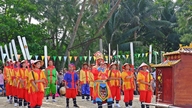
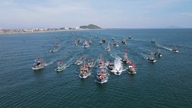
Unwilling to let the songs fade into oblivion, fisherman Cao Van Minh (Nai Hien Dong ward) has painstakingly collected, compiled, and revived the ancient lyrics, while also creating new scripts to suit contemporary life.
For him, the Ba Trao folk singing tradition needs to be preserved not only through personal dedication but also with the support of the government and the community. Only when there are people to keep the flame alive, people to pass it on, and people to embrace it, can this song that stirs the waves continue to live on – like the breath of the ocean in the heart of Vietnam.
Longing to rediscover the song sung at sea.
On the calm, windless sandy shores of Man Thai fishing village, 92-year-old Mr. Phung Phu Phong often gazes out to sea, where the melodies of Ba Trao folk songs once echoed amidst the bustling Fishing Festival. For him, Ba Trao is not simply a folk performing art, but the very essence, the memory, and the soul of the seafaring people for generations.
At fifteen, he simultaneously learned seafaring and singing, from rowing practice sessions with the elders to becoming the "General Driller"—one of the three core positions in the traditional Ba Trao singing troupe. Now, he is the only one left of the old troupe, living and cherishing those songs. "I'm looking for a successor, but it's very difficult. Young people these days are busy making a living; few have the patience for Ba Trao," Mr. Phong mused.
Sharing the same concern, Mr. Huynh Van Muoi, a veteran fisherman deeply connected to traditional arts, said: "A few decades ago, Man Thai village never lacked the sounds of Ba Trao, Tuong, or Ho Khoan singing. These were the soul of the sea festivals."
According to Mr. Mười, every year on the 23rd day of the 7th lunar month, the anniversary of the death of the Fisherman, the village gathers in large numbers, joining together to sing the beloved Bả Trạo melodies, brimming with human and sea-related sentiments. With the remaining documents in both Han-Nom and Quoc Ngu scripts, and a promising group of young opera singers, the opportunity to preserve Bả Trạo is entirely feasible if the right investment is made.
However, in reality, this form of performance is still facing the risk of extinction. This is because Ba Trao singing is deeply ritualistic, not mainstream, and requires practitioners to have a long-term commitment and a profound understanding of both the art and the beliefs.
The Fishing Festival has gradually shrunk in scale and no longer holds the same economic appeal as before. The younger generation – preoccupied with making a living and modern lifestyles – is increasingly distancing themselves from the rigorous training and the responsibility of passing on the craft. Preserving the traditional fishing ritual requires more than just funding; it also demands the dedication of the instructors, the enthusiasm of the learners, and the coordinated efforts of the government, the community, and the cultural sector.
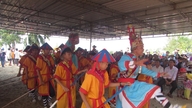
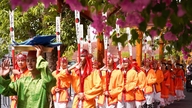
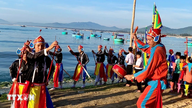
In this context, a glimmer of hope emerged from Nai Hien Dong ward (Son Tra district), where the ward's People's Committee established the Ba Trao Singing Club with 17 members, led by artisan Nguyen Van Thuc. The club was created not only to serve the Fishing Festival, funerals, and traditional ceremonies, but also to develop performances into unique tourism products embodying the spirit of the sea.
The ward is also actively seeking support for costumes and props, and inviting event organizers and travel agencies to join hands in promoting the art of Ba Trao singing - as a precious and enduring spiritual nourishment in the heart of the coastal city of Da Nang.
Preserving the Ba Trao song means preserving the voice of the sea, of a culture deeply etched in every wave. And when that song rises again, echoing across the vast ocean, it is also the moment we hold onto a part of Vietnamese cultural soul amidst the whirlwind of the times.
Source: https://baovanhoa.vn/van-hoa/loi-bien-xua-con-vong-145143.html
![[Photo] General Secretary and President To Lam receives Palestinian Ambassador Saadi Salama](https://vphoto.vietnam.vn/thumb/1200x675/vietnam/resource/IMAGE/2026/06/25/1782365384740_a1-bnd-9423-8322-jpg.webp)



![[Image] Schools organize meetings and introduce teaching models to students admitted to grade 10.](https://vphoto.vietnam.vn/thumb/1200x675/vietnam/resource/IMAGE/2026/06/25/1782368077271_ndo_br_z7970052192242-1ec8daeb77a6eed1a4e9f58c564ddd3e-jpg.webp)
![[Image] Ho Chi Minh City: Ma Lang area, Chicken-Rice Market about to change its appearance](https://vphoto.vietnam.vn/thumb/1200x675/vietnam/resource/IMAGE/2026/06/25/1782377698627_ndo_br_m1-jpg.webp)