

Without offering detailed comments on Wagner's rebellion, the Biden administration chose a cautious approach to avoid getting into trouble with Russia.
On the surface, Wagner's rebellion in Russia would benefit Ukraine and its Western allies, including the U.S., as it occurred at a time when Kyiv was pushing forward with its long-awaited counteroffensive. However, the U.S. reacted very cautiously to the event.
During and after the uprising, U.S. officials consistently stated that Washington had no role in the events, asserting that it was an internal Russian matter and refusing to comment on whether it influenced the conflict in Ukraine. President Joe Biden also adopted a similarly cautious stance.
On June 26, Mr. Biden told reporters that the U.S. and NATO were not involved in the rebellion in Russia. The U.S. president said he had spoken online with allies over the weekend and they all agreed that they must not make statements or take actions that could give Russia "an excuse to blame the West."
President Biden and U.S. administration officials also declined to comment on how Wagner's rebellion might impact the conflict in Ukraine, its leader Yevgeny Prigozhin, or Russia itself.
"It's still too early to conclude where these things are going to lead," President Biden said.
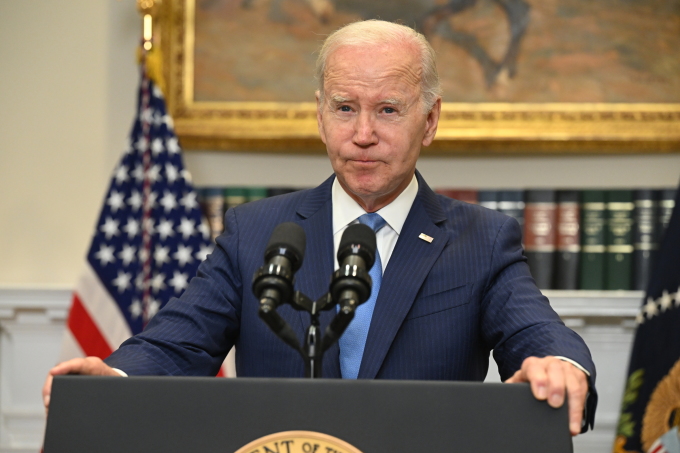
US President Joe Biden speaks at the White House on May 17. Photo: AFP
In his first public comments on the events of the past weekend, President Vladimir Putin said that "the enemies of Russia" hoped the rebellion could divide and weaken Russia, but they were mistaken. He identified these "enemies" as "neo-fascist elements in Kyiv, Western patrons, and many other traitors."
Foreign Minister Sergei Lavrov stated that Russia is investigating whether Western intelligence agencies were involved in Prigozhin's rebellion.
On June 24, as Wagner troopers advanced toward Moscow, U.S. diplomats contacted their Russian counterparts to emphasize that Washington viewed this as an internal matter for Moscow, according to State Department spokesman Matthew Miller.
Michael McFaul, former US ambassador to Russia, said President Putin has repeatedly accused the US of secretly interfering in many turbulent events around the world , including protest movements in former Soviet republics. Now, the US and NATO "don't want to be blamed for any attempts to destabilize" Russia, McFaul said.
Tensions between Wagner leader Yevgeny Prigozhin and Russian Defense Ministry leaders escalated throughout the Ukraine conflict, sparking the June 24 rebellion. Prigozhin deployed thousands of fighters from the Ukrainian battlefield into Rostov province, taking control of the Southern Military District headquarters in Rostov-on-Don. Another Wagner force advanced toward Moscow, while Prigozhin demanded the removal of Defense Minister Sergey Shoigu, a demand rejected by the Kremlin.
The U.S. national security advisory team provided President Biden with continuous updates as Wagner Group troops advanced toward Moscow. President Biden said he instructed them to "prepare for a range of scenarios" as the rebellion unfolded.
Biden did not elaborate on these scenarios, but White House National Security Council spokesman John Kirby mentioned concerns about warnings from Russia. Putin and his subordinates have repeatedly mentioned nuclear weapons since launching the Ukraine campaign 16 months ago, aimed at deterring NATO countries from increasing support for Kyiv.
The US President spoke with his Ukrainian counterpart Volodymyr Zelensky last weekend, reaffirming his commitment to supporting Kyiv. "Whatever happens in Russia, the United States will continue to support Ukraine in defending its sovereignty and territorial integrity," Biden declared.
On June 27, the Pentagon announced a new aid package worth $500 million for Ukraine, which includes armored vehicles and ammunition for HIMARS multiple rocket launchers.
U.S. officials earlier this week exercised extreme caution to avoid being perceived as supportive of Putin or Wagner in their public comments. "We believe that the Russian people are the ones who will decide who their leader is," Kirby said.

Wagner's 24 Hours of Rebellion. Video: Nhu Tam - Nam Do - Huyen Vu
The Washington Post reported on June 24 that U.S. intelligence had obtained information two weeks prior indicating that militant leader Wagner was planning armed action in Russia. At the time, U.S. intelligence did not fully understand the nature and exact timing of Wagner's plan to act against the Russian military, but they had sufficient grounds to report to U.S. leaders that "something was about to happen," according to an unnamed official.
However, the Biden administration has chosen not to comment on these reports this time, in contrast to its warnings about Russia's plans to send troops into Ukraine earlier last year. The U.S. has chosen to stay out of it, as Biden stated on June 26.
"We have to ensure that Russia has no reason to blame the West or NATO. We have made it clear that we are not involved in and have done nothing with that rebellion," he said.
Thanh Tam (According to AP )
Source link









































































Comment (0)