

I felt as if I had wandered into a fairytale world amidst the breathtaking green tea hills, undulating in a spiral pattern, in Huong Son (Ha Tinh).
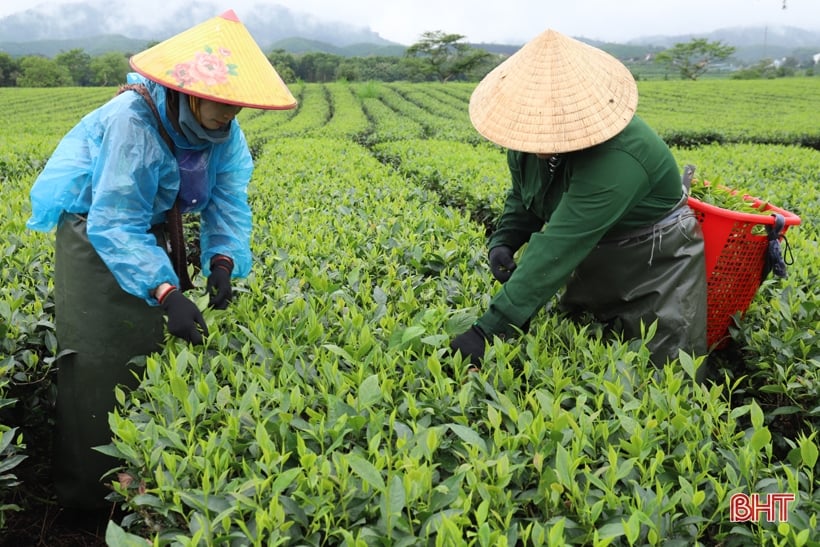
Huong Son tea plants are now being grown extensively in many communes, covering more than 90 hectares.
In early winter, a gentle, dry breeze sweeping across the tea fields brought me back to old memories.
Recalling the pioneering days of September 11, 1959, when young men and women from various rural areas came here to settle, it has been 64 years since then. Their images are etched into the trees and leaves, imprinted by the passage of time. The Tay Son tea plants have not disappointed those who cleared the land and sowed the first seeds. During the subsidy period, the Tay Son Tea Plantation (Son Kim 2 commune, Huong Son district) operated on a small scale. Although it had abundant human resources, it lacked machinery for reclaiming barren land and processing raw materials after harvesting. During the war, despite bombs and bullets, the workers still toiled on the tea hills twice a day. After the country was unified, the national economy faced difficulties, resulting in a small area of cultivated land, low yields, and low tea quality.
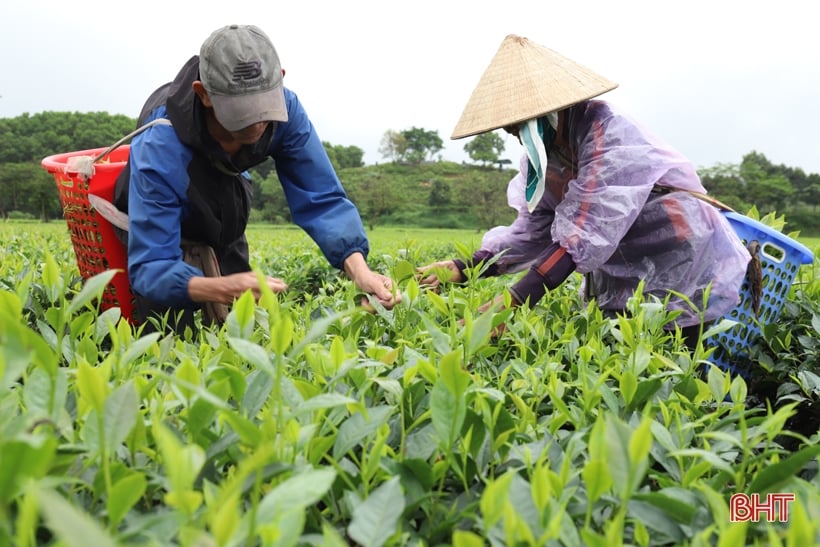
The Tay Son Tea Plantation's pilot project of "contracting out orchard management" is a "breakthrough" in developing human capabilities and land potential.
In 1986, Tay Son Tea Plantation implemented a self-management mechanism, contracting out the final product to workers, and the output of fresh tea leaves gradually increased according to the production curve. The output of fresh tea leaves harvested in 1987 reached 712 tons, an increase of over 200 tons compared to 1975. However, during the period of 1990-1992, a lack of capital, supplies, and high-tech processing machinery and equipment, coupled with an unstable market and fluctuating prices, caused tea production to plummet to 210 tons, making sales very difficult. Many families considered demolishing their tea plantations to plant other crops instead.
In response to this situation, Tay Son Tea Plantation implemented a pilot program of "plantation contracting," which was essentially "selling the tea plantations," empowering workers with autonomy. This was a "breakthrough" in developing human capabilities and land potential.
A new opportunity arose in 1992 when the State opened up economic development in the hilly areas with Decision 327-CT of the Chairman of the Council of Ministers on a number of policies and guidelines for the use of barren land and hills. On the other hand, the State boldly reformed existing tea production and trading enterprises, streamlining the organizational structure and management methods. At this time, the Tay Son Tea Plantation was renamed the Tay Son Tea Enterprise. All production and business activities were under the management of the Ha Tinh Tea Investment and Development Company. Tea prices were adjusted, and the company guaranteed the purchase of the product, creating a boost for families to confidently engage in production. From 1997 to 2002, the unit planted nearly 48 hectares of tea, produced 2,433 tons of fresh tea leaves, and processed more than 446 tons of finished tea products.
After equitization, to ensure accountability in production and business, the Ha Tinh Tea Investment and Development Company developed raw material areas, innovated technology, and sought markets. The Tay Son Tea Enterprise focused on tea cultivation and modernized machinery and equipment to improve product quality.
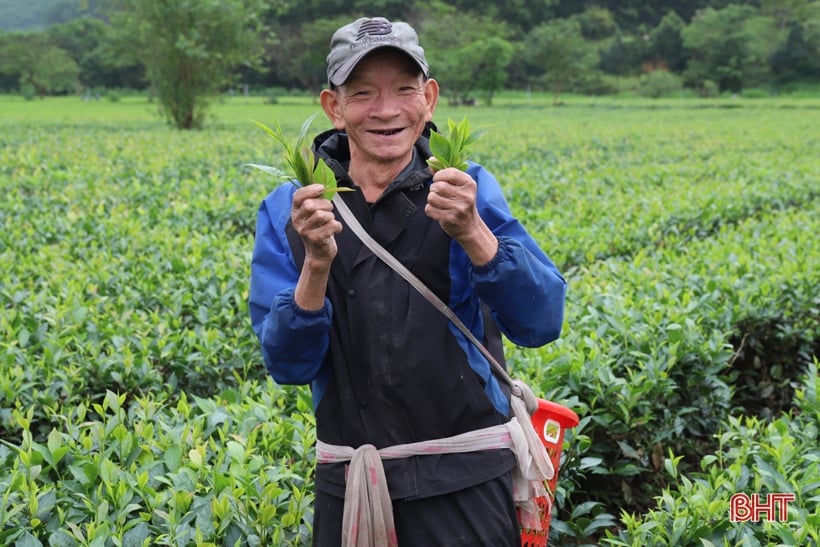
The joy of the tea growers in Huong Son.
During this field trip, I had the opportunity to meet Mr. Nguyen Hong Sanh, Director of Tay Son Tea Enterprise. Mr. Sanh affirmed: “The Tay Son tea plant has achieved its current position in the market thanks to a historical process, through the transfer of many generations. This upward movement is due to the unit's skillful application of policies and mechanisms in practice. Especially during the 10 years of reform (2010-2019), the unit collaborated with farmers in the communes of Son Kim, Son Tay, and Son Lam to expand the raw material area. Thanks to this collaboration, the tea planting area expanded by more than 90 hectares – a record number.” Of course, when the tea planting area was “connected,” the production and income of tea growers also increased. From that “milestone,” Tay Son Tea Enterprise focused on investing in intensive farming, improving production and quality in the direction of safe tea production. Producing safe tea according to VietGAP standards, and moving towards achieving international standards (RA), aims to ensure sustainable tea production.
Enthralled by the story of innovation in organization, high-tech processing, and attractive packaging, I asked Mr. Sánh:
- During the two years when the whole world faced the COVID-19 pandemic, many businesses encountered considerable difficulties in production and business. So, how are your company's tea products doing?
Mr. Sanh happily replied:
- Although the product price has decreased from 70,000 VND/kg to 65,000 VND/kg, the unit still exports more than 1,000 tons of dried tea buds each year. In 2023, the price was adjusted higher than before, and the enterprise is striving to export 1,400 tons of dried tea buds. This is a great effort by the Vietnam Tea Corporation. We are very grateful for the proactive approach of our superiors.
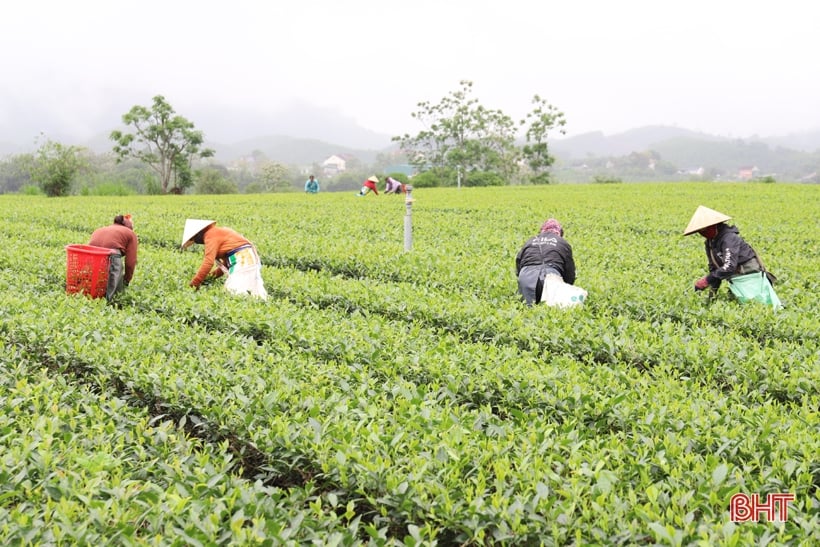
With the workers' confidence, the Tay Son tea fields will remain green for years to come.
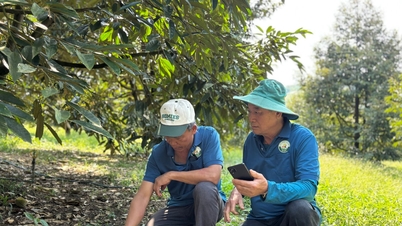
A technical officer from the unit led me and my colleagues to visit the three most successful tea producers in Tay Son tea village: Mr. Pham Dinh Huong (Ha Vang hamlet), Mr. Phan Dinh Nham (Lang Che hamlet), and Ms. Nguyen Thi Thuy (Tien Phong hamlet). These families each cultivate 0.8-1 hectare, yielding 60-70 quintals per harvest and generating revenue of 450-500 million VND.
Every household I visited saw couples diligently working in their large tea plantations. One was pruning buds, the other weeding; the work was continuous, with hands and feet moving non-stop. I lingered for quite a while in Mrs. Thuy's family tea plantation and asked:
- What motivated your family to take on a 1-hectare land lease and achieve such a high yield?
Mrs. Thuy smiled and said:
"It's the same everywhere, Uncle! To survive and thrive, you have to rely on the collective. The biggest motivation that gives me peace of mind is that both the input and output of our products are supported by the Tay Son Tea Factory. My family only focuses on production and care, while the seeds, fertilizers, pesticides, etc., are supplied promptly by the factory. The products we produce are collected and processed by the factory. I've never seen green tea farming so favorable as it is now."
I believe that once the workers have faith, the Tay Son tea fields will remain green for years to come.
October 2023
Phan The Cai
Source

![[Photo] The heat at the fireworks display site on the opening night of the Da Nang International Fireworks Festival 2026](https://vphoto.vietnam.vn/thumb/1200x675/vietnam/resource/IMAGE/2026/05/27/1779889741485_ndo_br_z7872039145157-fecaba5112f39e8352544099d7ef4738-5140-jpg.webp)

![[Photo] The courage of new recruits of Brigade 144 on the training ground.](https://vphoto.vietnam.vn/thumb/1200x675/vietnam/resource/IMAGE/2026/05/27/1779881651341_anh-man-hinh-2026-05-27-luc-18-32-52.png)




































![[Photo] The courage of new recruits of Brigade 144 on the training ground.](https://vphoto.vietnam.vn/thumb/402x226/vietnam/resource/IMAGE/2026/05/27/1779881651341_anh-man-hinh-2026-05-27-luc-18-32-52.png)




















Comment (0)