

 |
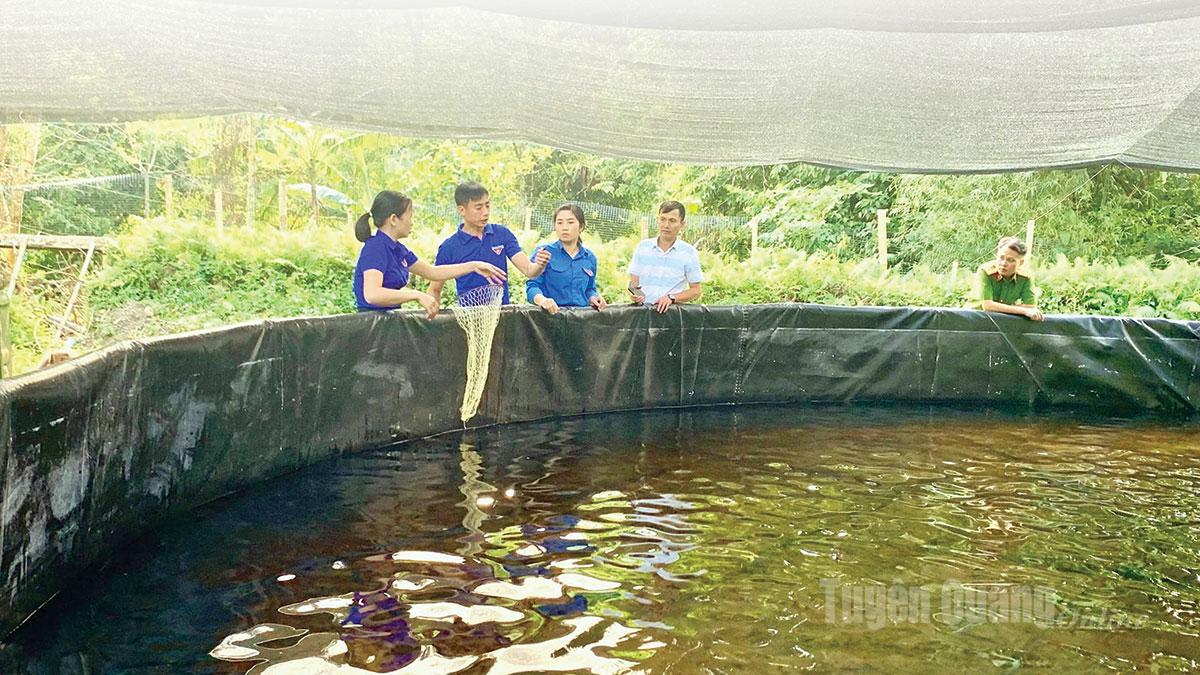
| The sturgeon farming model of Luong Van Huu, the Youth Union Secretary of the village, is a prime example for young people to learn about economic development. |
Inner strength to overcome difficulties
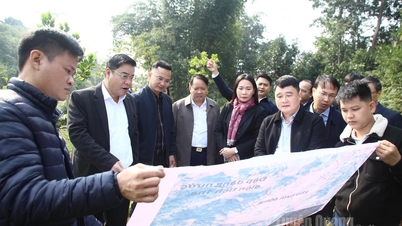
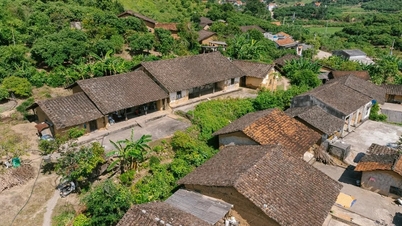
Party branch secretary Ly Tien Thang warmly welcomed the reporters, saying that the village currently has 76 households, mainly Dao and Tay people. Although life in the village is still difficult, in recent years, thanks to the attention of various levels of government and the villagers' efforts to improve their lives, the people's income has steadily increased, and only 13 households remain poor. Thang was moved, saying that his hometown of Cao Binh has changed significantly; there is electricity, roads, and schools for the children, so the villagers are very happy.
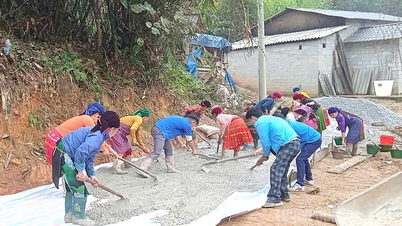
Recognizing that building new rural areas is a "golden opportunity" for Cao Binh to make a breakthrough, starting from the Party branch's resolution, the village began to implement, publicize, and mobilize the people to contribute money and labor to pave the roads. In two years (2021 - 2022), the villagers contributed hundreds of millions of dong and donated tens of thousands of square meters of garden and rice field land to concrete 3.5 km of roads in the village.
The entire village currently has over 25 hectares of peanuts. The peanuts in Cao Binh are spring peanuts, so they are harvested out of season, meaning the selling price is always higher than in many other peanut growing areas in the province. In the last peanut crop, Mr. Luong Van Phuong's family planted 3,500 square meters, selling them at 14,000 VND/kg, earning nearly 30 million VND. Traders prefer Cao Binh peanuts, spreading the word about the sweet, nutty flavor and firm kernels of this variety.
Cao Binh is also famous for its black pig farming movement. The village has millionaire pig farmers like Dang Phuc Vinh and Ly Tien Men, who earn hundreds of millions of dong each year.
According to Party Secretary Ly Tien Thang, Cao Binh has a total natural area of nearly 200 hectares, including more than 25 hectares of rice paddies, with the remainder being hilly orchards and forests. However, due to unfavorable water resources, Cao Binh can only cultivate one rice crop per year, planting peanuts in the spring when the fields lack water, and rice in the autumn. In 2014, the former Hung My commune government collaborated with Son Duong Sugar Company to introduce sugarcane to Cao Binh. Initially, only 30 households experimented with planting on more than ten hectares. The first crop was successful, and seeing that sugarcane cultivation was many times more profitable than cassava cultivation, the villagers gradually switched to sugarcane. To date, the village has more than 50 households growing sugarcane with a total area of over 25 hectares. On average, the village harvests nearly 2,000 tons of raw sugarcane per year. In the village, some households cultivate large areas of sugarcane, such as the family of Ms. Luong Thi Hanh with over 1.2 hectares, Mr. Hua Van Chatt with 1.1 hectares, and Mr. Luong Van San with over 1 hectare.
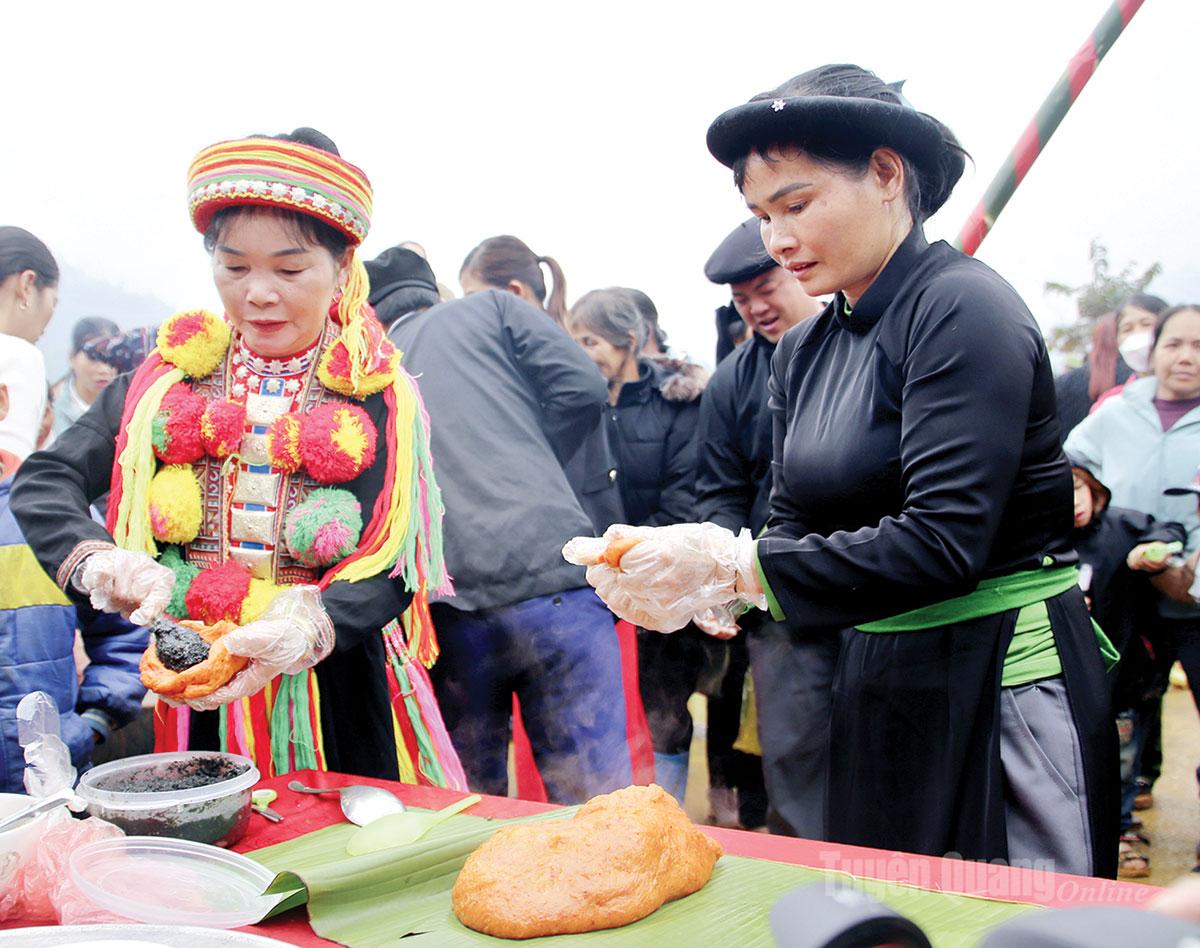 |
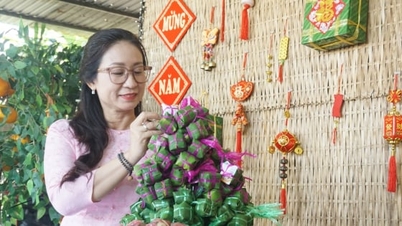
| The people of Cao Binh still maintain the traditional custom of making sticky rice cakes. |
Potential for experiential tourism
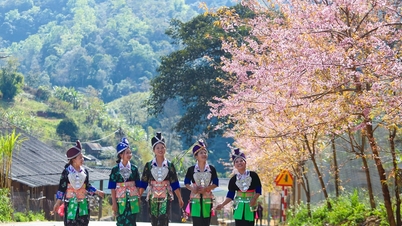
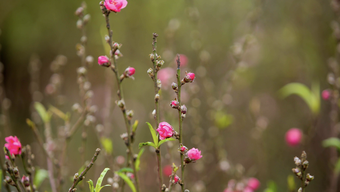
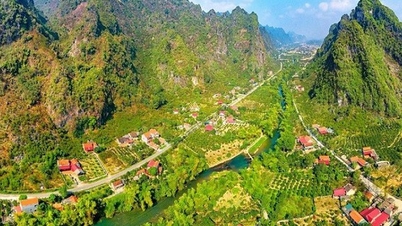
According to Tran Trung Hoang, Secretary of Tan My commune, Cao Binh is likened to a miniature Sapa amidst the vast forest, with its hills of purple rhododendrons, ancient peach blossoms, and beautiful caves. With its advantage of pristine and majestic natural mountain and forest landscapes, the local Party committee and government are gradually creating conditions for households in the village to develop ecotourism and community tourism.
Cao Binh is blessed with many natural advantages, such as a cool climate, pristine and majestic forests and mountains, and especially beautiful caves, among which Nam Bun Cave is particularly noteworthy. The cave is approximately 500 meters deep, divided into three levels, and was recognized as a provincial-level scenic spot in late 2023. Inside the cave, there is a year-round flowing water system, resulting in many incredibly beautiful stalactites and stalagmites... attracting tourists to explore and experience it.
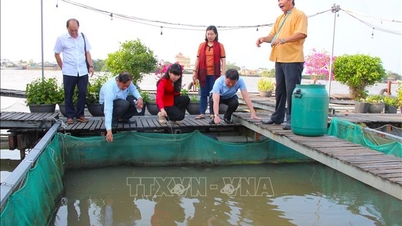
In Cao Binh, there is currently a successful sturgeon farming model generating high income. The owner, Mr. Luong Van Huu, is quite simple and approachable. Mr. Huu recounts that, driven by a passion for economic development and recognizing the area's cold climate suitable for raising the specialty sturgeon, he boldly joined nine other households in the village to invest in two ponds with an initial stock of 5,000 sturgeon fingerlings. Currently, the model is successful; if each fish reaches a weight of approximately 2 kg, the revenue could reach several hundred million dong. The sturgeon farming model has also become a tourist attraction.
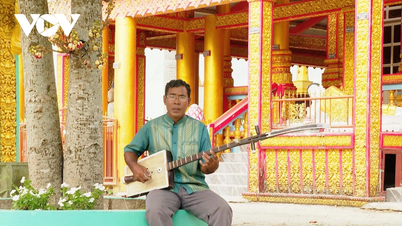
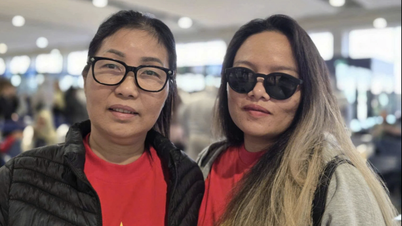
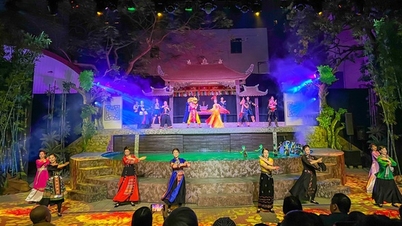
To capitalize on the potential and strengths of tourism development, many households in Cao Binh have proactively planted and developed over 2 hectares of myrtle trees. In addition, the village has encouraged residents to preserve their traditional ethnic cultural identity. To date, the village has established a Then singing and Tinh lute playing club and organized a training course to guide the organization and operation of the village's performing arts group. Ms. Tong Thi Lan Anh from Nam Dinh ward, Ninh Binh province, along with some friends, was quite surprised by the unspoiled beauty of Cao Binh. She shared that Cao Binh is quite beautiful and the people are open and approachable. She was most impressed by the opportunity to enjoy the sticky rice cake of the Tay people there.
Cao Binh today is different from the past; paved and concrete roads pave the way for new aspirations. But according to Party Secretary Ly Tien Thang, the road ahead is still wide open. He hopes the village will continue to receive attention and investment, so that it can boldly introduce the production of endemic, high-economic-value crops, creating a unique mark for this mountainous region. Because amidst this favorable natural environment and cool climate, with a breakthrough direction, Cao Binh could not only be a place with "enough to eat and live," but could also become a bright spot for economic and tourism development in Tan My commune, where every transformation is rooted in the people's inner strength and belief in a better future.
Notes by: Le Duy
Source: https://baotuyenquang.com.vn/van-hoa/du-lich/202511/moc-mac-cao-binh-0af05d5/


![[Photo] Delegates attending the opening session of the 14th National Congress of the Party](/_next/image?url=https%3A%2F%2Fvphoto.vietnam.vn%2Fthumb%2F1200x675%2Fvietnam%2Fresource%2FIMAGE%2F2026%2F01%2F20%2F1768881998853_ndo_br_1-jpg.webp&w=3840&q=75)





























![[Image] Ho Chi Minh City simultaneously commences construction and breaks ground on 4 key projects.](https://vphoto.vietnam.vn/thumb/1200x675/vietnam/resource/IMAGE/2026/01/15/1768472922847_image.jpeg)






















Comment (0)