


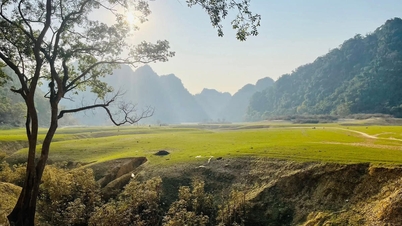
When I was a child, I saw my village surrounded by vast, open fields stretching as far as the eye could see. The square plots of land were separated by lush green embankments. Whenever I think of the fields, I often remember the image of my grandfather – a true farmer, who loved his land like his own flesh and blood. Even on bitterly cold winter days, with winds blowing from all directions, he would diligently and decisively plow the dry, hard soil, turning over each clod of earth, then quietly and painstakingly prepare the land for the next season's harvest. He often said, "A clod of dry earth is worth a basket of fertilizer," meaning that when the land is prepared, the fields can rest after seasons of hard work. The first thing a farmer must do is respect the land. If you are close and sincere with it, it will repay you with a bountiful harvest.
Later, when machinery replaced manual tilling, no one was seen diligently drying the soil, but plowing and turning the land remained a priority for the farmers to clear away remnants and disease germs from the fields, making the soil loose and airy. In preparation for plowing, without being told, some would clear the weeds from the embankments, while others would hoe the corners – turning over the remaining areas of the field that the machinery couldn't reach. During the plowing season, the pumping stations would operate, filling the ditches and canals to the brim. The newly channeled water would seep into the fields, penetrating every nook and cranny, and soon the entire field would be submerged. The water seemed to stir, awakening dormant life. Wherever the water went, the soil embraced it completely.
My family owned a rice field on high ground, where water couldn't be channeled into the field by itself. Every afternoon, I would go to the field with my parents to bail water using a rope-operated bucket. My parents each held two ropes, scooping up water and pouring it into the field, each bucket scooping rhythmically and steadily. Bailing water seemed simple, but it was actually quite difficult. When bailing water from the edge of the field, the person bailing had to stand with one foot in front of the other. Bending down to lower the rope, the bucket would be filled with water, and when pulling it up, they had to lean slightly backward so that the bucket's opening wouldn't hit the edge of the field. Although my parents had taught me and I had observed them doing it, I was still clumsy and awkward when holding the rope. Sometimes I would want to rush forward with the bucket, other times I would miss the rhythm and the bucket wouldn't fill with water.
During the planting season, we children were excited to explore the waterlogged rice paddies. Just yesterday, the fields were dry and cracked, seemingly lifeless, but today, the water arrived, bringing with it a rich world that urged us to explore, to dip our feet into the still-hard soil to wash over the gradually encroaching cold water. We often used leaves and banana flower stalks to make boats, floating them down the river, competing to see whose boat floated the fastest... The new water brought so much joy, making the fields more lively. For the adults, the arrival of water marked the beginning of a new planting season. The sound of tilling machines rumbled all day. The rice seedlings were sprouting green shoots, preparing to return and merge with the fields. The gentle chill still lingered in our voices, but our hearts were already filled with joy and hope for a bountiful harvest.
We grew up nourished by the fragrant rice of our homeland. Though far from home, we never forget the smell of mud and soil in the fields, the sweet scent of straw, so that sometimes we hum the song "Bringing food to mother working in the fields," our hearts yearning for those bygone memories.
Source: https://baohungyen.vn/mua-do-ai-3191331.html































![[Infographic] Vietnam's Economic Situation Report, Q1 2026: Strong Growth Momentum](https://vphoto.vietnam.vn/thumb/402x226/vietnam/resource/IMAGE/2026/04/04/1775298512042_tang-truong-kinh-te-viet-nam.jpeg)
![[Image] Close-up view of the 10-lane road connecting to Long Thanh Airport](https://vphoto.vietnam.vn/thumb/402x226/vietnam/resource/IMAGE/2026/04/04/1775291871988_ndo_br_1-resize-5690-jpg.webp)














Comment (0)