

The invasive nutria, native to South America, is devastating swamps, farmlands, and golf courses across the United States.
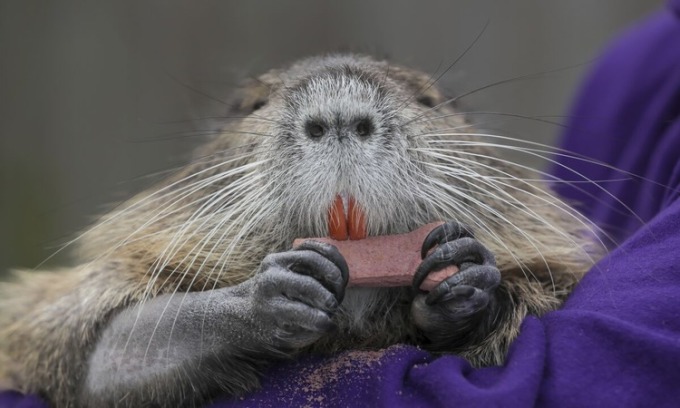
The invasive beaver rat population in the US. Photo: AP
Giant rats with orange teeth are spreading across the U.S. coast, destroying almond trees, golf courses, and bridges, the Wall Street Journal reported on April 11. The beaver rat, a semi-aquatic mammal native to South America, was introduced to the U.S. in the late 19th century for the fur trade. Once freed from captivity, these rats, which can weigh over 9 kg and reproduce year-round, have become very difficult to eradicate.
In Texas, the nutria is among the most hunted animals. In Oregon, hunting occurs year-round. California hopes this invasive species will begin to die out. State and federal authorities in Maryland have spent more than two decades and $30 million eradicating nutria and are prepared to assist other states.
Trevor Michaels, a wildlife biologist at the U.S. Department of Agriculture , heads the rat eradication project. His team hunts invasive rats across more than 202,000 hectares of land and wetlands using a technique called "thunderclap," in which they use nets to trap and eliminate beavers before moving on to the next area. In 2015, after catching 14,000 rats, authorities in Maryland killed the last one.
California is also adopting some of Maryland's measures, using sniffer dogs in Chesapeake Bay to search for beavers in the Sacramento-San Joaquin River Delta. Authorities are also improving on Maryland's tactics, setting traps to catch a few individuals and attaching radio-controlled collars to guide them to other beavers. "Beavers don't have necks, so attaching collars to them is extremely challenging," said Valerie Cook, manager of California's beaver eradication program. Instead, California plans to use satellite tracking tags that can be remotely monitored.
The Illinois Department of Natural Resources is working with the Wildlife Agency to survey the beaver population. They removed more than 1,500 beavers in 2022.
Louisiana is seeking to eradicate 400,000 beavers annually. The state's swamps are so overpopulated that authorities are paying $6 for each beaver tail during hunting season. Louisiana has spent $30.2 million in bounties on 6.1 beavers caught since the start of its Coastwide Nutria Control program in 2002. Beavers can eat a quarter of their body weight a day. Their voracious appetites have devastated thousands of hectares of land in Louisiana, turning some swamps into waterlogged ponds.
Louisiana provided funding in the late 1990s to research the nutritional value of beaver meat and market it as a food source for humans, but without success. However, some chefs and restaurants are now showing interest in dishes made from beaver meat, which tastes similar to wild rabbit.
An Khang (According to Wall Street Journal )
Source link


































































































Comment (0)