

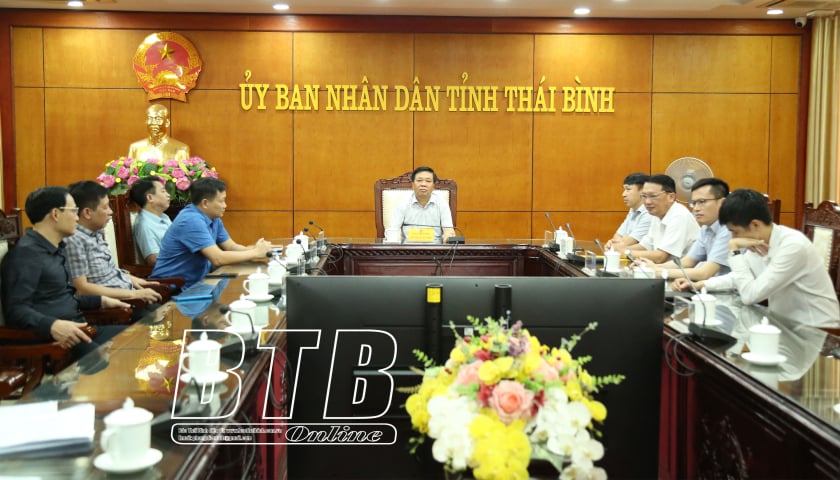
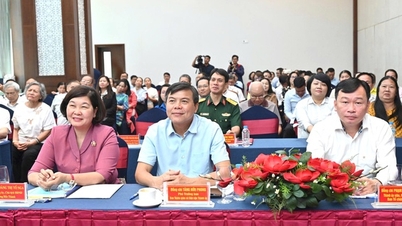
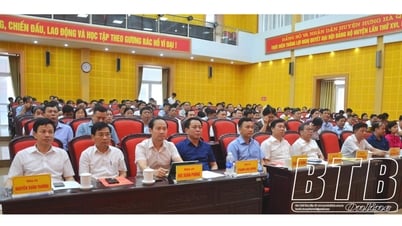
Comrade Nguyen Quang Hung, Member of the Standing Committee of the Provincial Party Committee and Permanent Vice Chairman of the Provincial People's Committee, attended the conference at the Thai Binh branch.
After three years of implementing Resolution No. 18-NQ/TW, land resources have been exploited and used more effectively for socio- economic development, ensuring national defense, security, and environmental protection; contributing to solving social problems and creating greater equality among land users; and initially overcoming the situation of arbitrary and widespread land allocation and leasing. The issue of residential and production land for ethnic minorities has received attention. The interests of all stakeholders involved in compensation, support, resettlement, and land acquisition, as well as the lives and livelihoods of those whose land is acquired, have been better considered and ensured. The rights and obligations of organizations, households, and individuals using land have been guaranteed and promoted, especially in the use of agricultural land. Preferential tax policies have significantly contributed to attracting investment, particularly in remote areas and economically and socially disadvantaged regions. Land policies regarding social housing have achieved some important results. Land price frameworks and land price tables are developed according to regulations, taking into account prevailing market land prices.
The implementation of the 2024 Land Law has brought many positive impacts, creating a clearer legal basis, minimizing overlaps and inadequacies in land management; resolving and addressing difficulties and obstacles in practice and the requirements of the development process; enhancing the efficiency of land resource use and management; better protecting the rights of the people; strengthening responsibility, transparency in land access, reducing corruption and negative practices; and promoting and strengthening administrative procedure reform, reducing procedures, intermediate steps, and costs... thereby increasing the trust of people and investors in the state's land management system.
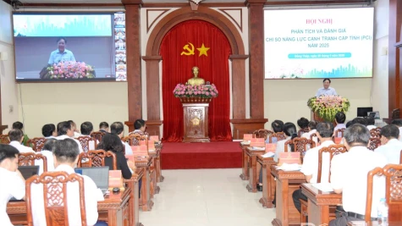
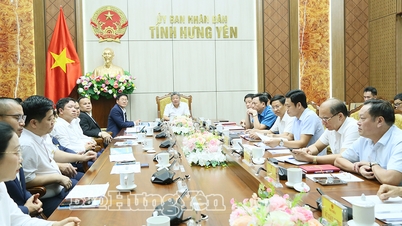
At the conference, representatives from ministries, sectors, and localities discussed and pointed out existing shortcomings and limitations, and proposed solutions to better implement Resolution No. 18-NQ/TW and the 2024 Land Law.
In his concluding remarks, Deputy Prime Minister Tran Hong Ha highly appreciated the efforts of ministries, sectors, and localities in implementing Resolution No. 18-NQ/TW and the 2024 Land Law; and emphasized that land management and use must be placed within the overall context of sustainable, equitable, and efficient socio-economic development, ensuring a harmonious balance of interests among the State, people, and businesses. He requested relevant ministries and sectors to continue reviewing legal documents guiding the implementation of the 2024 Land Law, ensuring consistency, uniformity, clarity, ease of application, and high feasibility. Provinces and cities should strengthen widespread dissemination of land policies and laws, paying particular attention to disadvantaged areas and remote regions; and promptly consolidate the state land management apparatus to be streamlined, effective, efficient, synchronized, and unified. Local authorities are focusing on resolving pressing issues related to land management and use, especially those related to land clearance for major central and provincial projects. They are strengthening training and capacity building for land management officials and civil servants; upgrading infrastructure and equipment to meet modern management requirements. They are also advising on the allocation of investment resources for basic surveys and assessments of land resources; land statistics and inventory; land use monitoring; and land protection, improvement, and restoration to ensure strict management of land quantity and quality, forming the basis for efficient and sustainable land use.
Tien Dat
Source: https://baothaibinh.com.vn/tin-tuc/4/226969/nang-cao-hieu-qua-cong-tac-quan-ly-nha-nuoc-ve-dat-dai




![[Photo] Admire the coral "masterpiece" amidst the million-year-old heritage of Dak Lak province.](https://vphoto.vietnam.vn/thumb/1200x675/vietnam/resource/IMAGE/2026/05/30/1780107638639_y25-jpg.webp)



















































































Comment (0)