

I've always believed that Tet (Vietnamese New Year) begins with the markets.
From the 15th day of the 12th lunar month onwards, the markets begin to bustle with activity. But the busiest days are the 26th, 27th, and 30th, right up to the morning of the thirtieth. When the sounds of laughter and chatter fill the air, and the footsteps of shoppers echo across the dew-covered ground, and when the aroma of sticky rice lingers in the distant mountains as people carry their baskets down to the market, it is a sign that spring has arrived.
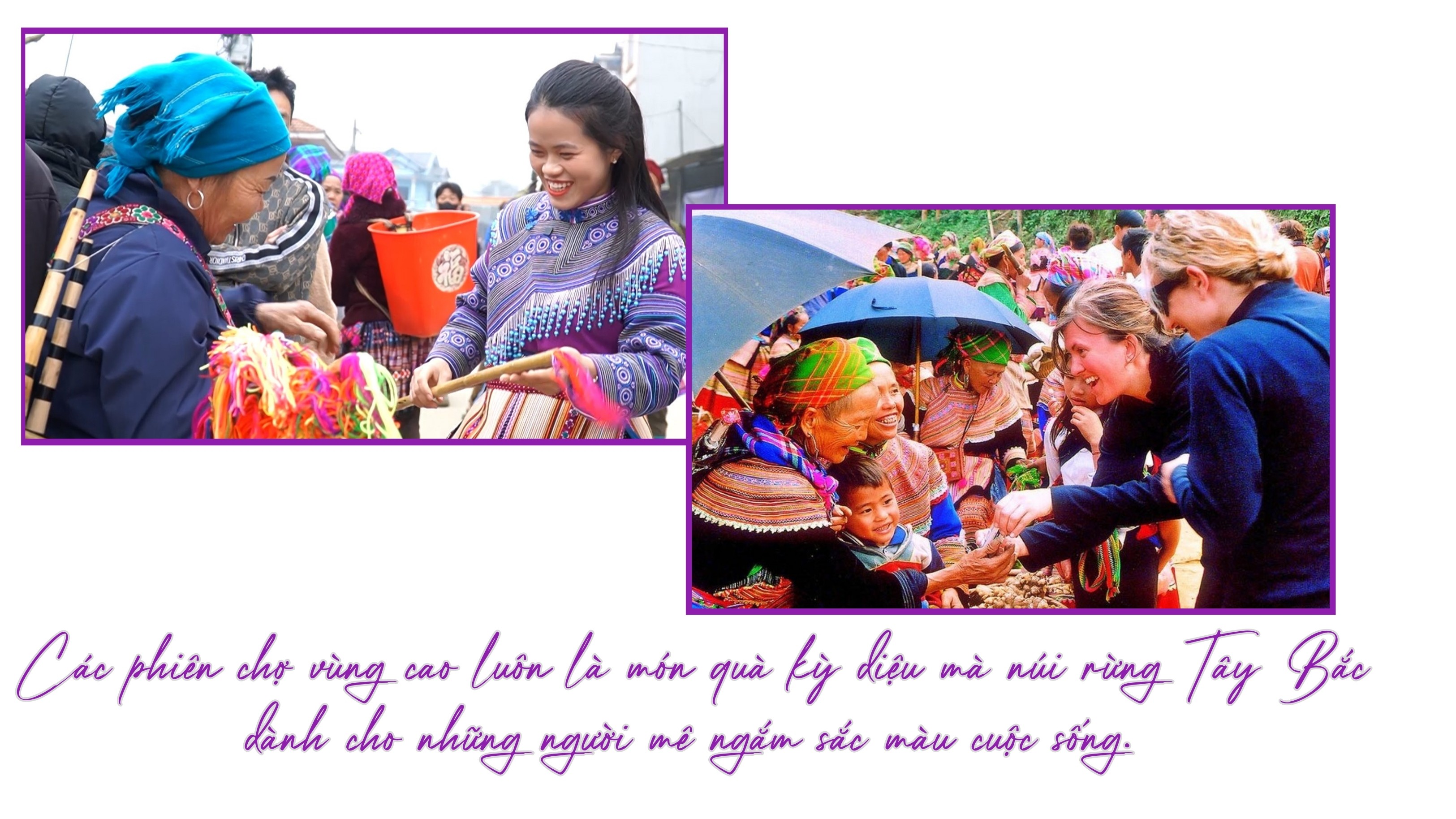
I enjoy going to Tet (Lunar New Year) markets. The highland markets are always a magical gift from the Northwest mountains to those who love to admire the colors of life, like me. Usually, from the 25th day of the 12th lunar month, I start making my way to the mountain markets. In the days leading up to Tet, every market is crowded, but even more so on market day. It seems people only wait for this day to go to the market, just as I only wait to go and admire the market and immerse myself in the bustling atmosphere of the Tet market.
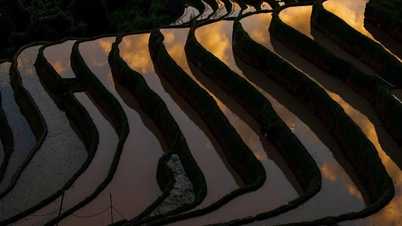
I started my journey to Y Tý right after the Tet Ong Cong Ong Tao (Kitchen God) festival, on Saturday morning, the market day. At an altitude of two thousand meters, Y Tý – a place steeped in mysterious legends – hangs precariously between heaven and earth. In the thick fog and biting cold, I still saw glimpses of people going to the market. They trudged past me, their backs hunched over by large slings, some carrying towering bundles of firewood on their backs.
- Oh, the Y Tý market also sells firewood during Tet (Lunar New Year).
- No, they bring them to sell to the restaurants near the market; they buy everything. They probably don't have motorbikes, or they live very close to the market. If they had motorbikes, they'd transport them by motorbike; why would they carry such a heavy load?
My friend explained. So, to cope with the freezing winter weather, many well-off families buy firewood for heating. Especially the restaurants in the center of the commune, with bonfires in the middle of the building, are a delight for tourists. These days, having a fire to warm yourself by in the cold is rare for city dwellers, even those in the Y Tý market town.
Around eight o'clock in the morning, the Y Tý market was already bustling. The Hani women, wearing boots and woolen wigs neatly wrapped around their heads, some letting them down to wrap around their necks like scarves for warmth, were busy. Living in the high mountains, they endured the cold and wind, so most of them had tanned skin. Each woman took turns displaying her goods: wild and cultivated vegetables, mushrooms, fresh wood ear mushrooms, banana blossoms, bunches of ripe red cardamom, and especially radishes. The radishes here were as big as an arm, crisp and sweet. The hybrid radishes had leaves as large as an open hand. The large radishes reminded me of a childhood story about a child hiding under a radish tree, making it impossible for the whole family to find. "This type of radish, boiled and dipped in fish sauce with egg, surpasses even the radishes from the lowlands; it's both sweet and tender," my friend continued.
Next to the vegetable stalls is a row of medicinal herb stalls with fresh roots, tubers, flowers, and leaves, as if they had just been dug up or picked from the garden or forest. The fruit stalls are ablaze with red in the corner of the market, and the candy and confectionery stalls are overflowing on large tables. Rows of dried goods are piled high with bamboo shoots, vermicelli, pho noodles, and various dried foods. Rows of meat stalls have thick layers of solidified fat clinging to the cutting boards. Large chunks of pork, not yet cleaned, still have thick patches of black hair on the skin, like wild boar meat. Beyond a few rows of vegetables and fruits is the section of the market selling pigs. The pigs are all roughly the same size, but the smaller, less robust pigs look tougher than the larger breeds.

Right at the entrance to the market are stalls selling all kinds of household goods, next to them are shops selling warm clothes in various sizes and colors. Shoppers stand around, browsing, picking up clothes to try on, and timidly haggling. The vendors look on sympathetically, sometimes nodding and lowering the price to the lowest possible level.
Around midday, when the sun was at its highest and warmest, the market closed. The wrinkles on the vendors' faces smoothed out. They murmured as they calculated the money they had earned after the market day. The boys and girls, bought new clothes by their mothers, immediately put them on, their faces beaming in the warm sunlight.
Goodbye Y Tý, I arrived in Mường Hum on Saturday afternoon to wait for the Sunday market the following morning. The people of Mường Hum were preparing their goods for the market. Mrs. Sẻn, from the middle row of houses, was grinding soybeans and laughing: "Making soybeans to sell at the market tomorrow. But tomorrow we have to fry them up to sell more. People from the remote villages buy fried soybeans so they don't break when they take them away."
The next morning, the market gradually became bustling. It was incredibly crowded. The market seemed cramped due to the presence of people from Muong Vi, Den Sang, and Y Ty communes. The lively sounds of the market spread far along the road, reaching across the surface of Muong Hum lake right below. Unlike the Y Ty market, which was mainly frequented by the Ha Nhi people with their predominantly black attire, the Muong Hum market was ablaze with the vibrant colors of many other ethnic groups.
Hmong women still wear their traditional brocade dresses, heavy earrings, and sparkling silver necklaces. Hmong girls resemble moving flowers, their flared skirts and tassels swaying with each step. Their attire is no longer the vibrant red of their mothers and grandmothers, but mainly blue, shimmering with purple and gold like dew in the morning sun.
Red Dao women in traditional attire: red skirts, indigo-colored long dresses with delicate floral embroidery, and headscarves made of bright red floral fabric. Tay and Nung people in black and indigo clothing. Giay people in shirts with diagonally buttoned blouses in banana yellow, pink, and sky blue… Muong Hum market is therefore overflowing with vibrant and rich colors. A baby sleeps soundly in a sling on its mother's back, its cheeks as red as ripe apples...
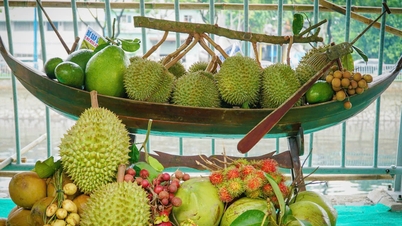
The goods are mostly agricultural products. Vegetables, red peanuts, roots, and fruits are piled high. Red sugarcane and chicken bone sugarcane are lined up at the end of the market. Various types of rice cakes with bone broth, fried cakes, steamed buns, fried dough sticks, baked cakes, and steamed rice cakes are abundant in the cake stalls.
But the most remarkable is still Bac Ha Market, located seventy kilometers from Lao Cai ward. Bac Ha Market is the most vibrant and distinctive market in the Northwest region of Vietnam. In recent years, Bac Ha Market has been developed into a cultural market, making it bustling and a vibrant gathering of ethnic groups; going to the market feels like going to a festival.
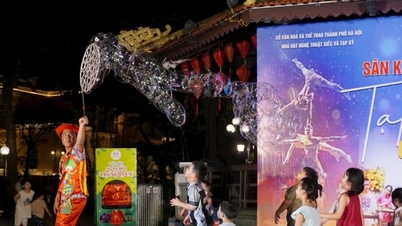
It's rare to find a market in Northwest Vietnam that also has a night market on Saturday evenings. From early evening, the market is bustling with activity thanks to dazzling performances on stage. Village and local performing arts groups present characteristic performances of their ethnic groups and localities.
Spectators enthusiastically danced along to the rhythm. Many foreign tourists, sometimes excitedly, even joined the dance on stage to the resounding applause. The night market concluded with a traditional circle dance around a bonfire in the courtyard. People held hands, making the circle seem to expand endlessly. Tourists, both Western and Vietnamese, locals and acquaintances alike, all joined hands and danced. The sounds and impressions of the Bac Ha night market will linger in the dreams of visitors that night and for years to come.
The next day, the market bustled with activity from dawn, and by the time the roosters crowed their last calls of the morning, it was already crowded and lively. The market was large but packed with people. Vendors spilled out onto the surrounding roads, filling the winding paths. Many had walked from two or three in the morning. Some came from as far as Muong Khuong, Si Ma Cai, Sin Cheng, and even Xin Man ( Tuyen Quang ). They arrived by motorbike or car, usually selling dried goods, fabrics, clothes, and household items. They struggled to make a living in the highland markets. Each stall was like a miniature department store. Loudspeakers constantly blared out sales pitches. Those who stopped by couldn't help but buy something within their budget.
Bac Ha Market is divided into many sections. There are sections for livestock and poultry, general merchandise, brocade fabrics and jewelry, and local vegetables and fruits. Besides the familiar agricultural products of the highlands, Bac Ha Market also has a large area dedicated to displaying and selling plants and flowers, especially orchids. Tourists often come to admire the plants, discuss the flowers, and haggle over prices. Sellers, regardless of whether they sell at a good price or not, are always cheerful and helpful, providing guidance on how to grow orchids in the lowlands so that the plants thrive and bloom regularly.
What makes a strong impression on foreign tourists are the dresses, clothes, and other garments, especially brocade. Do you fully understand it yet? If not, I invite you to visit the Bac Ha market to admire and experience the story of brocade, the meaning of each pattern on it. You can imagine that a traditional Hmong dress, hand-embroidered, can be worth as much as the produce of several corn harvests in autumn, while a ready-made Hmong dress, very beautiful and vibrant, only costs a few hundred thousand dong. Such a comparison shows how much people cherish and value the cultural significance of traditional clothing.

The most boisterous and bustling area was the food stalls, with pho, vermicelli, rice dishes, and most notably, the steaming pot of thang co (a traditional stew), its rich mountain flavor filling the air. People ate and drank until their faces were flushed, their tongues slurred, and they kept getting up and sitting down unsteadily. Even after the market closed, the wife patiently waited by the roadside, sheltering her husband under an umbrella until he woke up.
When talking about Bac Ha market, one cannot fail to mention the buffalo market. Sellers only know how to tell customers, "The buffaloes are strong, very strong, very fast." But buyers scrutinize and examine them carefully. And in the end, the buffalo slowly walks away with the stranger. With Tet (Lunar New Year) approaching, everyone is in a hurry to get things done. Sometimes, buyers and sellers make a small mistake, but they shrug it off knowing this is the last buffalo and horse sale of the year.
Returning home, I strolled through the Tet market and the flower market in Lao Cai ward. Here, it was like meeting familiar faces dressed in new clothes. Goods spilled from the market onto the surrounding streets. The flower market brought together all kinds of flowers, from those costing tens of thousands, hundreds of thousands, to millions of dong, brought from the lowlands. The vibrant flowers reflected their beauty along the Red River along An Duong Vuong street.
The market is bustling with shoppers, a whirlwind of activity in the hurried flow of the days leading up to Tet. But amidst this hustle and bustle, the spirit of the old market still lingers. Somewhere, the sounds of buyers and sellers exchanging wishes for a joyful spring can be heard. These warm and friendly greetings, even from strangers, and the nods of agreement as they choose their favorite peach blossom branches, warm the hearts of everyone on this pre-Tet holiday.

I stood in the middle of the market, my heart filled with a strange, uplifting feeling. It was as if I were witnessing the most beautiful things of my homeland blossoming under the spring sun. I realized that the market is not just a place for trading goods. There are things there that can be bought without bargaining. It's the toothless smile of an old woman selling her last bunch of vegetables, the toasts shared between strangers, the sparkling eyes of children gazing at their colorful toys.
At the recent local markets and even in the city streets, I've noticed the transformation of the highlands in every small detail. Ethnic minority people, dressed in rich traditional clothing, are holding smartphones and QR codes to receive money transfers from buyers. Teenagers wearing traditional hats paired with new jackets and sneakers walk with added confidence. Life is keeping pace with the country's modernization, yet the beauty of their cultural identity remains undiminished.

Having traveled through countless markets, from the highlands to the city streets, I realized I had brought home more than just Tet goods. It was a belief in abundance and happiness in living in peace, and gratitude for the cultural values preserved by ordinary people. Tet isn't just about the feast, the peach blossoms, or the new clothes; Tet comes from the markets where people meet, love, and rediscover the spring of youth in their hearts.
Outside, spring has arrived amidst the bustling crowds at the Tet market.
Source: https://baolaocai.vn/nao-nuc-cho-xuan-post893545.html














































































Comment (0)