

Building new houses or renovating existing ones can result in "losing land".
Ms. Ha, a resident of Tam Binh Ward (Thu Duc City), owns a 50.6 m² plot of land, with a length of 10 m. When she applied for a building permit, the authorities required her to set back 1 m and leave 2.4 m in front, leaving the house length at only 6.6 m. Furthermore, her land only permits a one-story house with a second floor, while neighboring plots allow for one-story and three-story houses built to the full extent of the land. "My family has already hired a designer, but now we have to rent a house because if we build a house with a length of only 6.6 m, we won't be able to arrange enough rooms for my husband, myself, and our two children," Ms. Ha complained.
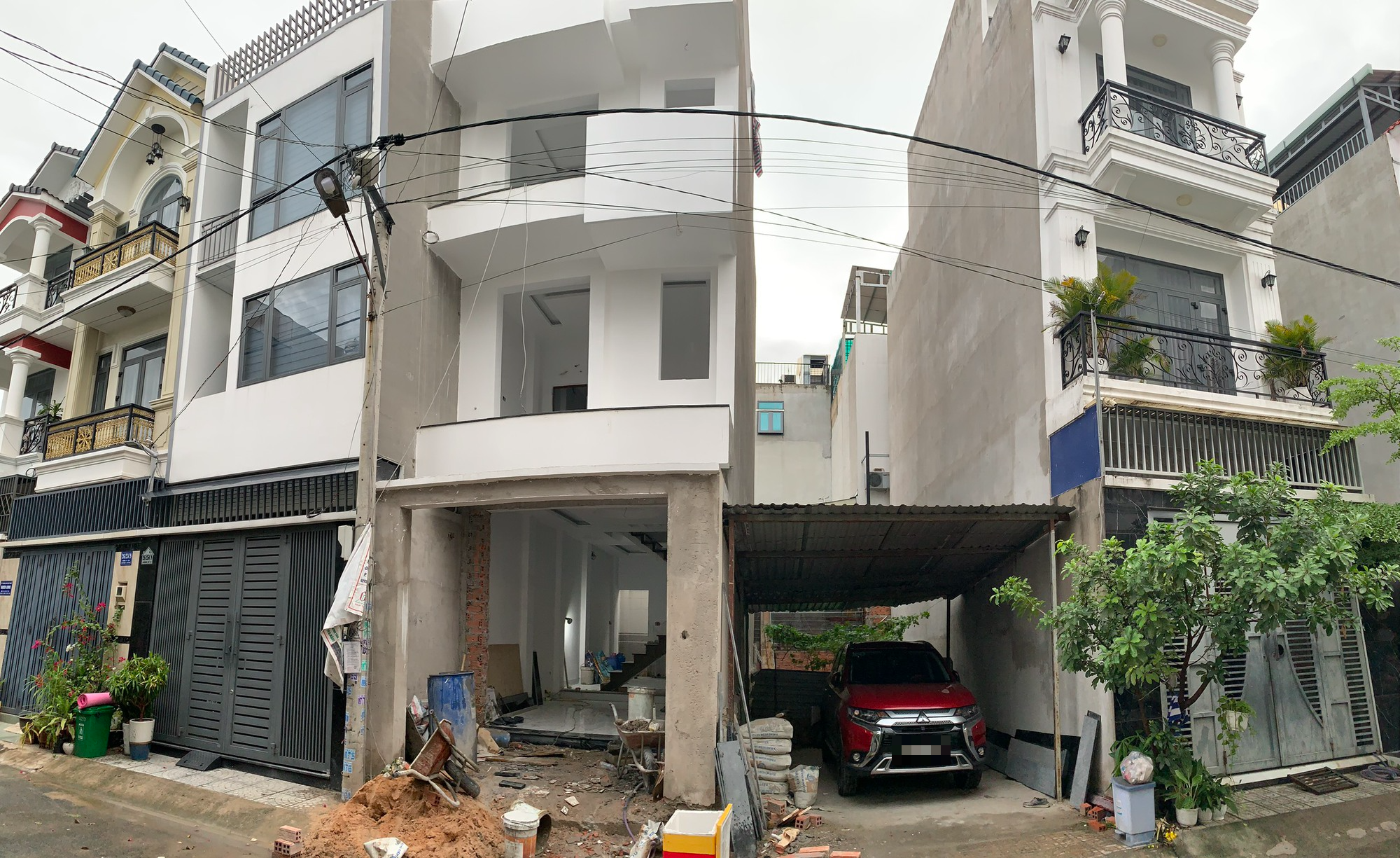
Ms. Ha's plot of land (in the middle) is "abandoned" because the setback distance and land use coefficient are too low compared to the houses on either side that were built previously.
Mr. Tan, a resident of Phu Huu Ward (Thu Duc City), faced a similar situation. He owned a plot of land at a three-way intersection in a residential area, measuring 4 meters wide and 15 meters long, with an 8-meter wide road in front and a 7-meter wide road on the side. When applying for a building permit, he was required to set back 2.4 meters from the front, 1 meter from the back, and also from the side. Notably, other households in the area had already built on their entire plots; only those applying for permits were required to leave such setbacks.
"Moving back will make the whole area look bad because some houses will be jutting out, others will be set back, and there won't be enough usable space for the family," Mr. Tan said. One thing that greatly upsets him is the very low land-use ratio in this area, which is insufficient for his three-generation family to live in. "Thu Duc City is a suburban area, not a densely populated center, yet the government is forcing a low land-use ratio. This makes construction even more complicated and leads to many negative consequences. People have complained a lot about these issues, so why don't the government agencies resolve them to ease the suffering?" Mr. Tan said.
In Nha Be District, Mr. Le Dinh An said he was also tired of the unreasonable setback requirements applied to residential areas where people have been living stably. However, when he needed to request permission to repair or rebuild, he couldn't because his land had to be set back, leaving it isolated between two adjacent houses that had already been built without requiring a setback.
This should only apply to new residential areas.
According to Decision 56, for plots of land larger than 50 m², if the depth is greater than 16 m, the building must be set back from the rear boundary by a minimum of 2 m; if the depth is between 9 and 16 m, the setback must be at least 1 m; and if the depth is less than 9 m, creating a space behind the house is encouraged. Furthermore, in existing residential planning areas, the land use coefficient is very small, sometimes only 1-1.2 times. This results in a very small remaining building area, not to mention the height restrictions in some places, which further complicate matters for residents. In particular, in some cases, corner plots that require setbacks from the front, side, or rear are almost impossible to build on.
Speaking to Thanh Nien newspaper , Ms. Mai Thanh Nga, Deputy Head of the Urban Management Department (Thu Duc City), said that currently, applying setback regulations in Thu Duc City is very difficult due to the merger of three districts. Previously, the setback regulations in these three areas differed according to road width, building line, and terraced house standards. However, according to Decision 56, a unified approach has been implemented, leading to discrepancies and causing public dissatisfaction. Thu Duc City has also held meetings and reported to the Department of Planning and Architecture but has not yet received a response. Currently, Thu Duc City leaders have met and agreed that when granting construction permits for a particular neighborhood, they will consider the overall situation to ensure that permits are appropriate for that neighborhood. If a neighborhood or road previously did not require a setback, then under Decision 56, the setback will not be granted to ensure compliance. If a setback is required, it will be equal to the setback of the houses already built.
"We earnestly hope that the Ho Chi Minh City Department of Planning and Architecture will issue a timely and reasonable guidance document to make adjustments so that people who need to build can do so conveniently. Currently, there are too many setbacks and the building coefficient is too low, causing people who own land to hesitate to build houses."
"Following Decision 56 has resulted in excessive land cuts from residents, leading to many inconsistencies and public backlash. Previously, building height permits were based on road width, but now they are based on coefficients. Therefore, some roads that previously allowed 7-story buildings now only permit 2-3 stories. Regulations regarding coefficients, building height, and setbacks are intended to ensure good ventilation, but subsequent builders are reacting negatively because they feel disadvantaged compared to the previous regulations. In the near future, Thu Duc City will review previously subdivided areas that lacked architectural management regulations regarding setbacks, height, and coefficients. After the survey, the legal basis will be used to guide the permit issuance process, making it more appropriate," Ms. Nga said.
A leader from Nha Be District said that when Decision 56 was issued, all localities reacted differently, each interpreting it differently and applying it differently. Many places lacked 1/2,000 scale planning projects, or had outdated projects that hadn't updated the land use coefficient, so they didn't know how the coefficient was calculated, or the coefficient was too low, allowing only 2-3 stories to be built. In particular, houses on main roads are now allowed to be built much lower than before, causing public outcry. Local authorities want to resolve the issue for the people, but fear repercussions, so things remain stalled.
"In my opinion, the setback distance should be adjusted to suit the actual situation because many plots of land are too short. Whatever benefits the people should be done. The Department of Planning and Architecture and the People's Committee of Ho Chi Minh City should also hold a meeting and re-evaluate Decision 56. Any unsuitable aspects need to be amended to benefit the people. It might be applicable to new residential areas, but it's very difficult to apply to existing residential areas and needs revision," this person said.
ECONOMIC NEWS on June 7th: Vietnam joins the richest group in Asia | Apple launches brand new product
Source link
![[Image] National Assembly discusses the implementation of the socio-economic development plan.](https://vphoto.vietnam.vn/thumb/1200x675/vietnam/resource/IMAGE/2026/04/20/1776696707422_ndo_br_img-20260420-185419-jpg.webp)


![[Photo] General Secretary and President To Lam meets with National Assembly delegates from ethnic minorities.](https://vphoto.vietnam.vn/thumb/1200x675/vietnam/resource/IMAGE/2026/04/20/1776696701056_a1-bnd-8331-3342-jpg.webp)

































































































Comment (0)