

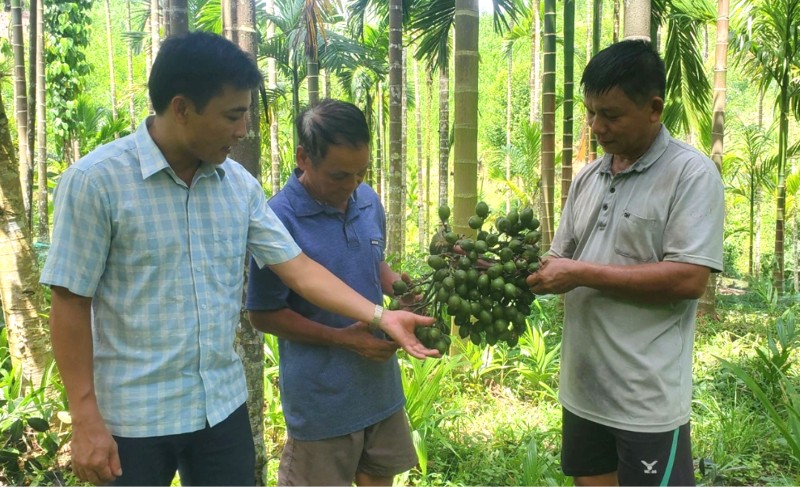
Nestled at the foot of the mountain, the village of Trô has recently been adorned with the refreshing green of tens of thousands of straight-standing betel nut trees. In the middle of his garden, spanning over 5 hectares, Mr. Hà Văn Dũng is busy inspecting his seedling nursery.
With nimble hands, Mr. Dung removed the straw covering the seedling beds and shared: “Before, I planted lemons, gac fruit, sugarcane, oranges, lychees, pomelos… but none of them turned out well. If there was a good harvest, the prices would plummet, and if there wasn't, nobody would buy them. I worked hard all year round but didn't have a penny left over.”
He recounted that at one point he had planted up to 5,000 gac fruit trees and 500 lemon trees, and seeing the orchard full of ripe red fruit filled him with anxiety. “Nobody in the village would buy them, so I had to carry baskets of gac fruit and bags of lemons down to the city by bus to sell them. Some days, I was crammed onto the bus, exhausted and disheartened.”
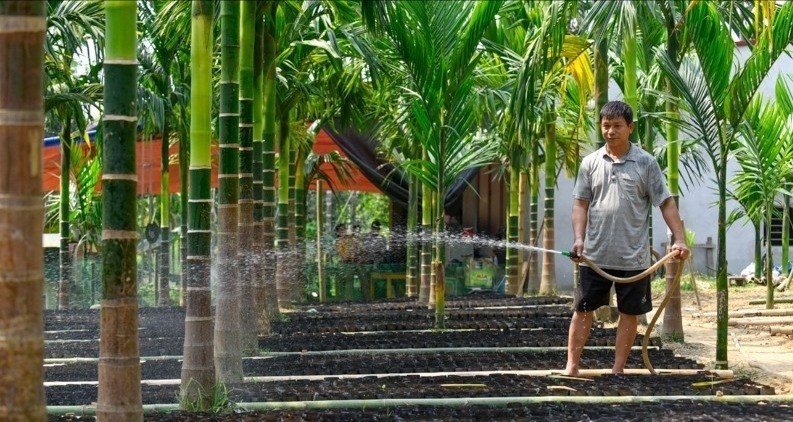
Not wanting to continue struggling in life, Mr. Dung began seriously considering a plant that few people paid attention to: the betel nut tree. Having spent nearly 20 years traveling to villages to buy medicinal herbs, he realized that betel nut trees had a fairly stable market, with traders coming directly to the orchards to purchase them. Mature betel nut seeds could also be sold to traditional medicine establishments.
With that in mind, in 2006, he boldly planted 1,200 betel nut trees as a trial. Five years later, the trees bore their first fruits; the yield wasn't high, but it was enough for him to see the potential: "It doesn't require much care, there are few pests and diseases, the capital is low, and the produce can be sold right in the garden, without having to run around looking for buyers."
From 2017 to 2019, he expanded his betel nut plantation to 5 hectares, planting a total of 14,000 trees. To date, more than 7,000 trees have yielded a steady harvest each year. Betel nuts sell year-round, and a stable price of 20,000 VND/kg or more ensures profitability.
Recalling the time he grew gac fruit, Mr. Dung still shook his head: "Every time we harvested, my wife and I lost sleep because we didn't know where to sell it. We packed it in bags and asked passenger buses to send it to the city. But that method was small-scale, laborious, and unsustainable."
After numerous failures, the betel palm tree seemed to be the most suitable choice. The soil didn't become depleted, and the betel palm tree remained strong through many rainy and windy seasons. There was no worry about the fruit falling, it didn't require much watering, only weeding and fertilizing once a year. "Perhaps the betel palm tree was made for the poor; it costs nothing to plant and thrives," Mr. Dung said with a gentle smile.
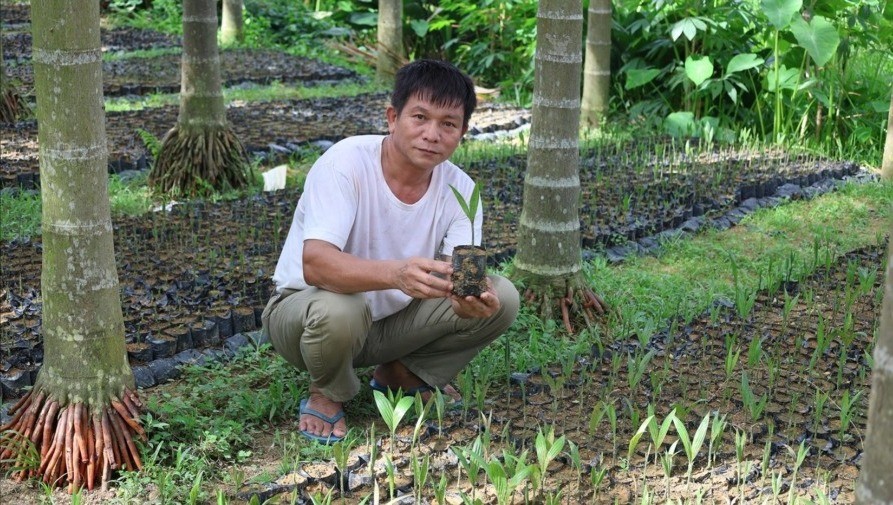
Besides cultivating betel nut trees, he also became a renowned betel nut seedling grower. Initially, he propagated the seedlings himself, but after discovering the quality of the variety, villagers came to inquire about purchasing them, and then customers from other provinces also sought him out. In 2024, he sold 30,000 seedlings to the market, at an average price of 25,000 VND per seedling. Adding the money from selling 5 tons of betel nuts, his total income that year reached 700 million VND.
"I guarantee the trees until they bear fruit," he said. "The betel nut seedlings must be taken from mother trees over 15 years old; only good varieties will produce abundant fruit. Customers who buy seedlings from me will receive thorough guidance on how to care for them and how to handle pests and diseases."
In addition, he also intercropped 600 plants of *Cynanchum auriculatum*, a medicinal plant that grows epiphytically on betel nut trees, saving land and increasing his income. Currently, traders are buying *Cynanchum auriculatum* roots at 30,000 VND/kg. He is propagating more plants to cover the remaining betel nut plantation area.
Seeing the success of Mr. Dung's model, dozens of households in Tro village have followed suit. The total area of betel nut trees in the village now exceeds 20 hectares, transforming what was once barren land into a lush betel nut forest.
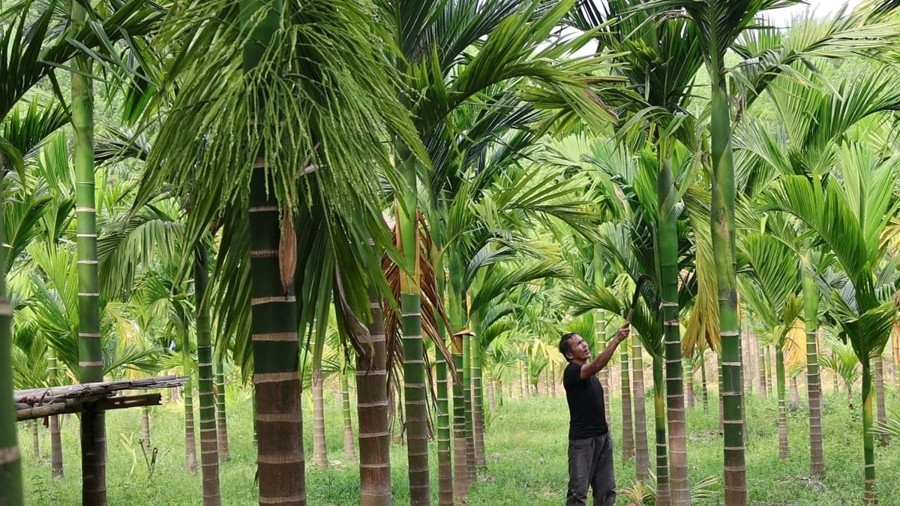
One of the pioneers following Mr. Dung's lead was Mr. Ha Van Oanh, born in 1964. Previously, he grew sugarcane, then switched to acacia trees, but due to his advanced age and declining health, he could no longer handle the heavy work, so he decided to plant 2,600 betel nut trees. "Since having the betel nut garden, my wife and I have had a much easier time; we only need to weed and fertilize occasionally," Mr. Oanh shared.
For Mr. Dung, joy comes not only from profit but also from the trust of the local people. He is always willing to share his experience, provide technical support, and even help rent drones to spray pesticides when aphids appear. "Areca palms also have pests and diseases, but they are easy to handle, unlike growing gac fruit, where you have to spray pesticides when the flowers bloom, and then all the young fruits fall off," Mr. Dung said.
Source: https://baolaocai.vn/nong-dan-mien-nui-thu-hang-tram-trieu-dong-moi-nam-tu-chuyen-doi-trong-cau-post649370.html
![[Live] 2025 Community Action Awards Gala](/_next/image?url=https%3A%2F%2Fvphoto.vietnam.vn%2Fthumb%2F1200x675%2Fvietnam%2Fresource%2FIMAGE%2F2025%2F12%2F16%2F1765899631650_ndo_tr_z7334013144784-9f9fe10a6d63584c85aff40f2957c250-jpg.webp&w=3840&q=75)

![[Image] Leaked images ahead of the 2025 Community Action Awards gala.](/_next/image?url=https%3A%2F%2Fvphoto.vietnam.vn%2Fthumb%2F1200x675%2Fvietnam%2Fresource%2FIMAGE%2F2025%2F12%2F16%2F1765882828720_ndo_br_thiet-ke-chua-co-ten-45-png.webp&w=3840&q=75)
![[Photo] Prime Minister Pham Minh Chinh receives Lao Minister of Education and Sports Thongsalith Mangnormek](/_next/image?url=https%3A%2F%2Fvphoto.vietnam.vn%2Fthumb%2F1200x675%2Fvietnam%2Fresource%2FIMAGE%2F2025%2F12%2F16%2F1765876834721_dsc-7519-jpg.webp&w=3840&q=75)
![[Photo] Prime Minister Pham Minh Chinh receives the Governor of Tochigi Province (Japan)](/_next/image?url=https%3A%2F%2Fvphoto.vietnam.vn%2Fthumb%2F1200x675%2Fvietnam%2Fresource%2FIMAGE%2F2025%2F12%2F16%2F1765892133176_dsc-8082-6425-jpg.webp&w=3840&q=75)














































![[Photo] Prime Minister Pham Minh Chinh attends the Vietnam Economic Forum 2025](https://vphoto.vietnam.vn/thumb/402x226/vietnam/resource/IMAGE/2025/12/16/1765893035503_ndo_br_dsc-8043-jpg.webp)


























Comment (0)