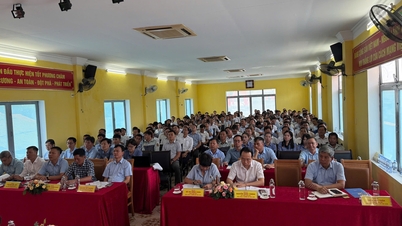
The conference was organized by the Thang Long - Hanoi Heritage Conservation Center and the Institute of Archaeology.
During the excavation site survey, the international team of experts from the World Heritage Center (UNESCO, ICOMOS) and domestic experts highly appreciated the fact that the architectural traces of many historical periods were still very well preserved beneath the Kính Thiên Palace. This provides a highly credible scientific basis for researching and restoring the Kính Thiên Main Palace.
In 2023, the Thang Long - Hanoi Heritage Conservation Center, in collaboration with the Institute of Archaeology, conducted exploratory excavations in the northeastern area of the Kinh Thien Palace foundation, covering a total area of over 1,000 m2 at three locations: the Operations Department, the Kinh Thien Palace foundation, and the Rear Pavilion.
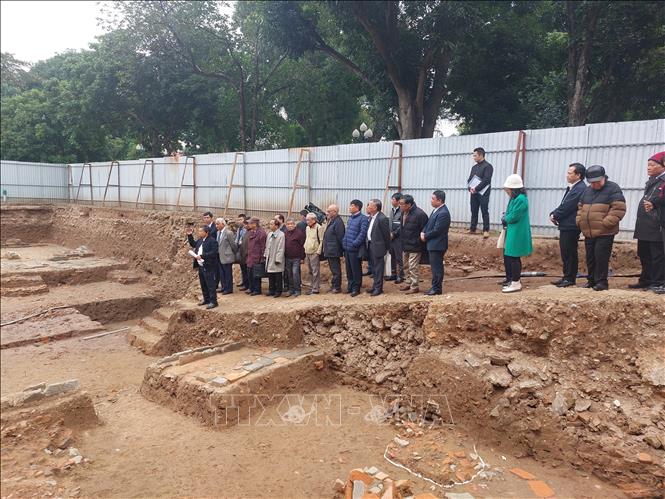
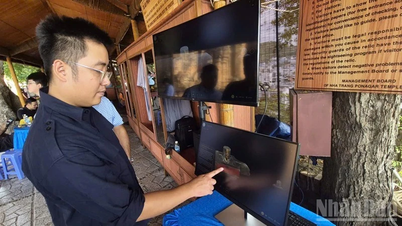
Visiting the archaeological excavation site south of the Rear Tower of Thang Long Imperial Citadel.
At the excavation site on the northern side of the Operations Department building, several sections of the Dan Tri courtyard and traces of the Royal Road were unearthed, continuing the results of the 2022 excavation and the foundation of Ly Dynasty architecture. At the location on the Kinh Thien Palace foundation, exploratory excavation pits were opened directly on the Kinh Thien Palace foundation.


To date, the excavation sites have revealed traces of Nguyen Dynasty architecture (19th-20th centuries), Le Trung Hung Dynasty (17th-18th centuries), and Le So Dynasty (15th-16th centuries). Essentially, the excavation has provided two crucial pieces of information regarding the structure and foundation layout of the Kinh Thien Palace during the Le and Le Trung Hung Dynasties, 17th-18th centuries. Besides architectural remains, the excavation has also yielded various types of artifacts such as bricks, tiles, glazed ceramics, and stoneware related to the architectural development and life of the Imperial Palace.
Since 2011, after the Thang Long Imperial Citadel - Hanoi was recognized by UNESCO as a World Cultural Heritage site, the Thang Long - Hanoi Heritage Conservation Center has collaborated with the Institute of Archaeology (Vietnam Academy of Social Sciences) and the Vietnam Archaeological Association to conduct excavation and research in the central area (the Kinh Thien Main Palace area) with a total area of over 10,000 m2.
Excavations have yielded results in understanding the outstanding universal values of the Thang Long Imperial Citadel - Hanoi World Heritage Site; and have also obtained much new, highly authentic documentation contributing to the research and restoration of the Kinh Thien Main Hall. The excavation results have identified a rich system of relics and artifacts, and have initially determined part of the architectural structure of the Kinh Thien Main Hall area during the early Le Dynasty (15th - early 16th centuries) and the later Le Dynasty (17th - 18th centuries), including: the Kinh Thien Main Hall, the Royal Road, the Grand Courtyard, the gate, the surrounding wall, and the surrounding corridor.
The overall spatial layout is as follows: The Kính Thiên Palace, the largest and highest structure, is built in the center, slightly to the north. To the south is Đoan Môn, the final main gate of the Thăng Long Forbidden City. Connecting Đoan Môn and the Kính Thiên Palace foundation is the 136.7-meter-long Imperial Road. On either side of the Imperial Road are the Đại Triều courtyards, covering approximately 12,000 square meters. The entire area is surrounded by outer walls. Inside the walls are corridors to protect against rain and sun, interspersed with various entrances and exits.
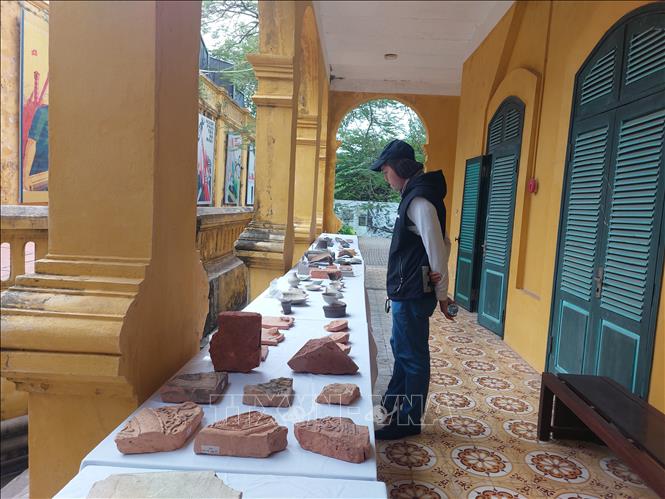
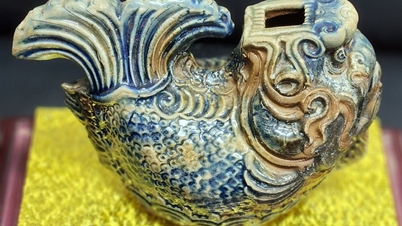
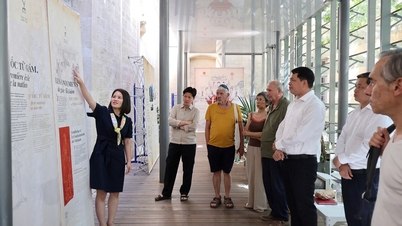
Exhibiting artifacts excavated at Thang Long Imperial Citadel in 2023.


Excavations also uncovered over 70 gilded wooden architectural components from a multi-story wooden structure dating back to the early Le Dynasty. A system of glazed blue and gold dragon-shaped roof tiles, depicting a unique embossed dragon found only in Thang Long and Vietnam, was also discovered. A multi-tiered glazed terracotta architectural model showing the configuration of a roofing style, a wooden structure from the early Le Dynasty decorated with dragons and lotus flowers, and a bronze plaque titled "Cung Nu Xuat Mai Bai" (Cung Nu Xuat Mai Bai), a card issued to palace maids allowing them access to the inner palace for buying and selling, were also found.
According to Nguyen Thanh Quang, Director of the Thang Long - Hanoi Heritage Conservation Center, the Center will collaborate with the Institute of Archaeology to develop an "Archaeological Strategy for the Central Axis of the Thang Long Imperial Citadel"; focusing on the Kinh Thien Palace and its surrounding area. In addition, the unit will research the Inner Palace area (behind the Kinh Thien Palace) – the King's daily workplace.
According to VNA/News Agency
Source
![[Photo] General Secretary and President To Lam receives Palestinian Ambassador Saadi Salama](https://vphoto.vietnam.vn/thumb/1200x675/vietnam/resource/IMAGE/2026/06/25/1782365384740_a1-bnd-9423-8322-jpg.webp)

![[Image] Schools organize meetings and introduce teaching models to students admitted to grade 10.](https://vphoto.vietnam.vn/thumb/1200x675/vietnam/resource/IMAGE/2026/06/25/1782368077271_ndo_br_z7970052192242-1ec8daeb77a6eed1a4e9f58c564ddd3e-jpg.webp)
![[Image] Ho Chi Minh City: Ma Lang area, Chicken-Rice Market about to change its appearance](https://vphoto.vietnam.vn/thumb/1200x675/vietnam/resource/IMAGE/2026/06/25/1782377698627_ndo_br_m1-jpg.webp)