

 |
| Labeling technology from the field of biochemistry is being used in cancer treatment. (Source: SCMP) |
In immunotherapy, immune cells need to receive strong enough signals to detect and destroy cancer cells. However, cancer cells are sophisticated, often "camouflaging" themselves with very sparse natural signals on their surface, making them difficult for the immune system to detect.
To overcome this obstacle, a team of scientists from the Center for Molecular Cell Science (Chinese Academy of Sciences) has applied "labeling" technology from the field of biochemistry to disease treatment.
The research team successfully created a nanozyme – a type of artificial enzyme with nanoscale dimensions – that is capable of reacting when activated by deep red light or ultrasound waves.
These nanozymes can carry antibodies or ligands that recognize cancer cells, travel through the bloodstream, and accumulate on the surface of malignant cells. When instructed by light or ultrasound, the nanozymes will clearly "label" the cancer cells, turning them into specific targets for the immune system.
Scientists also injected a special molecule called BiTE (Bispecific T-cell Engager) into the bodies of experimental mice. This molecule not only marks the target but also activates T cells of the immune system to participate in attacking cancer.
According to the scientists, "this labeling can simultaneously activate the whole-body immune system and form long-term memories, much like the body has just been injected with a 'tumor vaccine'."
In a research report published in Nature on September 11th, the research team confirmed that this method yielded promising treatment results in both mouse tumor models and clinical tumor samples cultured in artificial environments in the laboratory.
Experts expect this discovery to pave the way for a new generation of smarter, more effective immunotherapy, offering great hope for cancer patients in the future.
Source: https://baoquocte.vn/pha-vo-chieu-tro-nguy-trang-cua-te-bao-ung-thu-327523.html

![[Photo] Prime Minister Pham Minh Chinh receives Lao Minister of Education and Sports Thongsalith Mangnormek](/_next/image?url=https%3A%2F%2Fvphoto.vietnam.vn%2Fthumb%2F1200x675%2Fvietnam%2Fresource%2FIMAGE%2F2025%2F12%2F16%2F1765876834721_dsc-7519-jpg.webp&w=3840&q=75)
![[Photo] Prime Minister Pham Minh Chinh receives the Governor of Tochigi Province (Japan)](/_next/image?url=https%3A%2F%2Fvphoto.vietnam.vn%2Fthumb%2F1200x675%2Fvietnam%2Fresource%2FIMAGE%2F2025%2F12%2F16%2F1765892133176_dsc-8082-6425-jpg.webp&w=3840&q=75)

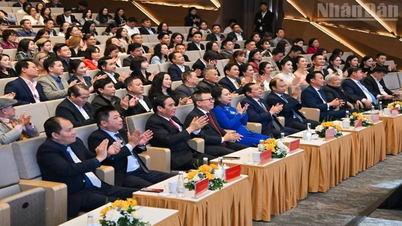
![[Live] 2025 Community Action Awards Gala](/_next/image?url=https%3A%2F%2Fvphoto.vietnam.vn%2Fthumb%2F1200x675%2Fvietnam%2Fresource%2FIMAGE%2F2025%2F12%2F16%2F1765899631650_ndo_tr_z7334013144784-9f9fe10a6d63584c85aff40f2957c250-jpg.webp&w=3840&q=75)
![[Image] Leaked images ahead of the 2025 Community Action Awards gala.](/_next/image?url=https%3A%2F%2Fvphoto.vietnam.vn%2Fthumb%2F1200x675%2Fvietnam%2Fresource%2FIMAGE%2F2025%2F12%2F16%2F1765882828720_ndo_br_thiet-ke-chua-co-ten-45-png.webp&w=3840&q=75)









































































Comment (0)