

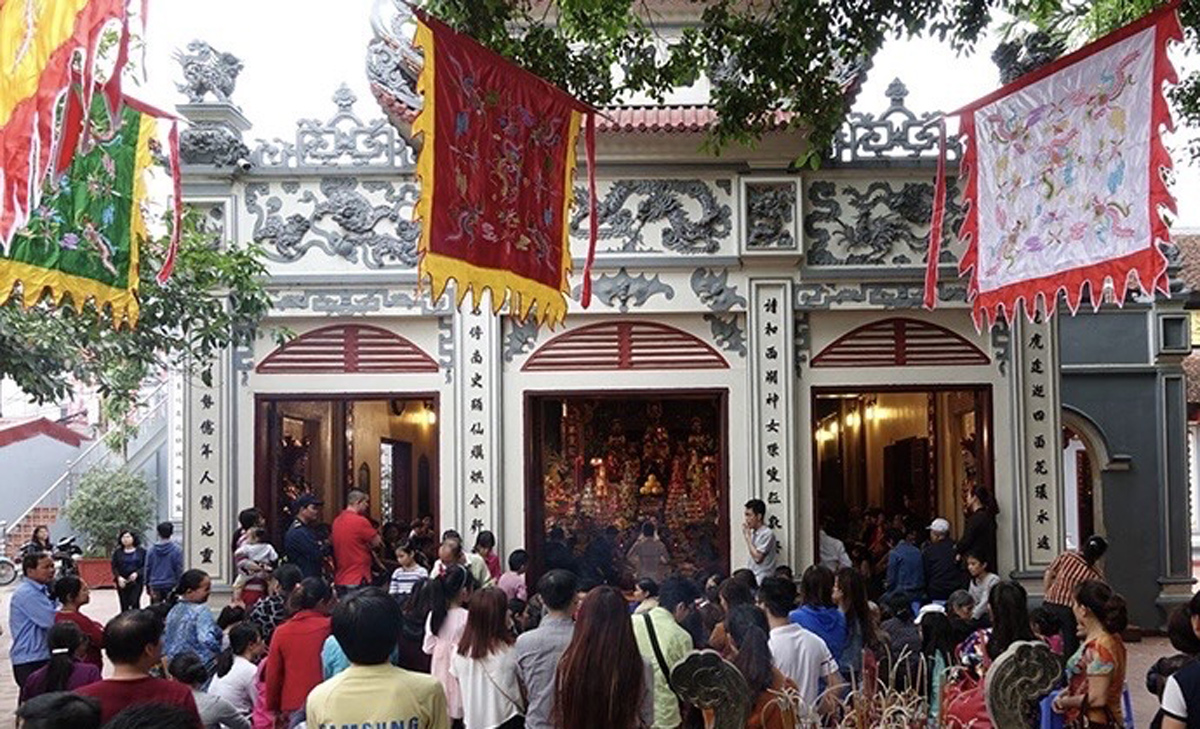
Tay Ho Temple always attracts many tourists who come to worship and admire the scenery.
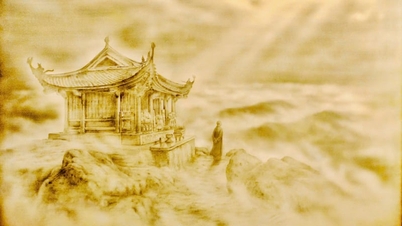
Tay Ho Temple is a place of worship dedicated to Lady Lieu Hanh, one of the four immortal saints in Vietnamese folk beliefs. Located in the former Nghi Tam village, it resembles an island jutting out from the vast waters of West Lake. It is now at 52 Dang Thai Mai Street, Quang An Ward, Tay Ho District, Hanoi . We visited Tay Ho Temple on a day other than a major holiday or a weekday, so it wasn't overly crowded. Therefore, after the ceremony, we had time to admire the space, architecture, and miniature landscapes, and to study the temple's sacred legends. Overall, the space exudes solemnity and tranquility, yet is also incredibly poetic. Tay Ho Temple stands out with its ancient architecture, deeply rooted in Vietnamese folk culture, creating a peaceful and sacred atmosphere in the heart of Hanoi. The road leading to the temple winds along the lake, with willow branches swaying gently like a curtain. Stepping through the gate, one is greeted by a majestic ancient banyan tree, followed by two rare, large Syzygium jambos trees and an old fig tree right in front of the Son Trang Palace, their branches and leaves a vibrant green, their massive roots extending down to the lake. The palace's architecture is meticulously designed and decorated. The four doors are carved with the four seasons on the upper part, the four mythical creatures on the lower part, and peach blossoms in the middle. The front is a two-story triple-arched gate, with the inscription "Tay Ho hien tich" (Tay Ho hien tich) on the central roof. Next is the Son Trang Palace, a two-story structure with eight curved roofs; the upper floor houses the statue of Quan Am (Guan Yin), while the lower floor contains three Son Trang caves. Beyond the temple and palace, the grounds also include a guesthouse, the Lady's Pavilion, the Gentleman's Pavilion, etc. The main palace is a single, interconnected building, but divided into three sections in a "three-part" shape.
The worship area is arranged in layers: The first layer is dedicated to the Three Realms Assembly, the Four Realms of Myriad Spirits, and the Council of Officials, with three pairs of couplets praising Lady Lieu Hanh. The second layer is dedicated to the Jade Emperor and the Southern and Northern Dippers, with couplets depicting the scenic beauty of West Lake. The third layer is dedicated to the Three Holy Mothers, with an arched doorway inscribed "West Lake's Wind and Moon" and a pair of couplets praising Lady Lieu Hanh. Above the roof near the back door hangs a large inscription "Mother of the World," flanked by wooden couplets. The uppermost layer, the inner sanctuary, houses statues of Lady Lieu Hanh and the goddesses Chau Quynh and Chau Que. Above are the large inscriptions "Heavenly Immortal Descending" and "Mother of the World." The artifacts within the temple are quite abundant, including many couplets, arched doorways, dragon thrones, ancestral tablets, and altars. The arched doorways and arched doorways are beautifully carved. In addition, there are various types of canopies, parasols, bronze bells, bronze incense burners, imperial decrees, and 50 statues of various sizes.
Although it houses many altars and precious artifacts, Tay Ho Palace is officially the temple dedicated to the goddess Lieu Hanh. Legend says that Lieu Hanh was the daughter of the Jade Emperor, banished to the mortal world for breaking a precious jade cup. After wandering throughout the mortal realm, she was captivated by the beauty of West Lake and decided to settle there, opening a tea house, composing poetry, and enjoying literary pleasures amidst the mystical nature. During her time there, she helped the people settle down and prosper, eliminating corruption so that the people could live in peace and happiness. As if by fate, during a boat trip through this area, the scholar Phung Khac Khoan visited the goddess's tea house. Sharing similar thoughts, they composed the poem "Tay Ho Imperial Tea House," which is still preserved today. No one knows how long the goddess stayed there; only that when Phung Khac Khoan returned to look for her, she was gone. To ease his longing, he had a temple built to honor his kindred spirit. The temple was built around the beginning of the 17th century. With its cultural and historical value, in 1996, Tay Ho Temple was classified as a historical and architectural monument by the Ministry of Culture, Sports and Tourism. With investment, restoration, and decoration in accordance with its legend, Tay Ho Temple has become one of the most sacred, peaceful, and tranquil places in Hanoi.
Lam Nguyet (Contributor)
Source: https://baohoabinh.com.vn/276/200961/Phu-Tay-Ho-chon-linh-thieng,-binh-yen-va-thu-thai.htm

![[Image] Hanoi's urban life under the challenge of a "scorching hot" environment](https://vphoto.vietnam.vn/thumb/1200x675/vietnam/resource/IMAGE/2026/05/25/1779706979265_nang-nong-t5-2026-minh-duy-7-4636-jpg.webp)
![[Image] Close-up view of the interchange connecting the two expressways and Long Thanh Airport.](https://vphoto.vietnam.vn/thumb/1200x675/vietnam/resource/IMAGE/2026/05/25/1779703378210_ndo_br_z7863716673926-224453a31600126cce10622af6290afd-4549-jpg.webp)

































































Comment (0)