

Synchronize fiscal and monetary policies to support the economy.
Under the pressure of achieving double-digit growth targets for the 2026-2030 period, the issue of mobilizing and effectively utilizing financial resources is no longer a purely technical matter for the finance and banking sector alone, but has become a central theme throughout the economic development strategy.
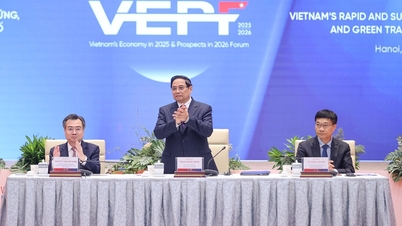
At the Finance - Banking thematic session within the framework of the Vietnam Economic Forum 2025, Outlook 2026, held on the morning of December 16th, analyses and assessments from fiscal and monetary authorities clearly revealed a multifaceted picture of the economy, where opportunities and challenges intertwine, requiring a new approach to resource allocation and utilization.
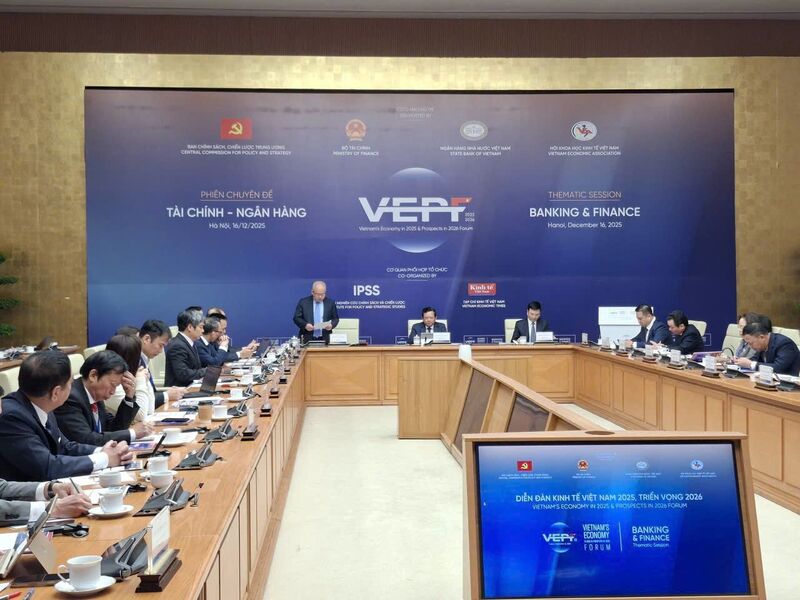
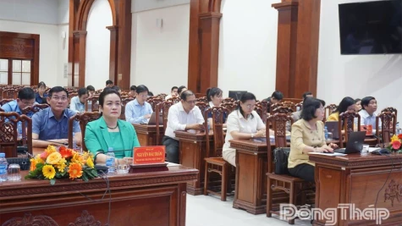
The Finance - Banking thematic session within the framework of the Vietnam Economic Forum 2025, Outlook 2026.
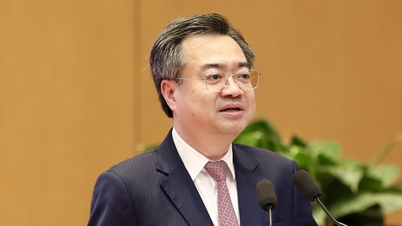
Speaking at the forum, Deputy Minister of Finance Do Thanh Trung emphasized that, amidst a volatile international economy, Vietnam has maintained macroeconomic stability, controlled inflation, and achieved relatively high growth. This result is closely linked to the government's comprehensive implementation of fiscal policies to support the economy, ranging from tax and fee exemptions, reductions, and extensions to prioritizing resources for important projects, social welfare, and public services.
Meanwhile, from the monetary policy perspective, Ms. Ha Thu Giang, Director of the Department of Credit for Economic Sectors, State Bank of Vietnam, stated that the banking sector has closely followed the guidelines and directives of the Party, the National Assembly , and the Government, implementing monetary and credit policies aimed at both controlling inflation, stabilizing the macroeconomy, and supporting sustainable growth.
According to Deputy Minister Do Thanh Trung, the State budget continues to ensure development investment and recurrent expenditures, while maintaining a total social investment rate of approximately 32-33% of GDP. These resources are focused on developing strategic infrastructure, economic and social infrastructure, thereby creating a favorable investment environment and attracting other investment resources. The investment structure shows that the domestic household and business sector accounts for over 65% of total social investment, while the FDI sector contributes about 16%, placing Vietnam among the top 15 countries attracting the most FDI in the world.
Alongside investment flows, the size of the financial market continues to expand. By November 30th, the total size of the financial market was estimated at approximately $390 billion, equivalent to 82% of GDP.
However, this picture is not all rosy. The Deputy Minister of Finance frankly pointed out that the growth model heavily reliant on cheap capital, cheap labor, and outsourcing is gradually reaching its limits. When double-digit growth targets are set for the coming period, the requirement is not only to expand the scale of investment capital, but also to fundamentally change the mindset regarding the allocation, management, and use of resources. Fiscal policy, therefore, plays a growth-building role, operating proactively, sustainably, and with a focus on key areas, concentrating on development investment and strategic sectors such as digital infrastructure and green transformation, while ensuring financial safety and controlling public debt.
Flexible management to prepare for a new growth phase.
While fiscal policy is expected to lay the foundation for long-term growth, bank credit continues to be identified as the primary channel for capital flow in the economy in the short and medium term. According to Ms. Ha Thu Giang, in practice, the State Bank of Vietnam has strengthened its guidance to credit institutions to promptly meet capital needs for production, business, and consumption. Sector-specific credit solutions have been implemented decisively, contributing to increased access to capital and better alignment with the economy's capital absorption capacity. This is particularly important given that many businesses still face cash flow difficulties.
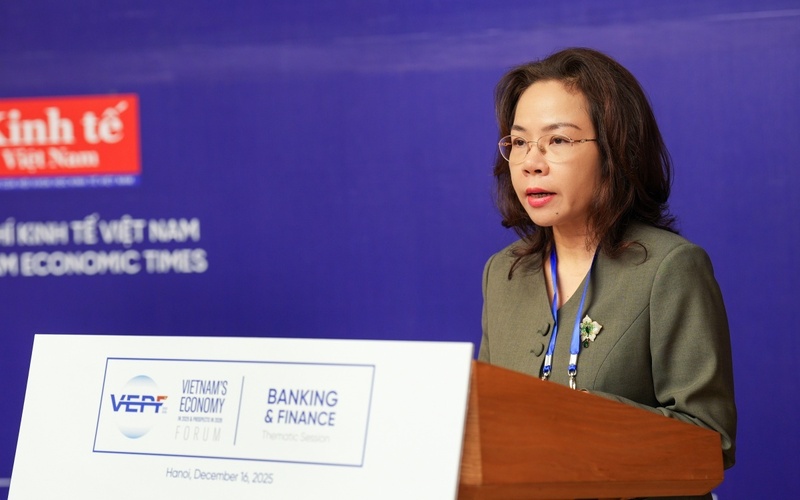
Ms. Ha Thu Giang, Director of the Department of Credit for Economic Sectors, State Bank of Vietnam, delivered a speech at the forum.
One of the key points mentioned by the State Bank of Vietnam representative was the policies to restructure loan repayment terms and maintain the same loan classification for customers facing difficulties due to objective reasons such as epidemics, natural disasters, or difficulties in production and business. These solutions have supported approximately 1.3 million customers in restructuring their debts, with a total principal and interest value of approximately 1 trillion VND. During the Covid-19 pandemic alone, credit institutions reduced interest rates for customers totaling approximately 50 trillion VND.
In addition, many preferential credit programs have been adjusted and expanded to suit practical needs. For example, the credit program for the agriculture, forestry, and fisheries sector has been increased to 185 trillion VND, with a disbursement rate of approximately 94%. The rice-farming linkage loan program under Decision No. 1490/QD-TTg, within just five months, has achieved a cumulative disbursement of nearly 3,000 billion VND.
Besides commercial credit, policy credit continues to play a crucial role in ensuring social security. According to Ms. Ha Thu Giang, the outstanding balance of policy credit through the Social Policy Bank has now exceeded 398 trillion VND, supporting more than 6.8 million poor people and other policy beneficiaries, contributing to achieving the goals of poverty reduction and economic and social stability.
However, these positive figures also come with considerable challenges. According to Ms. Ha Thu Giang, the pressure to supply capital to the economy remains high as the corporate bond market and the stock market have not fully played their role as channels for medium and long-term capital mobilization. The demand for capital for key national projects and works is very large, while the lending capital of credit institutions mainly comes from short-term deposits, accounting for about 80% of the total deposits in the system, creating pressure on capital balance and maturity risk management.
In this context, the State Bank of Vietnam has determined to continue managing credit flexibly, closely following macroeconomic developments and the economy's capacity to absorb capital. Notably, the State Bank is coordinating with the Ministry of Finance and relevant agencies to develop and submit to the Government a Decree on providing a 2% annual interest rate subsidy for private sector enterprises, business households, and individual businesses borrowing capital to implement green and circular projects, applying environmental, social, and governance standards. Along with this, credit flows will continue to be directed towards production and business sectors, growth drivers, and key, feasible projects and works.
By November 27, 2025, outstanding credit reached over 18.2 million billion VND, an increase of 16.56% compared to the end of 2024. The credit structure shifted in line with the structure of economic sectors, with credit to agriculture and rural areas accounting for approximately 23%, and to small and medium-sized enterprises (SMEs) approximately 19%. Notably, credit to high-tech enterprises and supporting industries experienced high growth rates, averaging 17.51% and 19.91% respectively during the past period.
Source: https://congthuong.vn/tai-khoa-kien-tao-tin-dung-dan-von-mo-du-dia-tang-truong-hai-con-so-435029.html
![[Photo] Prime Minister Pham Minh Chinh receives the Governor of Tochigi Province (Japan)](/_next/image?url=https%3A%2F%2Fvphoto.vietnam.vn%2Fthumb%2F1200x675%2Fvietnam%2Fresource%2FIMAGE%2F2025%2F12%2F16%2F1765892133176_dsc-8082-6425-jpg.webp&w=3840&q=75)

![[Photo] Prime Minister Pham Minh Chinh receives Lao Minister of Education and Sports Thongsalith Mangnormek](/_next/image?url=https%3A%2F%2Fvphoto.vietnam.vn%2Fthumb%2F1200x675%2Fvietnam%2Fresource%2FIMAGE%2F2025%2F12%2F16%2F1765876834721_dsc-7519-jpg.webp&w=3840&q=75)

![[Image] Leaked images ahead of the 2025 Community Action Awards gala.](/_next/image?url=https%3A%2F%2Fvphoto.vietnam.vn%2Fthumb%2F1200x675%2Fvietnam%2Fresource%2FIMAGE%2F2025%2F12%2F16%2F1765882828720_ndo_br_thiet-ke-chua-co-ten-45-png.webp&w=3840&q=75)
![[Live] 2025 Community Action Awards Gala](/_next/image?url=https%3A%2F%2Fvphoto.vietnam.vn%2Fthumb%2F1200x675%2Fvietnam%2Fresource%2FIMAGE%2F2025%2F12%2F16%2F1765899631650_ndo_tr_z7334013144784-9f9fe10a6d63584c85aff40f2957c250-jpg.webp&w=3840&q=75)
















































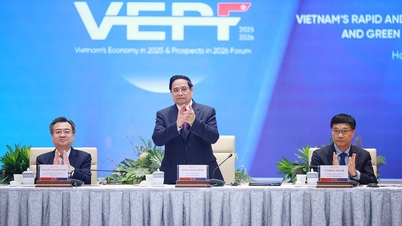
![[Photo] Prime Minister Pham Minh Chinh attends the Vietnam Economic Forum 2025](https://vphoto.vietnam.vn/thumb/402x226/vietnam/resource/IMAGE/2025/12/16/1765893035503_ndo_br_dsc-8043-jpg.webp)



























Comment (0)