

Baoquocte.vn. To make suburban tourism a real focus in Hanoi's tourism development plan, localities need to develop new tourism products, create strong linkages, and turn potential into a "lever" to attract domestic and international tourists.
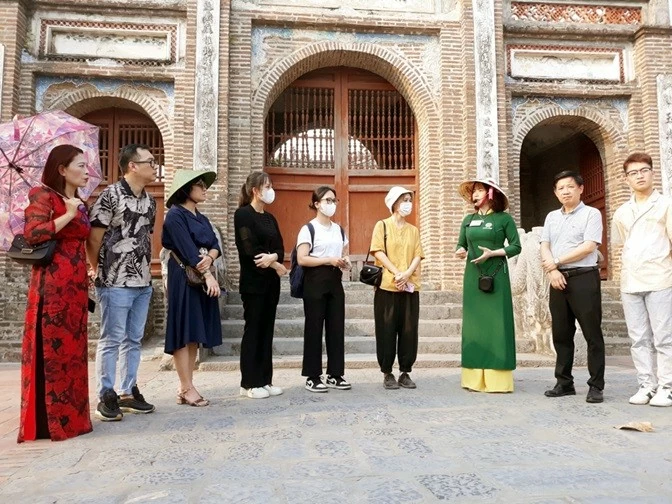 |
| In recent years, Hanoi has focused on developing tourism in its suburbs. (Source: KTĐT) |
Develop more new tourist routes.
In 2024, Hanoi's tourism industry aims to welcome 26.5 million visitors, a 10.4% increase compared to 2023. Therefore, the city's Department of Tourism prioritizes supporting and directing units managing heritage sites and cultural relics to invest in and research the development of cultural tourism tours and experiential tourism products linked to night tourism, based on exploiting traditional cultural values. Simultaneously, it aims to develop new experiential tourism products associated with heritage sites, relics, and traditional craft villages along the Hanoi Central - Thanh Tri - Thuong Tin - Phu Xuyen route; and the Hanoi Central - Thanh Oai - Ung Hoa - My Duc route…
Hanoi has 18 districts and towns, each with its own potential and advantages for tourism development, creating attractive tourism products. The city has typical destinations such as: Son Tay Ancient Citadel, Va Temple, Duong Lam Ancient Village (Son Tay); Nguyen Trai Temple (Thuong Tin), Cu Da Ancient Village, Uoc Le Ancient Village (Thanh Oai)... My Duc District is home to the Huong Son scenic complex (Huong Pagoda), attracting millions of visitors every year.
Many valuable historical sites in the suburbs are located along the city's main transportation routes. Along Thang Long Boulevard are Thầy Pagoda (Quoc Oai) and Tay Phuong Pagoda (Thach That), both of which are Special National Monuments. Route 32 includes Dai Phung Temple (Dan Phuong), Hat Mon Temple (Phuc Tho), and other historical sites in Son Tay district…
Despite their strengths in tourism development, the suburban districts of Hanoi have not yet fully exploited their inherent potential, resulting in lower-than-expected visitor numbers. According to Tran Trung Hieu, Deputy Director of the Hanoi Department of Tourism, most suburban districts have not identified their target tourist groups, leading to a lack of clear product planning and development strategies. Furthermore, tourism services are inadequate and do not meet actual needs, and promotional activities lack professionalism, resulting in visitor numbers in suburban districts not matching their inherent potential and advantages.
Recently, the Hanoi Department of Tourism, in coordination with suburban districts, developed two new tourist routes: " Exploring the Southern Thang Long Heritage Route," comprising the route from Central Hanoi to Thanh Tri, Thuong Tin, and Phu Xuyen, and the route from Central Hanoi to Thanh Oai, Ung Hoa, and My Duc. These new tourist routes will serve as a model to be replicated in all suburban districts.
The highlights of the Hanoi - Thanh Tri - Thuong Tin - Phu Xuyen tourist route are Ngau village (Thanh Tri district), Phuc Am village (Thuong Tin district), and Cuu village (Phu Xuyen district). Ngau village is famous for its traditional rice wine making, and the Ngau temple and pagoda have beautiful architecture. Besides admiring the scenery and historical sites, visitors can also visit families who make rice wine and sample the 4-star OCOP chrysanthemum wine. Phuc Am village is a famous traditional craft village. Cuu ancient village is renowned for its dozens of old houses with European architecture amidst a rustic and peaceful countryside.
Meanwhile, the Hanoi Central - Thanh Oai - Ung Hoa - My Duc tourist route highlights heritage sites and traditional craft villages, including Noi Binh Da communal house (Thanh Oai district), Quang Phu Cau incense stick making village (Ung Hoa district), and silk and lotus silk weaving (My Duc district). Tourists will have the opportunity to learn about the architecture, cultural values, and history of the temple dedicated to the national ancestor Lac Long Quan.
The incense stick making village of Quang Phu Cau is currently attracting many domestic and international tourists. The silk and lotus silk making villages of My Duc also have great potential to attract international visitors.
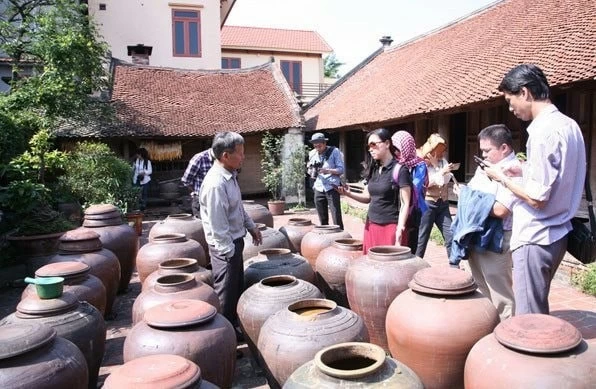 |
| Tourists learn about the traditional soy sauce making craft at Duong Lam Ancient Village, Son Tay town. (Source: Hanoimoi) |
Actively promote the image and unique characteristics of the locality.
According to Ms. Dang Huong Giang, Director of the Hanoi Department of Tourism, suburban tourism is a key focus in the capital's tourism development plan. To achieve this, localities need to develop new tourism products and create strong linkages to transform potential into a "lever" to attract tourists.
One of the destinations that has attracted a large number of domestic and international tourists recently is Duong Lam Ancient Village (Son Tay town). A new feature in tourism activities here is the development of agricultural experience products. Tourists can participate with the locals in planting rice, raising buffaloes, making candy, making soy sauce, etc.
According to Nguyen Dang Thao, Head of the Duong Lam Ancient Village Management Board, at the end of March 2024, Duong Lam Ancient Village welcomed a group of nearly 50 visitors from various countries such as Singapore, Malaysia, Australia, and Japan, who came to experience agricultural and rural tourism products. This product is a highlight in the tourist experience activities this summer.
In addition, the Duong Lam Ancient Village Management Board has launched a "Gamification of Heritage" experience product to allow tourists to explore the heritage of Duong Lam through real-life games such as finding secret messages, treasure hunts, and solving puzzles... "This product is suitable for large families, companies, and businesses," Mr. Nguyen Dang Thao shared.
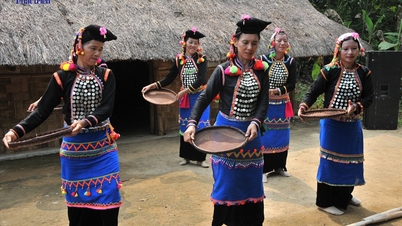
In addition, another attractive experiential tourism destination during the summer months is the Vietnam Ethnic Culture and Tourism Village (Dong Mo, Son Tay town). Here, visitors can experience the distinctive architectural spaces of various ethnic groups, such as the Central Highlands, the Cham ethnic group, and the ethnic minorities of the Northwest region. Visitors can not only take stunning photos and capture memorable moments at the destination but also participate in experiential activities, festivals, and enjoy local cuisine with the ethnic communities.
Besides familiar destinations, Hanoi has also developed many attractive new tourist spots in the suburbs such as: Quang Phu Cau incense stick village (Ung Hoa district), Hong Van ornamental plant village tourist area (Thuong Tin district), Me Linh flower village (Me Linh district), Dan Phuong ecological area... Recently, many localities have launched resort and medical tourism products to meet the needs of tourists.
According to experts, to "awaken" the potential and advantages that attract tourists, localities need to improve the quality of tourism products in their areas, invest in a comprehensive infrastructure system, create a healthy tourism environment, and strengthen connections with businesses.
In addition, districts need to select target customer segments to develop suitable products and plan tourism products that meet the right target audience and market needs. With many upgraded and renewed tourism products, the outskirts of Hanoi are becoming an ideal choice for tourists seeking recreation and relaxation.
Therefore, to develop tourism in the outskirts of Hanoi, in addition to support from all levels of government, local authorities and people also need to flexibly approach and mobilize the participation of the entire community, promote the image so that tourists know about the unique features of the region, thereby creating conditions for tourism development.
Source: https://baoquocte.vn/ha-noi-tao-don-bay-de-du-lich-ngoai-thanh-phat-trien-287785.html
![[Photo] Prime Minister Pham Minh Chinh holds a phone call with the CEO of Russia's Rosatom Corporation.](/_next/image?url=https%3A%2F%2Fvphoto.vietnam.vn%2Fthumb%2F1200x675%2Fvietnam%2Fresource%2FIMAGE%2F2025%2F12%2F11%2F1765464552365_dsc-5295-jpg.webp&w=3840&q=75)


![[Photo] Closing Ceremony of the 10th Session of the 15th National Assembly](/_next/image?url=https%3A%2F%2Fvphoto.vietnam.vn%2Fthumb%2F1200x675%2Fvietnam%2Fresource%2FIMAGE%2F2025%2F12%2F11%2F1765448959967_image-1437-jpg.webp&w=3840&q=75)






































![[OFFICIAL] MISA GROUP ANNOUNCES ITS PIONEERING BRAND POSITIONING IN BUILDING AGENTIC AI FOR BUSINESSES, HOUSEHOLDS, AND THE GOVERNMENT](https://vphoto.vietnam.vn/thumb/402x226/vietnam/resource/IMAGE/2025/12/11/1765444754256_agentic-ai_postfb-scaled.png)









































Comment (0)