

The US private space station, approximately 100 meters long and comprising multiple modules and artificial gravity, will operate in Earth orbit within two years.
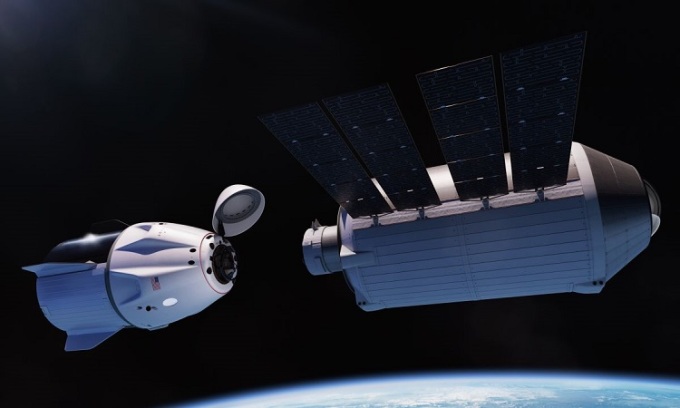
A simulation of SpaceX's Dragon spacecraft flying to the Haven-1 space station. Photo: Vast Space LLC
On May 10, the California-based startup Vast Space announced plans to launch the Haven-1 space station on a SpaceX Falcon 9 rocket no later than August 2025. This will be followed by a Vast-1 mission to transport a crew to the new station and allow them to stay for 30 days. Vast-1 will also launch on a Falcon 9 rocket, and the astronauts will reside in SpaceX's Dragon capsule.
"Vast will launch the world's first commercial space station, Haven-1, and its first crewed space station will be Vast-1," said Jed McCaleb, the company's CEO. "Partnering with SpaceX is the first step in our long-term goal of launching more and larger artificial gravity space stations in Earth orbit and beyond."
Vast is a young company founded two years ago. The company aims to operate a 100-meter-long, multi-module artificial gravity space station launched using SpaceX's transport system. Vast will explore how to conduct the world's first artificial gravity experiment with Haven-1. The company is currently selling four spots on the Vast-1 mission. SpaceX will be responsible for astronaut training, providing spacesuits, and other services, similar to Ax-1, the private flight to the International Space Station (ISS) conducted by Houston-based Axiom Space in April 2022.
If all goes according to plan, Haven-1 will be one of several privately-backed space stations under development. For example, Axiom Space plans to launch several modules to the ISS in the coming years. These modules would then detach and become independent space stations. In late 2021, NASA also allocated a total of $415 million in funding to teams at Blue Origin, Nanoracks, and Northrop Grumman with the hope that at least one privately-backed station will be operating in low Earth orbit before the ISS is decommissioned at the end of 2030.
An Khang (According to Space )
Source link


![[Photo] Prime Minister Pham Minh Chinh presides over a meeting on private sector economic development.](/_next/image?url=https%3A%2F%2Fvphoto.vietnam.vn%2Fthumb%2F1200x675%2Fvietnam%2Fresource%2FIMAGE%2F2025%2F12%2F20%2F1766237501876_thiet-ke-chua-co-ten-40-png.webp&w=3840&q=75)




















































































Comment (0)