


Tourists visiting Con Nhan beach. Photo: Trung Hau
Positive signs
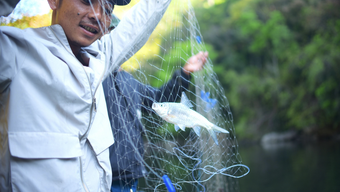
From as early as 3 a.m., depending on the tide, Mr. Ly Van Cong and his wife set sail to begin their near-shore fishing trip. After getting married, Mr. Cong, formerly a fisherman, "started his own business" with a small fishing boat. The workforce consists of three people: him, his wife, and a fellow fisherman. Mr. Cong said: "A fishing trip can earn a few million dong. The work starts early in the morning and ends at noon, then we return to shore. But we have to stay home depending on whether the sea is rough or stormy. The main fishing season is from after Tet (Lunar New Year) until June. This job allows us to save for half a year and eat for the other half, which is how we manage to support four people, especially our two children who are still in school!" They truly are fishermen. Mr. Cong speaks clearly, has a sturdy build, and his skin is tanned by the sun. His wife is also strong and muscular, clearly a skilled net-caster. Having spent more than half his life at sea, and 10 years establishing himself as a fisherman, Mr. Cong confided: "The sea provides a livelihood; this sea yields plenty of fish and shrimp." As she bid farewell to the homeowner, Ms. Do Thi Tuyet, the head of Thanh Ninh hamlet, turned and pointed to two spacious houses still smelling of paint, saying: "Every now and then, you see a beautiful house pop up here. Look! These two houses belong to the two brothers, Mr. Cong and his sibling. The older brother also fishes in this sea."
The people are happy because they can make a living from the sea. That's why Mr. Le Van Vu Thanh, Chairman of the People's Committee of Bao Thuan commune, confidently stated: "In a few years, you'll see a big difference. It will happen very quickly. When it comes to fishing and exploiting marine resources, this commune is only second to An Thuy (now Tiem Tom town)." He then enthusiastically added: "Do you know? The coastal road from Tien Giang to Ben Tre and then to Tra Vinh, which is 6km long, passes through Bao Thuan commune before reaching An Thuy. With a national highway running through the commune, the people are very excited! Oh, Bao Thuan is also about to build a green hydrogen production plant, and the investor is also from Ba Tri!"
Regarding Bao Thuan at the end of this year, I noticed encouraging signs of economic development towards the East, in line with the Provincial Party Committee's policy. Indeed, the East is the sea. For generations, fishermen have gone out to sea to live and work, reaping many benefits from it. It's a native resource, a generous gift from nature. But in this 21st century, with the development of modern technology, what else can people exploit from the ocean? Besides what nature has given, there are many things being reserved, many things being exploited. The image of giant wind turbines glittering on the surface of the sea in Bao Thuan and An Thuy is all too familiar to the people of this region, just as people are becoming accustomed to the terms "wind power" and "solar power" appearing in the countryside. And what about green hydrogen? Let's hear what science has to say:
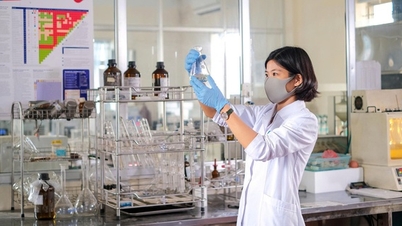
Green hydrogen is a type of hydrogen produced by using renewable energy sources such as wind, solar, or hydroelectric power to electrolyze water ( H₂O ) into hydrogen ( H₂ ) and oxygen ( O₂ ). This process does not emit greenhouse gases and is therefore considered environmentally friendly. Green hydrogen is seen as a clean and sustainable energy source.
Currently, green hydrogen is widely used in many industries, such as: steel production, ammonia synthesis for fertilizer production, road transport for heavy trucks, and in maritime and air transport...
The economy is booming.
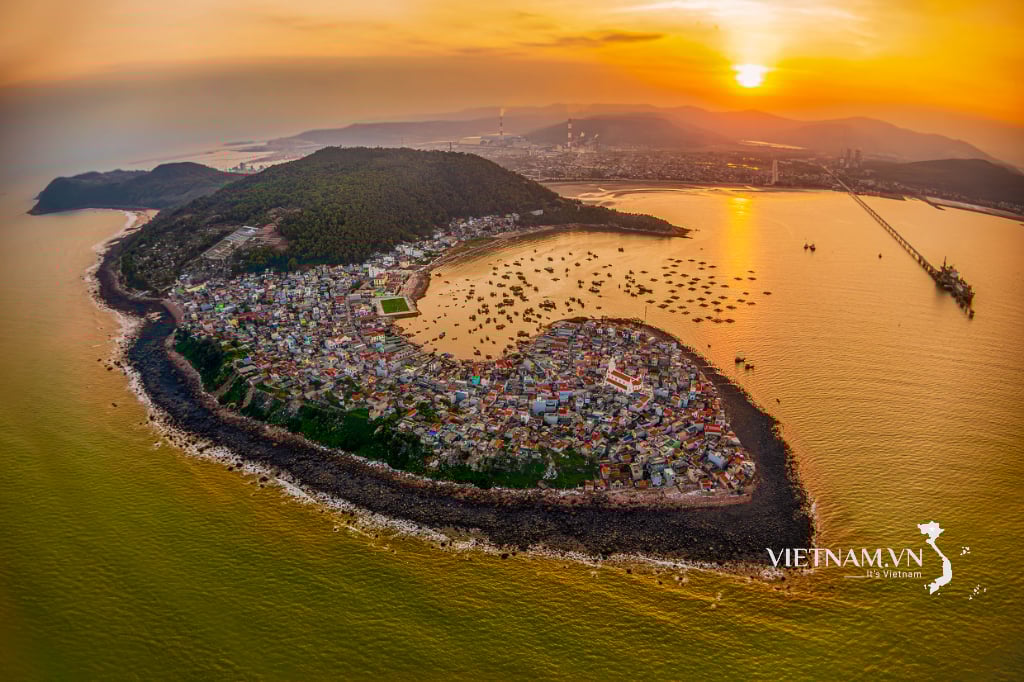
Standing on Nhàn sand dune and contemplating the sea, one is reminded that the sand dune system in the coastal areas of Ba Tri district in particular, and Ben Tre province in general, is the result of repeated sea erosion – advancing and retreating, retreating and advancing – over millions of years. Therefore, the sea has shaped the Vietnamese consciousness with the impermanence of nature and life. "The vast sea transforms into mulberry fields," and do we realize that within each grain of salty silt lies the accumulation of countless dimensions of space and time, the accumulation of immense knowledge from our ancestors, shaping the form and appearance of this coastal region? Today, thanks to the application of new science and technology in exploiting local resources, the coastal economy will undoubtedly flourish strongly in the not-too-distant future.

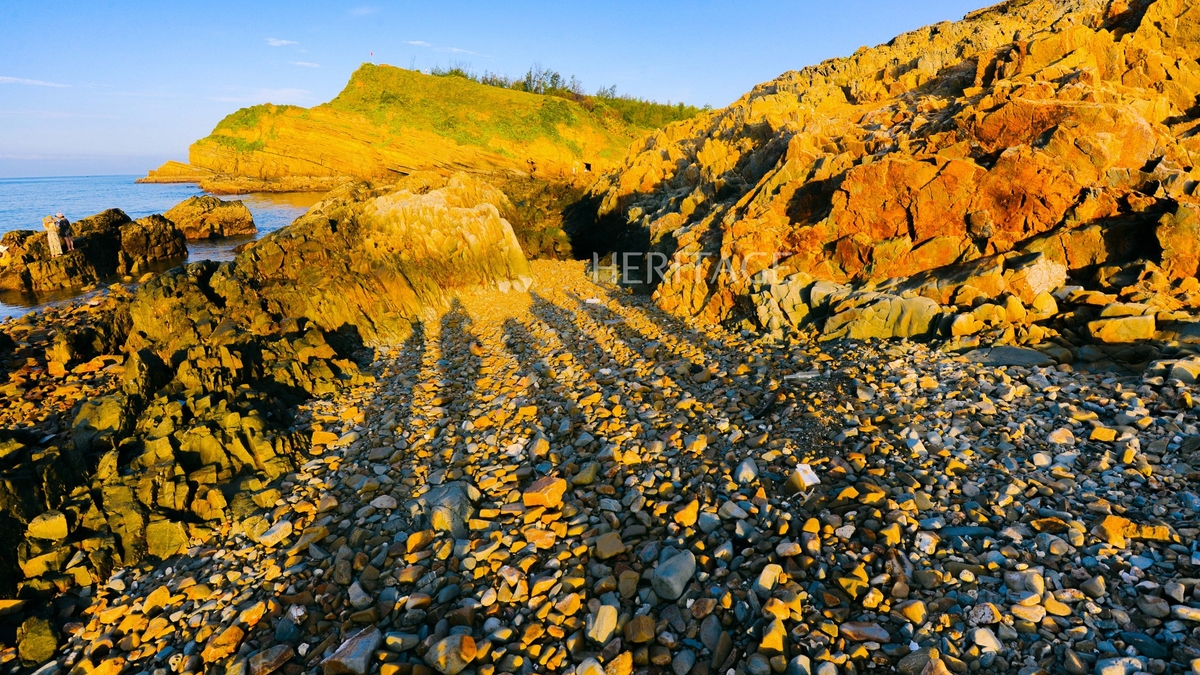
A view of Con Nhan beach, Bao Thuan commune, Ba Tri district. Photo: Minh Hoang
Bao Thuan's land is more naturally endowed than other places, with sand mixed with alluvial soil. This natural condition has helped to distribute production in layers: the coastal area is used for shrimp farming, followed by the land for cotton cultivation, and the inland areas for rice cultivation. Thus, Bao Thuan's direction is to develop a diversified economy, prioritizing the development of fishing and industrial shrimp farming.
One question arises: What will Bao Thuan do to embrace the new wave of economic development towards the East?
Chairman of the People's Committee of Le Van Vu Thanh commune said: "Bao Thuan has a high-tech road" (?). He explained: "Currently, the commune is calling for investment to expand tourism and shrimp farming. To do that, we need modern infrastructure. High-tech roads are roads 8 meters or wider leading to industrial shrimp farming sites, tourist spots, green hydrogen production plants, etc."
Of course, land prices are increasing. According to the leaders of Bao Thuan commune, information about economic development towards the East, land reclamation projects, and coastal roads has attracted many businesses to invest. Currently, land prices in the Con Nhan tourist area are rising. Recently, a tourism investor bought 2 acres of land on the embankment for 5 billion VND! Perhaps that's a price that people in this coastal commune couldn't have imagined two years ago. That's understandable. On National Day, September 2nd, 2024, Bao Thuan commune experienced traffic congestion. That sounds strange! The Chairman of the People's Committee of Bao Thuan commune, Le Van Vu Thanh, said: “About 3,000 people crowded together, with cars and motorbikes pouring into Con Nhan beach. This was the first time Bao Thuan had experienced traffic congestion. Although we had to focus on clearing the roads, it's also a very positive sign because beach tourism is attracting visitors.”
Aspiration to rise
According to the development orientation towards the East, how will Bao Thuan focus its human resources? Chairman of the People's Committee of the commune, Le Van Vu Thanh, said: “Currently, the commune's staff is standardized, and most families in the commune are conscious of raising their children to receive a good education. The number of young people with university degrees or professional skills is increasing. That's the immediate situation; investment in training and improving the quality of human resources must be further promoted.” But Bao Thuan also has an extremely important human resource. The shrimp and fish caught in Bao Thuan have been sold by locals all the way to Saigon, especially at the Binh Dien wholesale market. Some wealthy individuals have opened seafood warehouses at Binh Dien market, then brought their entire families to trade, opening even more seafood warehouses. They established their businesses in Saigon and commute back and forth – a life of two homes. For a long time, Binh Dien market has been the main seafood distribution hub for Bao Thuan. Of the 122 fishing vessels, 36 are offshore fishing vessels. A single owner can possess multiple fishing vessels. This also represents a strong resource for attracting local reinvestment capital.
In the late afternoons of the year, darkness descends as quickly as a witch throwing her black cloak into the depths. The fishing village sinks into night to recharge its energy. Then dawn appears, igniting a bustling rhythm of life. Boats glide across the waves towards the shore to catch the early morning market. Trucks busily turn around, heading towards Saigon. Tourist groups arrive in droves. The docks and boats are bustling with activity. When the sky clears and the view broadens, standing on the sea dike, one suddenly recognizes the distinct shape of the coconut-growing island region. Looking out to sea, to the right is the green strip of Thanh Phu district, separated by the Ham Luong river mouth; to the left is Binh Dai district, lying along the slope of the Ba Lai river mouth. Bao Thuan commune and Tiem Tom town form the base of the delta triangle of the Mekong River. The strips of land on either side of Thanh Phu and Binh Dai stretch out to sea as if two outstretched arms welcoming the future coastal city not far away. It is the aspiration to reach eastward, with a large-scale coastal road connecting the Mekong Delta becoming a driving force for the region's development. It is a crossroads in time at the beginning of the 21st century, and it will be the path to awakening the mindset of wealth creation by exploiting the "ore veins" of local resources. This year's monsoon season is particularly strong, igniting the dream of building a modern coastal city in Ba Tri.
“In the near future, the commune will call for investment in tourism development, focusing on attracting investors with strong capital and technology to create a breakthrough in seafood processing. Bao Thuan will concentrate on exploiting local raw materials, expanding offshore fishing, and high-tech shrimp farming. We will actively build new rural criteria, focusing on investing in transportation, electricity, water systems, etc., to pave the way for investment projects that will be very active this year and in the coming years.” (Chairman of Bao Thuan Commune People's Committee, Le Van Vu Thanh) |
Kim Lien
Source: https://baodongkhoi.vn/kinh-te/thuong-mai/thanh-pho-bien-trong-tam-tay-a141328.html
![[Photo] Prime Minister Pham Minh Chinh holds a phone call with Algerian Prime Minister Sifi Ghrieb](https://vphoto.vietnam.vn/thumb/1200x675/vietnam/resource/IMAGE/2026/03/18/1773849689752_ndo_br_dsc-9609-jpg.webp)


![[Photo] General Secretary To Lam presides over a thematic session on strategic technology.](https://vphoto.vietnam.vn/thumb/1200x675/vietnam/resource/IMAGE/2026/03/18/1773838586650_anh-1-bnd-1822-7089-jpg.webp)












































Comment (0)