

Shifting from small-scale production to supply chain integration.
In recent years, many agricultural economic models based on land advantages, farming experience, and the dynamism of farmers have emerged, gradually shifting from small-scale production to chain linkages. Among these, the Viet Ket Medicinal Herb Cooperative (Nhan Thang commune) is a clear example of the leading role of farmers in production and processing linkages.
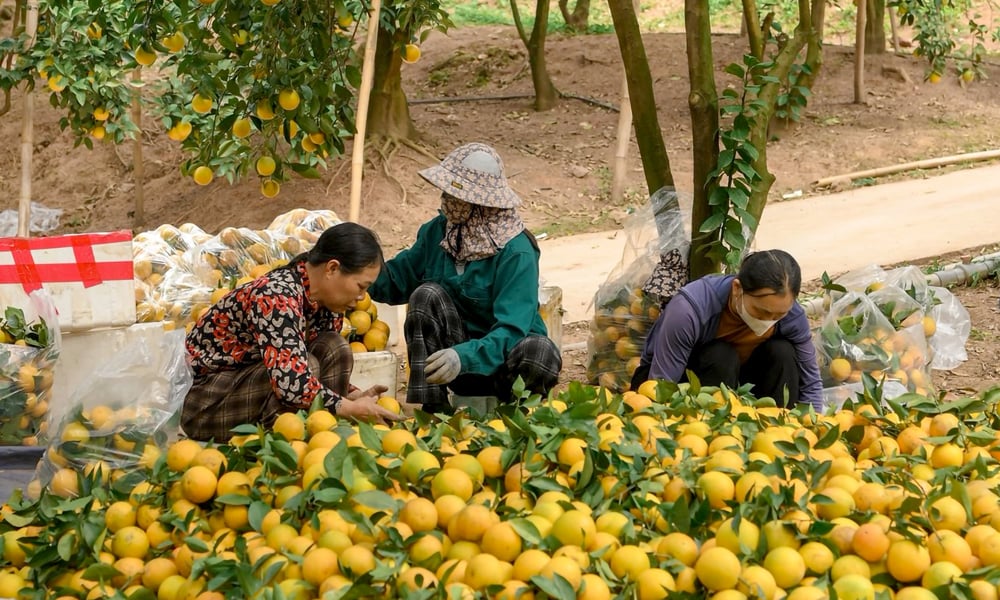 |
Harvesting oranges in the orchard of Mrs. Vu Thi Tan's family. |
Established in 2023 with 10 initial members, the Cooperative aims to cultivate, process, and market medicinal plants, effectively utilizing the land and farming expertise of local people. According to Mr. Tran Dinh Hung, the Cooperative's representative, over the years the unit has leased additional land, reorganized medicinal plant growers into concentrated raw material areas; and collaborated with neighboring localities to procure and expand raw material sources. Simultaneously, it has invested in a modern system of cold drying machines, grinding machines, packaging machines, industrial presses, and production lines; and built a processing and packaging workshop that meets GMP standards as licensed by the Department of Health .
To date, Viet Ket Cooperative has 7 products recognized as 4-star OCOP products. Besides selling through distributors, the Cooperative also proactively applies digital technology , participating in sales on e-commerce platforms such as Shopee, Lazada, TikTok Shop, and Postmart, thereby increasing product value and income for local people.
Not only focusing on production and processing, some farming households are proactively expanding their agricultural development into the service and tourism sectors, creating added value on the same area of land.
On an area of over 4 hectares, the family of Ms. Vu Thi Tan in Bang Cong village, Kien Lao commune, still grows oranges and pomelos like many other households, but they have chosen to combine it with ecotourism. The orchard is cultivated according to the criteria of clean agricultural products, minimizing the use of chemicals, and growing seasonal fruits. Taking advantage of its proximity to the Bau Tien ecotourism area, Ms. Tan's family has developed an agricultural tourism model, opening their orchard to visitors for sightseeing, taking photos, and enjoying the fruit on the spot.
Ms. Tan shared that thanks to the application of intensive farming techniques, the orange orchard is bearing abundant fruit, with a projected yield of approximately 100 tons in 2025. Since the beginning of November, the orchard has been open to visitors at a fee of 30,000 VND per adult, with children admitted free of charge. On average, the orchard receives 150-200 visitors daily from various locations within and outside the province. Revenue from fruit sales and tourism activities is estimated at around 2.8-3 billion VND.
Sustainable agricultural development
For Nhan Thang commune, the challenge of developing the agricultural economy has become more clearly defined with the Resolution of the First Party Congress of the commune, term 2025-2030, which identifies three key objectives: developing and restructuring the agricultural sector towards sustainability; building a safe and environmentally friendly agricultural sector; and increasing people's income. The highlight of the Resolution is the affirmation of the central role of farmers in organizing production, selecting crops, and participating in the value chain.
Following the merger of the former Kien Lao and Kien Thanh communes, Kien Lao commune now has a total natural area of 82.27 km². Of this, the area under fruit trees reaches over 1,811 hectares, with an estimated production of 13,782 tons in 2025. The main crops are lychees (1,106 hectares); over 215 hectares of longan (approximately 1,937 tons, estimated revenue of 11.62 billion VND); along with 85 hectares of oranges, 190 hectares of pomelos, and 130 hectares of apples. These are currently high-value crops, providing a primary source of income for many farming households.
The Resolution of the First Congress of the Kien Lao Commune Party Committee identified the development of high-tech agriculture and forestry, adapting to climate change, based on a green economy and circular economy, and linked to enhancing product value. Simultaneously, it emphasized promoting the application of science and technology and digital transformation; mobilizing investment resources to develop connecting transportation; and prioritizing the development of tourism and services as a key economic sector, maximizing the ecological advantages and local identity.
To restructure the agricultural sector in a substantive way, localities in the province are focusing on leveraging the advantages of each region and each type of strong crop; promoting the establishment of cooperatives; guiding farmers in building planting area codes, linking production and consumption chains, and ensuring that agricultural products meet the requirements to participate in domestic and export markets. At the same time, they are clearly identifying key pillars and breakthrough solutions. First and foremost is raising farmers' awareness and skills in crop varieties, cultivation techniques, and production organization. This is coupled with mechanisms for support through cooperatives, credit funds, and policies supporting capital and seeds. An equally important pillar is investing in infrastructure and forming concentrated agricultural zones suitable to the soil conditions and advantages of each locality.
All these solutions aim to affirm that farmers are the main actors and the central focus in agricultural and rural economic development. Agricultural restructuring also means transforming farmers from mere producers into key players in the rural economy, contributing to building a safe and sustainable agricultural sector and increasing people's income.
Source: https://baobacninhtv.vn/thich-ung-voi-thi-truong-nang-hieu-qua-nong-nghiep-postid433249.bbg

![[Image] Leaked images ahead of the 2025 Community Action Awards gala.](/_next/image?url=https%3A%2F%2Fvphoto.vietnam.vn%2Fthumb%2F1200x675%2Fvietnam%2Fresource%2FIMAGE%2F2025%2F12%2F16%2F1765882828720_ndo_br_thiet-ke-chua-co-ten-45-png.webp&w=3840&q=75)
![[Live] 2025 Community Action Awards Gala](/_next/image?url=https%3A%2F%2Fvphoto.vietnam.vn%2Fthumb%2F1200x675%2Fvietnam%2Fresource%2FIMAGE%2F2025%2F12%2F16%2F1765899631650_ndo_tr_z7334013144784-9f9fe10a6d63584c85aff40f2957c250-jpg.webp&w=3840&q=75)
![[Photo] Prime Minister Pham Minh Chinh receives Lao Minister of Education and Sports Thongsalith Mangnormek](/_next/image?url=https%3A%2F%2Fvphoto.vietnam.vn%2Fthumb%2F1200x675%2Fvietnam%2Fresource%2FIMAGE%2F2025%2F12%2F16%2F1765876834721_dsc-7519-jpg.webp&w=3840&q=75)
![[Photo] Prime Minister Pham Minh Chinh receives the Governor of Tochigi Province (Japan)](/_next/image?url=https%3A%2F%2Fvphoto.vietnam.vn%2Fthumb%2F1200x675%2Fvietnam%2Fresource%2FIMAGE%2F2025%2F12%2F16%2F1765892133176_dsc-8082-6425-jpg.webp&w=3840&q=75)


































![[Photo] Prime Minister Pham Minh Chinh attends the Vietnam Economic Forum 2025](https://vphoto.vietnam.vn/thumb/402x226/vietnam/resource/IMAGE/2025/12/16/1765893035503_ndo_br_dsc-8043-jpg.webp)















Comment (0)