

 |
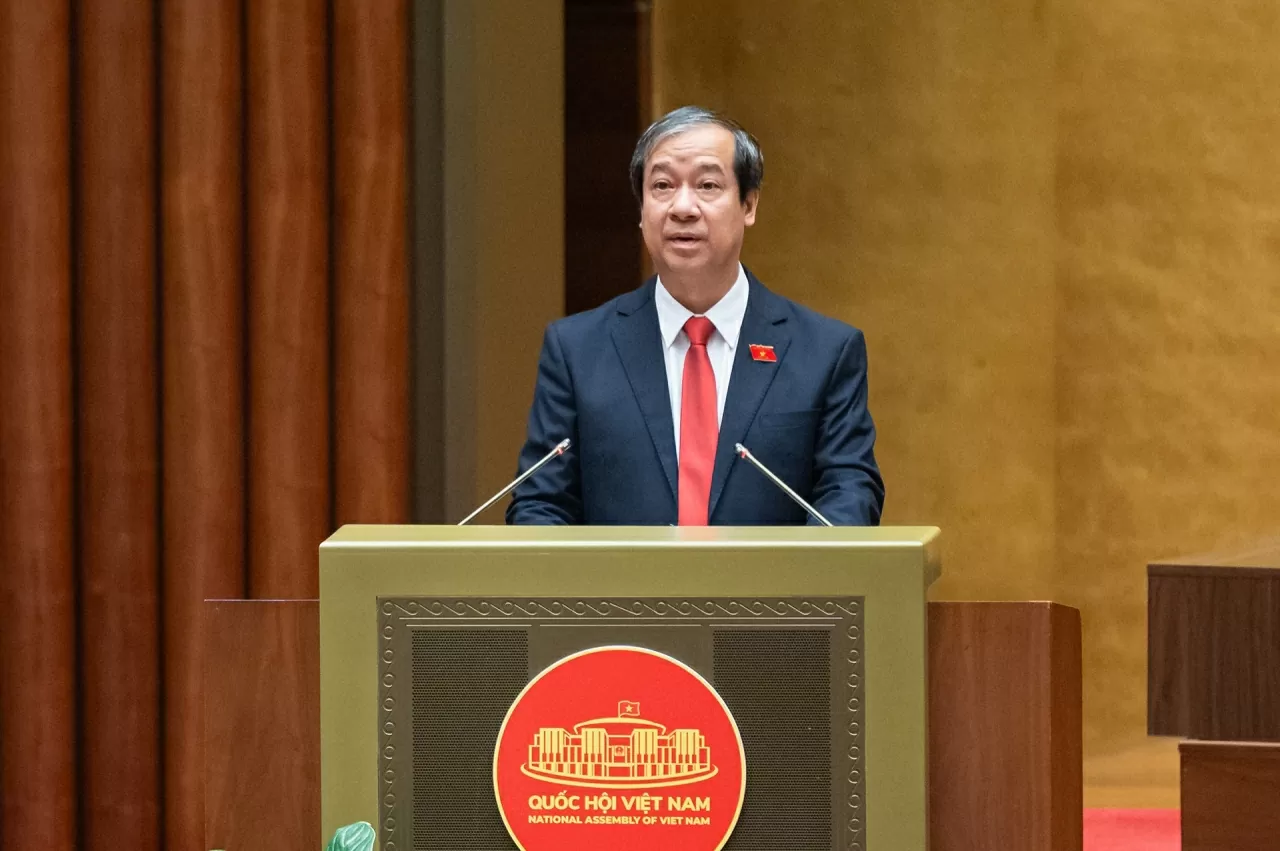
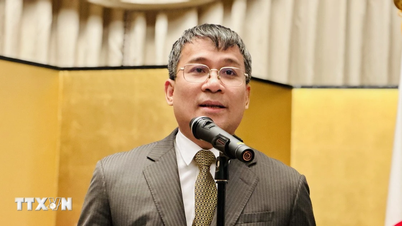
| Minister of Education and Training Nguyen Kim Son. (Source: National Assembly ) |
At the 10th session of the 15th National Assembly, on the morning of December 10th, the National Assembly voted to pass the amended Law on Higher Education .
According to a report by the Minister of Education and Training, Nguyen Kim Son, during the drafting and finalization process, the draft law received 336 comments, including 244 comments from National Assembly deputies, 19 comments from specialized deputies, and 3072 comments from the National Assembly's Committee on Culture and Social Affairs.
Based on the feedback received on the draft law, the Government has promptly incorporated as many comments as possible, as well as finalized the draft Law on Higher Education (amended), and completed the revised report to be submitted to the National Assembly. On behalf of the Government, and authorized by the Prime Minister , Minister Nguyen Kim Son presented a summary of the eight main groups of contents that have been incorporated and revised by the drafting agency.
Firstly , regarding the necessity and scope of amendments to the higher education law, and the conformity of the draft content with the Party's guidelines and policies.
The majority of National Assembly delegates agreed with the content of the draft law regarding its necessity, and unanimously supported the objectives and perspectives for a comprehensive revision of the higher education law, in line with the Party and State's policies and guidelines. This was especially true for the Politburo's resolutions on breakthroughs in the development of education and training in science and technology, innovation, digital transformation, and international integration.
Secondly , regarding university autonomy linked to accountability, the government has incorporated feedback on university autonomy and institutional frameworks into its policies, ensuring full and comprehensive autonomy for higher education institutions regardless of their level of financial autonomy. The perspective has shifted from "autonomy means self-reliance" to a mechanism where the state and higher education institutions jointly care for the development of higher education.
Thirdly , regarding the regional university model. Regional universities were established in accordance with the Party and Government's policies and have proven effective, achieving prestigious rankings among educational institutions in Asia and the world. The Government has incorporated revisions and redesigned them to improve the internal governance of each regional university and clarify its strategic coordination function. The Government has also comprehensively reviewed the organizational model of regional universities, assessed the current level of decentralization and decentralization, and reviewed and reduced intermediate steps as directed by Resolution 71 of the Politburo.
Fourth , review the regulations on member universities of national and regional universities. The government has incorporated revisions and improvements to the regulations on the legal status of member universities, aiming to overcome the inconsistencies in the application of the law in the past.
Member universities are both constituent units within the organizational structure of national and regional universities, and selectively inherit the provisions of the current higher education law.
This revision ensures that the legal and organizational relationships and internal governance between the National University, the Regional University, and its member universities are fully reflected, in the spirit of "reducing intermediaries, streamlining the apparatus, and enhancing efficiency, effectiveness, and efficiency."
Fifthly , regarding advanced postgraduate training in the health sector, residency and specialist training (Specialist Level 1, Specialist Level 2) is postgraduate training aimed at producing skilled doctors to work in hospitals. It does not fall under the master's or doctoral levels, but rather is considered an academic training program.
The Ministry of Education and Training and the Ministry of Health have reached a high level of agreement on the general principles stipulated in the draft law. Advanced postgraduate training programs in the health sector leading to residency and specialist doctor degrees will be guided, organized, and managed by the Ministry of Health. This formalizes the work that the Ministry of Health has been doing for some time now.
Sixth , the group of suggestions related to financial investment, quality assurance, policies for students, and investment in building a model of international university training center similar to an international financial center. The Government has incorporated and revised the orientation in accordance with Resolution 71, in which the State plays a leading role in supporting funding for public higher education institutions to train in certain fields to achieve regional and international standards, as well as providing partial funding for public higher education institutions to upgrade their standards.
The government implements policies to support the sustainable development of private higher education institutions, fostering the formation of excellent universities that lead the system and ensuring investment resources for higher education. The state manages the information technology application system to ensure multiple standards, seamlessly combining post-audit and pre-audit processes to guarantee the quality of higher education. Regarding the International University Training Center, similar to the International Finance Center model, the government agrees that further research and evaluation of this model are needed, along with consideration of its practical application in the future.
Seventh , the group of opinions added to the application of technology in higher education. The government has accepted and explained that the draft law already includes regulations on the core contents of digital transformation in higher education. This includes requirements for technological infrastructure, information security, protection of personal data, and digital competency standards for lecturers, administrators, and students. At the same time, it allows higher education institutions to cooperate with businesses and research institutes to cultivate digital competencies and implement advanced technological solutions. The regulations also clarify the responsibilities of higher education institutions in digital transformation in governance and training organization.
Eighth , regarding the documentation, the procedures for policy development, law drafting, and the technical language and format of the document. Besides finalizing the draft law, the Government also organized the development and finalization of the draft decree detailing the implementation guidelines for the law, following the correct procedures as stipulated in the Law on the Promulgation of Legal Documents.
After hearing the Government's report on the amendments and explanations, the National Assembly voted to pass the Law on Higher Education (amended) with 440 delegates participating (93.02%), of which 411 delegates voted in favor (86.89%).
Thus, the amended Law on Higher Education has been officially passed, with the expectation of contributing to the modernization and improvement of the quality of education in our country during this new development phase.
Source: https://baoquocte.vn/thong-qua-luat-giao-duc-dai-hoc-sua-doi-bo-y-te-quan-ly-viec-dao-tao-bac-si-noi-tru-chuyen-khoa-337344.html

![[Photo] Prime Minister Pham Minh Chinh receives the Governor of Tochigi Province (Japan)](/_next/image?url=https%3A%2F%2Fvphoto.vietnam.vn%2Fthumb%2F1200x675%2Fvietnam%2Fresource%2FIMAGE%2F2025%2F12%2F16%2F1765892133176_dsc-8082-6425-jpg.webp&w=3840&q=75)
![[Image] Leaked images ahead of the 2025 Community Action Awards gala.](/_next/image?url=https%3A%2F%2Fvphoto.vietnam.vn%2Fthumb%2F1200x675%2Fvietnam%2Fresource%2FIMAGE%2F2025%2F12%2F16%2F1765882828720_ndo_br_thiet-ke-chua-co-ten-45-png.webp&w=3840&q=75)
![[Photo] Prime Minister Pham Minh Chinh receives Lao Minister of Education and Sports Thongsalith Mangnormek](/_next/image?url=https%3A%2F%2Fvphoto.vietnam.vn%2Fthumb%2F1200x675%2Fvietnam%2Fresource%2FIMAGE%2F2025%2F12%2F16%2F1765876834721_dsc-7519-jpg.webp&w=3840&q=75)
















































![[Photo] Prime Minister Pham Minh Chinh attends the Vietnam Economic Forum 2025](https://vphoto.vietnam.vn/thumb/402x226/vietnam/resource/IMAGE/2025/12/16/1765893035503_ndo_br_dsc-8043-jpg.webp)





























Comment (0)