

"With the abolition of district-level police forces, the operations of 694 district-level police units and approximately 5,916 teams under those district-level police forces will cease," the Minister of Public Security informed.
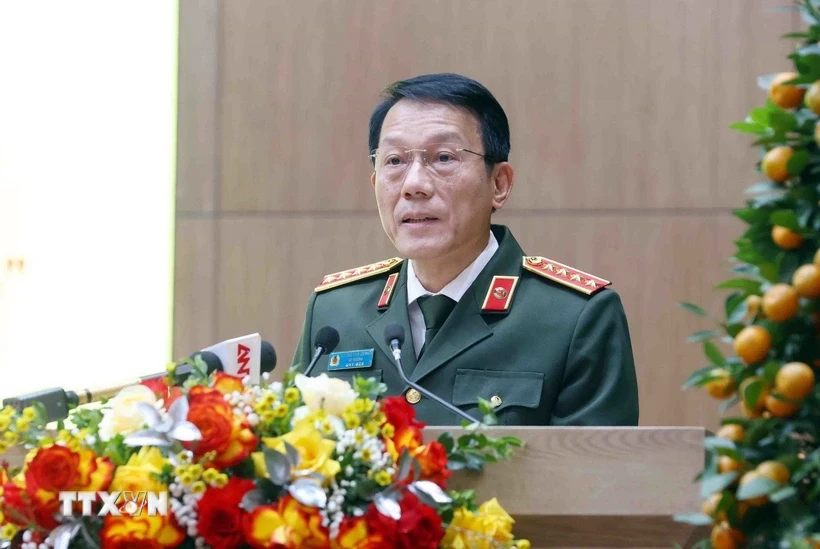
On February 18th, General Luong Tam Quang, Member of the Politburo and Minister of Public Security, provided information on the policy of establishing a three-tiered police force, eliminating district-level police forces. He stated that this policy had been thoroughly assessed in terms of tasks, with careful calculations and adjustments to assignments and decentralization to ensure clarity, consistency, and continuity, preventing interruptions in work and ensuring no gaps in areas or fields. This was coupled with the adoption of five groups of tasks from various ministries and agencies, and the acceleration of digital transformation and administrative procedure reform.
The workload is large, and the work must be carried out with a very high level of responsibility.
Minister Luong Tam Quang stated that, setting an example and taking the lead in implementing the Party's policies, the conclusions and plans of the Central Steering Committee, the Government Steering Committee, the Party Committee of the Central Public Security Ministry, and the Ministry of Public Security, the Ministry has promptly summarized the 7 years of implementing Resolution No. 18 of the Sixth Plenum of the 12th Central Committee on some issues regarding the continued reform and restructuring of the political system's organizational apparatus to be streamlined, effective, and efficient; reported to the Politburo and the 13th Central Committee for approval of the policy to continue adjusting the functions, tasks, powers, and organizational structure of the Ministry of Public Security towards streamlining the local police apparatus to be lean, efficient, and effective; and taken over some tasks from other ministries and sectors regarding the People's Public Security force to thoroughly overcome the situation of overlapping and fragmentation in geographical areas and fields, causing difficulties and reducing the effectiveness in organizing services for people and businesses.
Specifically, the People's Public Security Force will take over five groups of tasks from ministries and agencies (including state management and ensuring aviation security; state management of cybersecurity; state management of testing and issuing driver's licenses for motor vehicles; state management of criminal records and providing public services for issuing criminal record certificates; state management of drug addiction treatment and post-treatment management) and will also take over the General Corporations to build a modern, dual-use security industry; and streamline the local police organizational structure from three levels to two levels (without establishing district-level police).
“Compared to previous occasions, this restructuring and streamlining of the Ministry of Public Security's organizational apparatus was carried out synchronously with the summary of Resolution 18 at all levels and sectors, in a very short time. However, like previous occasions, it involved an extremely large volume of work, carried out with a very high sense of responsibility, unity, and solidarity of the entire force with the spirit of wholeheartedly serving the Fatherland and the people, daring to think, daring to act, daring to take responsibility, daring to sacrifice, all for the development of the country, for ensuring firm security and order, and for the peaceful and happy lives of the people,” Minister Luong Tam Quang emphasized.
Reducing hierarchical levels to improve the quality, effectiveness, and efficiency of work.
Regarding the decision not to establish district-level police forces, Minister Luong Tam Quang stated that the review of Resolution No. 18 showed that the organizational structure of the police force according to four levels – "a lean central ministry, strong provincial police, comprehensive district police, and grassroots-based commune police" – needs further adjustment to reduce hierarchical levels and intermediate tiers, making it more streamlined, efficient, effective, and better serving the people.
Accordingly, the Party Committee of the Central Public Security Ministry and the Ministry of Public Security reported to and received approval from the Politburo and the Central Committee for the principle of reorganizing the four-level police model into a three-level system. For local police forces, the motto will be adjusted from "strong province, comprehensive district, grassroots-based commune" to "comprehensive province; strong, grassroots-based commune"; provincial-level police will comprehensively address all security and order situations in the locality; and commune-level police will be strengthened, built to be strong and grassroots-based, resolving emerging security and order issues from the outset and at the grassroots level.
"With the abolition of district-level police forces, the operations of 694 district-level police units and approximately 5,916 teams under those district-level police forces will cease," the Minister of Public Security informed.
The restructuring and streamlining of the local police apparatus aims to change the operating mechanism, reduce hierarchical levels, and improve the quality, effectiveness, and efficiency of work, as well as the quality of service to the people.
The reorganization and restructuring of tens of thousands of officers and soldiers will be carried out, focusing on the deployment and reinforcement of personnel at the provincial and commune levels, with priority given to the deployment and reinforcement of personnel at the commune level, especially in areas with large land areas, dense populations, complex security and order situations, difficult areas, and remote regions.
The facilities, headquarters, and equipment of the former district-level police continue to be strictly managed in accordance with the regulations of the State and the Ministry of Public Security; the Ministry has developed a plan to adjust them to ensure they are consistent with the new organizational structure and the orientation of force deployment in the area, meeting the requirements and tasks.
Minister Luong Tam Quang stated that the Politburo's policy is to maintain and ensure the staffing levels of the armed forces during the reorganization of the apparatus to meet the requirements and tasks of the new era; the Ministry of Public Security has taken on additional tasks from other ministries and sectors, therefore it does not encourage officers and soldiers to retire before the age limit, while actively implementing personnel reduction for those with weak qualities and capabilities.
Regarding the arrangement, deployment, and transfer of personnel when district-level police forces are not organized and when receiving personnel from ministries and agencies, the Party Committee of the Central Public Security Ministry and the Ministry of Public Security have thoroughly discussed and agreed on the principles, orientations, and plans as a basis for police units and localities to develop specific plans and organize implementation, ensuring compliance with the principles of democratic centralism, emphasizing the responsibility of the head, transparency, objectivity, and based on accurate personnel evaluation according to regulations and specific personnel work requirements; strictly prohibiting the abuse of the policy for corruption and negative practices; and simultaneously directing the strengthening of inspection, supervision, and prevention of violations.
Party committees and organizations within the People's Public Security have effectively carried out political and ideological work, creating unity in understanding and determination throughout the force regarding the restructuring and streamlining of the organizational apparatus for efficient, effective, and effective operation.
The vast majority of officials possess strong political resolve, are confident in their work, and wholeheartedly support the Ministry of Public Security's policy of reforming and reorganizing its structure, contributing to improving the quality of security and order maintenance in the new situation.
Promoting full-process online public services towards personalized digital services, independent of administrative boundaries.
Regarding the competence of officials and the effectiveness of work management, the Minister of Public Security stated that this is measured by the quality and effectiveness of security and order maintenance work; and the satisfaction of the people in carrying out administrative procedures related to security and order.
In this new organizational model, national security will be firmly strengthened across all areas and sectors, addressing complex potential issues early, proactively, and at the grassroots level; crime will be sustainably reduced; and people will live peacefully and happily in an increasingly orderly, disciplined, safe, and healthy society, with the quality of public service constantly improving.
The process of summarizing and proposing the policy of organizing the police force into three levels involved a thorough assessment of tasks, careful calculations, and adjustments to assignments and decentralization to ensure clarity, consistency, and continuity, preventing interruptions in work, ensuring no areas or fields are left unattended, and avoiding the omission or loss of responsibilities.
Along with accelerating the implementation of digital transformation and administrative procedure reform in the Public Security sector, and continuing to advise on and strongly promote the implementation of Project No. 06 in the direction of "strengthening the reduction and elimination of unnecessary administrative procedures, shifting the state of public service provision from 'request-and-grant' to 'proactive' service to citizens and businesses; improving the quality of online public services throughout the entire process towards personalized digital services, independent of administrative boundaries," with regular guidance and professional direction from provincial and ministerial-level Public Security agencies to the commune level, basically no significant difficulties or obstacles will arise.
Ensure inter-agency coordination with the Courts and the Procuratorate.
Regarding inter-agency coordination with the Courts and Procuratorates when there is no district-level police force, Minister Luong Tam Quang stated that the Ministry of Public Security has coordinated with the Supreme People's Procuratorate and the Supreme People's Court to research and develop a joint circular regulating coordination between competent agencies in criminal proceedings, management, execution of temporary detention and custody, and execution of criminal sentences when there is no district-level police force.
This comprehensively addresses issues in the coordination of investigation, detention, custody, and execution of criminal sentences between investigative agencies and the People's Procuracy and People's Courts at the local level.
At the same time, a comprehensive review of the relevant legal documents was proactively and urgently conducted, and proposals for amendments and additions were made to meet the requirements of the work immediately after the reorganization, ensuring legal consistency and preventing legal gaps that would disrupt the normal operation of the police force as well as agencies, organizations, businesses, and individuals.
Initially, we will apply the National Assembly's Resolution on handling matters related to organizational restructuring; subsequently, we will proactively advise the Government and the National Assembly to issue appropriate amendments and supplements.
The transfer of functions and responsibilities from several other ministries and agencies essentially creates cohesion and interconnectedness, overcoming the previous fragmentation where multiple agencies handled the same task. It reduces coordination mechanisms (for example, the criminal record check, formerly handled by the Ministry of Justice, was jointly carried out by the Ministry of Public Security's professional records department), and improves the quality of work and the effectiveness of service to the people.
Minister Luong Tam Quang further stated that the Ministry of Public Security has developed specific plans for its functions and tasks in serving the people, and will publicly and widely announce detailed information to the public before the implementation of the new organizational structure. This is to ensure there are absolutely no negative impacts and to provide the greatest possible convenience for citizens in resolving related issues.
Reorganizing the police force without district-level police units will create the highest efficiency, effectiveness, and effectiveness, best serving the people, maximizing convenience for national development, ensuring solid security and order, consolidating a safe and healthy environment, and contributing to new breakthroughs for the country in the digital transformation era.
Source
![[Photo] Prime Minister Pham Minh Chinh receives the Governor of Tochigi Province (Japan)](/_next/image?url=https%3A%2F%2Fvphoto.vietnam.vn%2Fthumb%2F1200x675%2Fvietnam%2Fresource%2FIMAGE%2F2025%2F12%2F16%2F1765892133176_dsc-8082-6425-jpg.webp&w=3840&q=75)
![[Photo] Prime Minister Pham Minh Chinh receives Lao Minister of Education and Sports Thongsalith Mangnormek](/_next/image?url=https%3A%2F%2Fvphoto.vietnam.vn%2Fthumb%2F1200x675%2Fvietnam%2Fresource%2FIMAGE%2F2025%2F12%2F16%2F1765876834721_dsc-7519-jpg.webp&w=3840&q=75)
![[Image] Leaked images ahead of the 2025 Community Action Awards gala.](/_next/image?url=https%3A%2F%2Fvphoto.vietnam.vn%2Fthumb%2F1200x675%2Fvietnam%2Fresource%2FIMAGE%2F2025%2F12%2F16%2F1765882828720_ndo_br_thiet-ke-chua-co-ten-45-png.webp&w=3840&q=75)

![[Live] 2025 Community Action Awards Gala](/_next/image?url=https%3A%2F%2Fvphoto.vietnam.vn%2Fthumb%2F1200x675%2Fvietnam%2Fresource%2FIMAGE%2F2025%2F12%2F16%2F1765899631650_ndo_tr_z7334013144784-9f9fe10a6d63584c85aff40f2957c250-jpg.webp&w=3840&q=75)














































![[Live] Closing Ceremony and Award Presentation for the "Impressive Vietnam Tourism" Video/Clip Creation Contest 2025](https://vphoto.vietnam.vn/thumb/402x226/vietnam/resource/IMAGE/2025/12/17/1765974650260_z7273498850699-00d2fd6b0972cb39494cfa2559bf85ac-1765959338756946072104-627-0-1338-1138-crop-1765959347256801551121.jpeg)























Comment (0)