

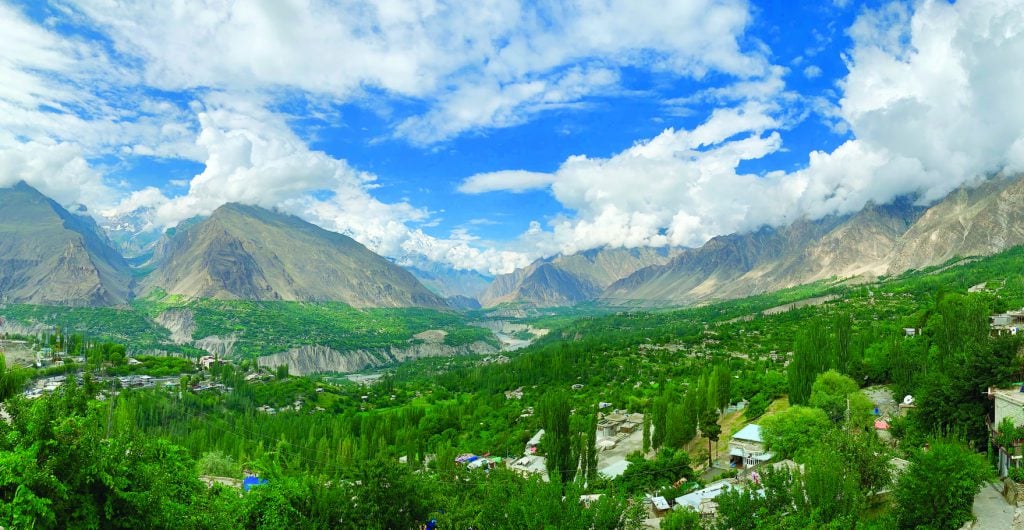
Panoramic view of the Hunza Valley from Fort Baltis.
The most talked-about destination in this South Asian country is the pristine northern mountainous region – the Hunza Valley. To get there, you must travel nearly 600km along winding mountain roads from the capital Islamabad, following the N15 highway, crossing the Barbusar Pass, which is over 4,000m high, before descending along the Karakoram Highway. The route is filled with treacherous, hair-raising curves, with cloud-shrouded cliffs on one side and a bottomless abyss on the other; during rainy seasons, landslides can occur, causing hours of traffic jams. Only Pakistani drivers possess the alertness and agility to skillfully navigate the roads, providing travelers with a thrilling yet captivating experience. Along the way, you'll encounter numerous large trucks, adorned with the country's famous colorful designs, and sometimes even military convoys maintaining security at key high points and border areas; it's sure to be a memorable experience for those hours spent chasing the sunset.
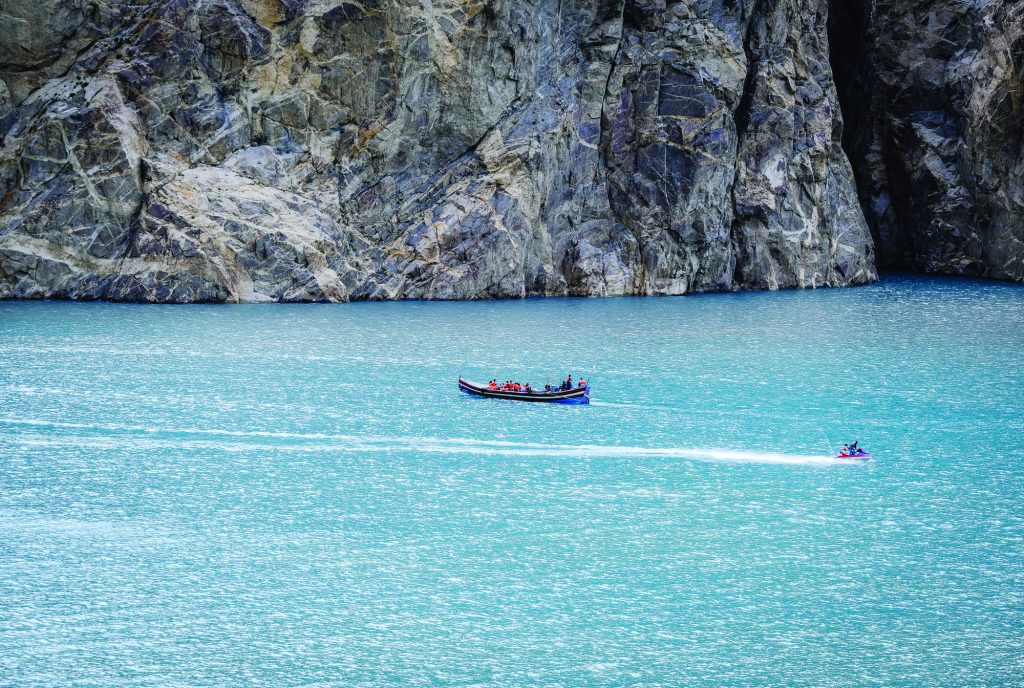
Lake Attabad with its peaceful, white and blue waters.
Another option for travelers is to fly from the capital to Gilgit Airport, which is 100km by road from Hunza. However, this domestic route uses ATR aircraft, so takeoffs and landings are entirely dependent on weather conditions, and most flights are cancelled if conditions are unfavorable.
Crossing the Karakoram Highway, admiring the deep green patches of forest against the rocky hills, gazing at the rushing rivers and streams at the foot of the pass, and following the setting sun hidden behind snow-capped peaks, travelers "fall" into the heart of the Hunza Valley in the wondrous Gilgit Baltistan region. Hunza is surrounded by many majestic peaks such as Rakaposhi (7,788m), Diran (7,266m), Ultar II (7,388m), Shispare (7,611m), and Passu Sar (7,478m), making it a renowned destination for those who love mountaineering and adventure sports . One of our favorite activities was waking up early, climbing to the high points, setting up our tripods, and leisurely watching the sunrise carpet the snow-capped slopes and illuminate the peaceful valley with its vibrant villages below. As night falls, amidst the surrounding silence and mountains, the vast sky of Hunza captivates with thousands of twinkling stars and the majestic, unbelievably beautiful Milky Way stretching out before one's eyes!
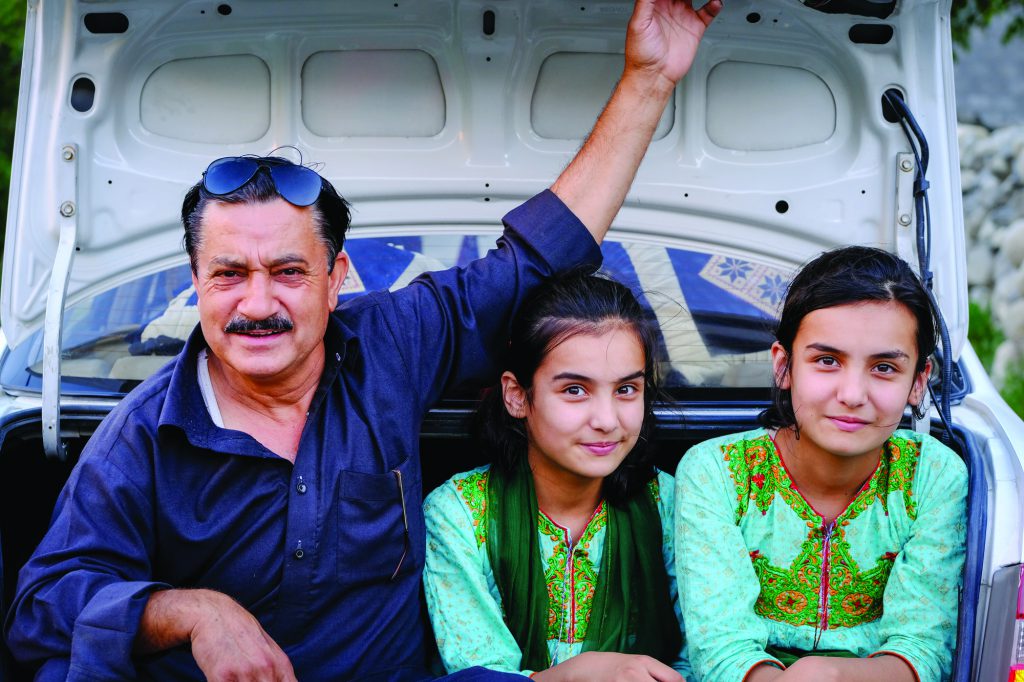
The people of Hunza are friendly and hospitable.
The uniqueness of Hunza lies not only in its scenery but also in its culture and people! Descendants of the Indo-Aryan people, carrying within them the oldest influences of Zoroastrianism from Persia, the essence of South Asia distilled from the thousand-year-old Silk Road, and blended with the finest elements of Shia Islam; the people of Hunza surprise anyone who only knows this land through the media. The sincerity and hospitality of the locals are the most beautiful reward for those who are not afraid to explore .
Pakistani children attend school and learn in English, so in Hunza, it's easy for everyone to communicate with foreign tourists. They readily invite you to their homes for tea, jam, and to pick fresh fruit from their gardens. When you leave, you receive fruits they've grown and harvested themselves. I don't remember how many kilometers I traveled through the hills and mountains, how many houses I visited, how many stone fences I passed, or how many locals I met, but I vividly remember the feeling of being moved by each charming Pakistani smile. To them, everyone seems like a stranger arriving as a traveler and leaving as a close friend.
In recent years, Pakistan has been striving to attract tourists by opening eVisa to over 170 countries, including Vietnam, tightening security, promoting friendliness and safety, and upgrading tourism services and amenities. It is believed that this land will soon welcome even more adventurous travelers and explorers.
Source: https://heritagevietnamairlines.com/thung-lung-hunza/
![[Photo] A vibrant celebration of generations of Nhan Dan Newspaper staff](https://vphoto.vietnam.vn/thumb/1200x675/vietnam/resource/IMAGE/2026/03/11/1773228432744_cb-75-nam-7-7034-jpg.webp)









































































Comment (0)