Counterfeit drugs in local areas
While there are now established mechanisms for decentralization and delegation of authority, the question remains how effective the practical implementation is, leading to continued cases of counterfeit drugs, cosmetics, and food products. Despite clear decentralization and delegation of authority, the organization and practical implementation still suffer from many shortcomings.
Ministries and departments are responsible for providing guidance, and localities for organizing, but why do incidents like the recent one in the provinces involving counterfeit medicines and fake dietary supplements still occur, seriously affecting people's health? Therefore, it is necessary to discuss and propose solutions. If the problem is due to institutional issues, proposals for adjustments and amendments will be urgently made.
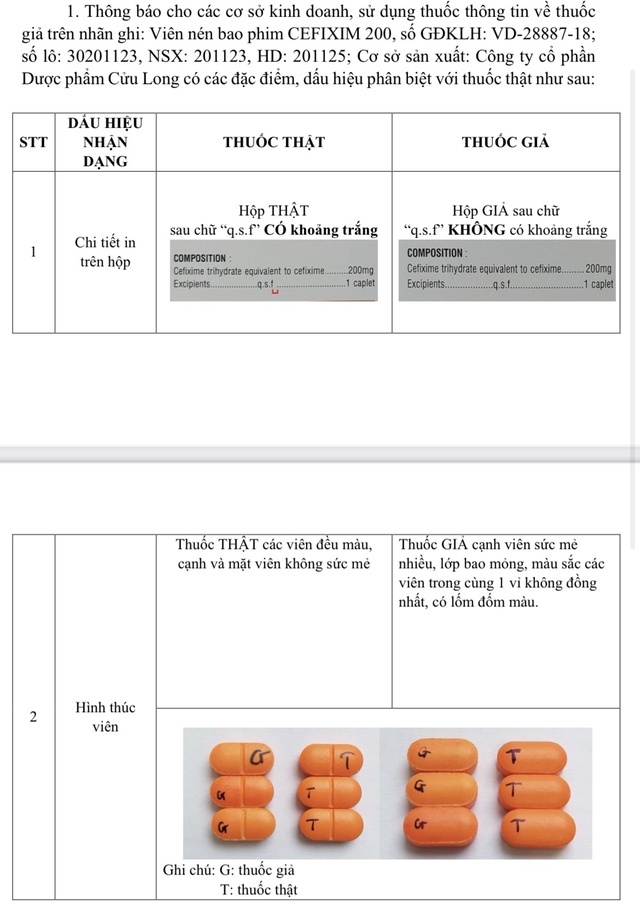
Counterfeit drugs focus on common medications: antibiotics, and bone and joint medications.
PHOTO: DAV.GOV.VN
At an online meeting held this morning (May 7th) with ministries, departments, and provincial and city People's Committees on controlling and preventing counterfeit drugs, cosmetics, and food, Deputy Minister of Health Do Xuan Tuyen highlighted the existing realities that allow counterfeit drugs and food to exist. This situation is assessed by the management agency as "increasingly sophisticated and easily infiltrating the distribution channels."
Mr. Tuyen believes that a realistic assessment of the production, trade, distribution, and use of functional foods and medicines is needed, so that in the future, more systematic solutions can be developed, and management of each stage—import, production, distribution, and consumption—can be tightened.
Drugs of unknown origin are slipping through inspection.
Regarding information on counterfeit drugs, Mr. Ta Manh Hung, Deputy Director of the Drug Administration Department (Ministry of Health ), said that monitoring has shown that counterfeit drugs are concentrated in antibiotics and specialized medications (respiratory, digestive, and musculoskeletal).
According to Mr. Hung, every year, the Ministry of Health develops and implements plans for regular and unscheduled inspections of business conditions; the maintenance of compliance by drug manufacturing, trading, wholesale, and retail establishments; and conducts regular inspections of over 30% of drug manufacturing and trading establishments.
In 2024 alone, the Drug Administration Department and the Traditional Medicine Administration Department (Ministry of Health) deployed 170 inspection teams to examine the production, storage, and distribution of pharmaceuticals, cosmetics, medicinal herbs, and traditional medicine ingredients. As a result, 46 administrative violation penalties were issued, totaling over 2.5 billion VND.
However, Mr. Hung pointed out the reality that people still completely trust sellers and retailers, while violations of drug quality standards are not being thoroughly controlled or dealt with.
"Buying and selling without invoices or receipts creates opportunities for counterfeit drugs to exist, but this practice has not been strictly and thoroughly addressed, allowing counterfeit drugs to infiltrate various establishments. During inspections, businesses hide drugs without invoices, making it impossible to obtain samples for testing," Mr. Hung pointed out the limitations that have persisted over the years, making it very difficult to find counterfeit drugs during sampling.
Deputy Minister Tuyen suggested that people should be encouraged to report suspected counterfeit products, the sale of medicines without a clear origin, and to report establishments that produce counterfeit food and medicine.
"In particular, we need to strengthen the management of online businesses. We need to increase unannounced inspections. Because if we only conduct pre-announced, periodic inspections, everything will be fine," Mr. Tuyen said.
"I urge provinces and cities to launch a concentrated campaign in May to combat counterfeit medicines and fake dietary supplements. Local authorities must actively participate, not just keep plans on paper; and report the results to the Ministry of Health before June 10, 2025," Mr. Tuyen emphasized.
Source: https://thanhnien.vn/thuoc-gia-kho-phat-hien-khi-di-lay-mau-185250507095740467.htm























![[Photo] Reception to welcome General Secretary and President To Lam and his wife on their State visit to the Philippines](https://vphoto.vietnam.vn/thumb/1200x675/vietnam/resource/IMAGE/2026/06/01/1780295488620_vna-potal-chieu-dai-chao-mung-tong-bi-thu-chu-tich-nuoc-to-lam-va-phu-nhan-tham-cap-nha-nuoc-toi-philippines-8798060-7855-jpg.webp)



















































Comment (0)