


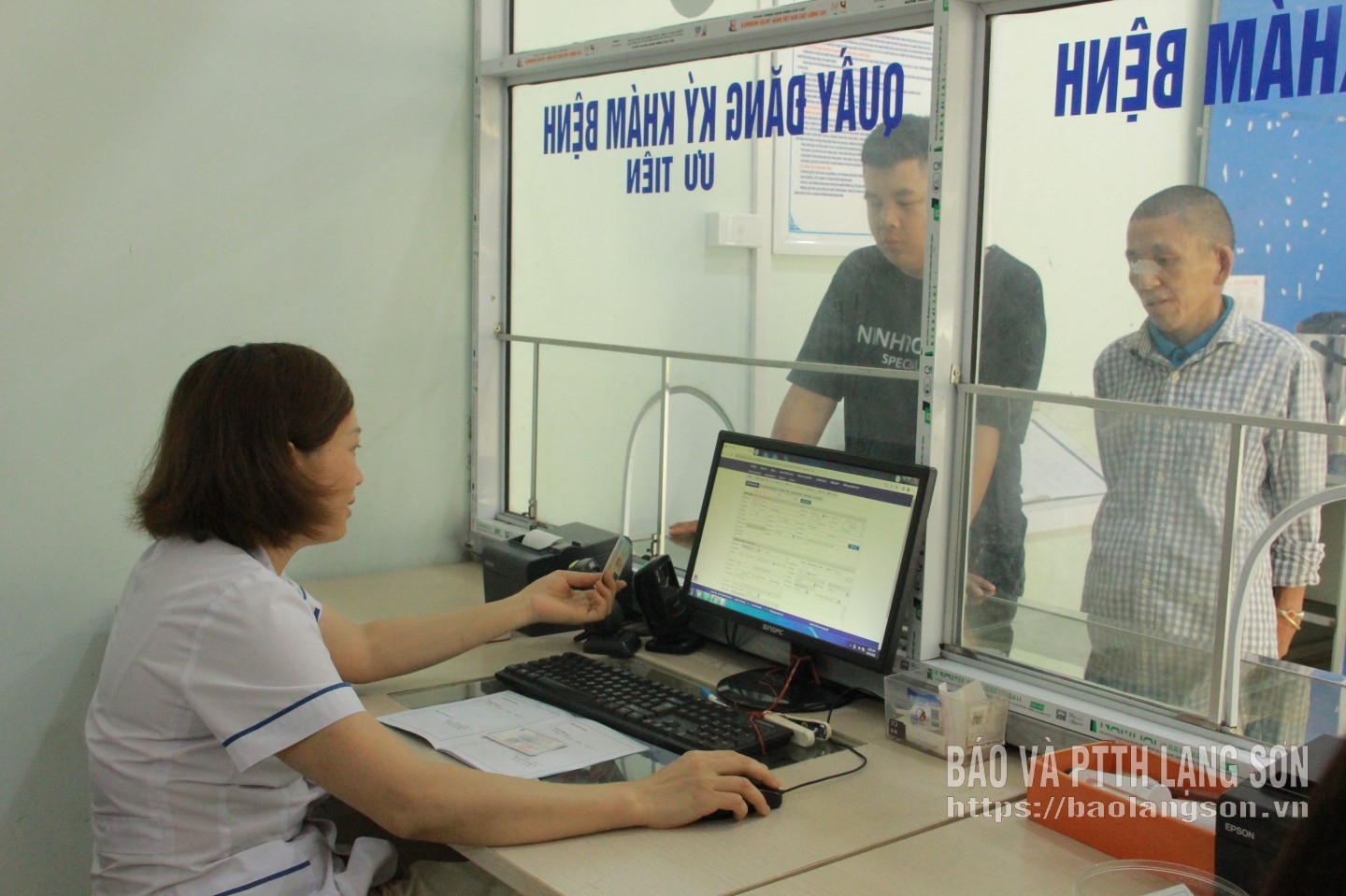
In early December 2025, Ms. Hoang Thi Thuy from That Khe commune visited the Trang Dinh Regional Health Center for a follow-up medical check-up. Unlike previous visits, she did not bring her health insurance card. At the reception counter, the medical staff simply scanned her ID card to verify and cross-check her health insurance information on the system. After the verification was complete, she was immediately directed to the examination room. Ms. Thuy shared: "Previously, forgetting my health insurance card was very worrying; sometimes I had to go home to get it or the procedures took a long time. Now, I just need to bring my ID card, and the staff checks it on the computer in a few minutes. It's much faster."
In 2025, the rate of medical examination and treatment procedures using ID cards at the Trang Dinh Regional Health Center will reach 93%. According to Mr. Be Van Khanh, Director of the Trang Dinh Regional Health Center, most people seeking medical treatment have health insurance coverage, so we only scan their ID cards and return them to them. Medical staff only need to verify the ID card and insurance information on the system. This process is both compliant with regulations and saves time, giving people more peace of mind, especially the elderly who often forget their documents.
It is known that since the implementation of ID card scanning for medical examination procedures, the patient reception process has been adjusted to be more streamlined and flexible. Not only in Trang Dinh, but at many medical facilities in the area, paper health insurance cards are no longer collected as before; instead, information is verified online through ID cards and interconnected data.
Based on the successful implementation at the Trang Dinh Regional Health Center, expanding the use of ID cards for medical examinations and treatment at the provincial level also poses stricter management requirements. At the Provincial General Hospital, which receives a large number of patients and provides many high-tech services outside the scope of health insurance coverage, the reception process has been adjusted to be more flexible but cautious.
For patients with health insurance cards who are eligible for co-payment, the hospital verifies their information through their identity card and applies a mechanism for advance payment of hospital fees; the amount of the advance payment is considered based on the patient's medical condition, the technical services used, and the actual circumstances of each patient in order to enhance co-payment responsibility and minimize revenue loss from hospital fees.
Ms. Nguyen Thi Thu Thuong, Head Nurse of the Outpatient Department at the Provincial General Hospital, said: "From June 2025, the hospital will officially apply this advance payment method for patients with co-payment health insurance cards. On average, the hospital receives about 600 patients for examination and admission each day, of which over 80% use their ID cards for procedures, double the number compared to 2024. This method both ensures the right to medical examination and treatment for the people and helps the hospital be more proactive in financial management when implementing high-tech services."
Reportedly, this model has been implemented synchronously at public health facilities in the province. Along with maintaining electronic medical records and promoting cashless payment of hospital fees, the provincial health sector is gradually forming a closed-loop examination and treatment process in a digital environment, reducing reliance on traditional paper documents. By the end of December 2025, the rate of medical examinations and treatments using identity cards in the province will reach 83.4%, fulfilling the planned target and increasing by 2.68% compared to 2024.
With the total number of public healthcare visits in the province reaching over 1.14 million in 2025, exceeding the annual plan by 120%, simplifying administrative procedures right from the reception stage is of particular importance, contributing to shortening the time for medical examinations and treatments and bringing satisfaction to patients.
Building on the achievements, in the coming period, the health sector will continue to improve its technological infrastructure, strengthen the connection and interoperability of medical examination and treatment data with national digital platforms, and move towards managing people's health throughout their entire life cycle.
Source: https://baolangson.vn/thu-tuc-y-te-them-thong-suot-5070547.html































































































Comment (0)