

“Double barriers” make it difficult for cooperatives to access capital
In the last days of the year, when many cooperatives are rushing to prepare for new investment plans, the story of capital access has once again become a persistent concern. Especially for models that are trying to shift from manual production to deep processing, the need for medium and long-term capital is not only urgent but also vital. However, the difficult paradox that has existed for many years is that although there are assets, legal documents are lacking, causing the credit door to be closed to most cooperatives.
The Ba Vi Green Farm Investment and Cow Development Cooperative ( Hanoi ) is a typical example. Although there is a plan to expand the scale and invest in a processing line to improve product quality, finding capital is an arduous journey. Mr. Ta Viet Hung, Director of the Cooperative, shared his wish for a more open mechanism, where unnecessary procedures are cut, helping the cooperative have the opportunity to realize its production orientation. Expectations for loans from banks or credit funds are often only at the "hope" level when the cooperative cannot fully meet the legal conditions required by the credit institution.
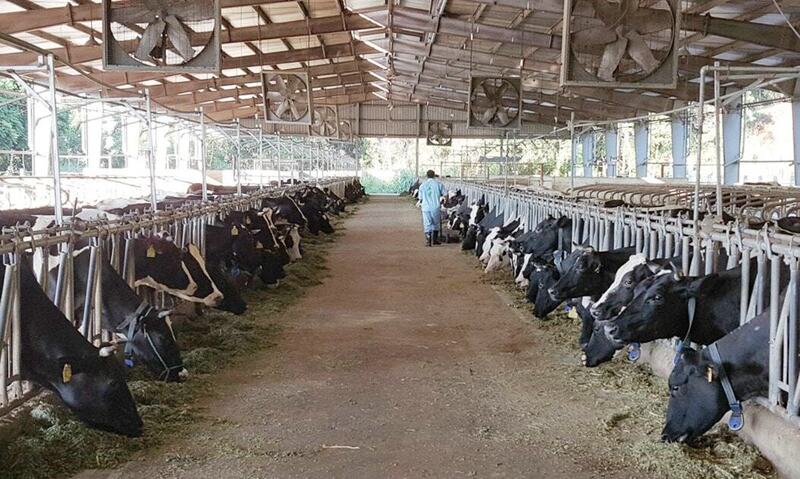
Raising cows at the Ba Vi Green Farm Investment and Cow Development Cooperative (Hanoi). Photo: TL
The story in Ba Vi is not an isolated one. In Thai Nguyen, the Vietnam Clean Agricultural Products Cooperative, a model expected to create a step change in local agricultural production, also faces a similar reality. Despite possessing a unique processing process and having experience in running a banana export business, the cooperative's leadership was still "doused with cold water" when its loan application was rejected because the cooperative was newly established and lacked experience. The promise to review after 1 year only made the leaders worry more: "Without capital, what can the cooperative do to survive during that time, where can farmers rely on, and how many opportunities will pass by?"
According to statistics from the State Bank, by the end of November 2025, the total outstanding loans for cooperatives and cooperative unions in the entire system only reached about 6,428 billion VND, equivalent to 0.04% of the total outstanding loans nationwide. A very small proportion compared to the number and needs of more than 20,000 cooperatives nationwide.
Statistics from the Vietnam Cooperative Alliance show that currently only about 20% of cooperatives nationwide have access to loans from credit institutions.
It is easy to see that most agricultural cooperatives have “tangible” assets such as factories, machinery, and raw material areas. However, most of them do not have legal documents or do not meet the requirements for collateral according to bank standards. The common assets of cooperatives are often not clearly separated from the personal assets of members. When it comes to mortgages, personal assets are difficult to handle when risks arise, making banks “hesitant” to lend.
Meanwhile, not all cooperatives can meet the requirements of financial capacity and creditworthiness. Many credit institutions want cooperatives to have equity capital participating in the project at the level of 20-30%. However, for most cooperatives with small charter capital, this is beyond their capacity. In addition, many cooperatives' production and business records are not up to standard, their financial reports are not complete, their accounting is not in accordance with regulations, and they do not have transparent invoices and documents.
Even policy credit programs have limits. As shared by Ms. Hoang Thi Chuong, Deputy Director of the Student Credit Department and other policy subjects (Bank for Social Policies), the maximum loan amount in the agricultural sector is only 2 billion VND/project, equivalent to no more than 100 million VND/employee. Value chain loan programs, although having preferential interest rates, the maximum loan amount of 2 billion VND is still too small compared to the actual needs of cooperatives that want to develop in a modern and circular direction.
For models that require tens of billions of dong in investment for processing lines or storage warehouses, a limit of a few billion dong is not enough to create change. The credit door is therefore narrowed, pushing cooperatives into a situation of "enough ideas, not enough money to do it".

By the end of November 2025, the total outstanding loans for cooperatives and cooperative unions in the entire system only reached about 6,428 billion VND. Photo: Duy Minh
The “key” to capital access for cooperatives
Pressure from reality has forced the Government to make important adjustments. Decree 156/2025/ND-CP has increased the unsecured loan limit for cooperatives to a maximum of VND5 billion. This is a significant step, creating conditions for units lacking collateral to still have the opportunity to access capital. However, unsecured loans still require cooperatives to have credit reputation, transparent records and feasible production and business plans. These requirements, in reality, are what many cooperatives are weak at.
Therefore, experts believe that it is necessary to form a national credit guarantee mechanism for cooperatives. Dr. Tran Thanh Long, Director of the Banking Academy (Phu Yen Branch), said that Vietnam can learn from the models of Korea and Taiwan. The important thing is not only the support fund, but also the mandatory application of credit insurance to share risks, reduce pressure on the budget and force commercial insurance organizations to participate in evaluating cooperative projects.
If this model is applied on a pilot basis to the Cooperative Development Support Fund, it will create a "first layer of guarantee", helping many cooperatives with stable output and participating in the value chain to be able to borrow capital much larger than the fund's capacity.
From the perspective of commercial banks, Agribank representatives said that they are implementing many specific credit packages for cooperatives, especially units participating in the 1 million hectares of high-quality, low-emission rice project in the Mekong Delta. The bank supports a minimum interest rate of 1%/year compared to normal and increases lending according to the value chain. However, Agribank representatives also frankly said that weak management capacity, lack of collateral, lack of financial transparency, small production scale... are the main reasons why cooperatives have difficulty accessing capital.
Therefore, the bank proposed four groups of solutions: Promoting rural agricultural credit; implementing lending according to the value chain model; developing green credit; and simplifying procedures and digitizing credit processes for cooperatives. At the same time, cooperatives need to proactively increase their scale by attracting more members or merging according to industry and location.
Looking at a broader perspective, Resolution 68-NQ/TW has identified the axis of “cooperatives, enterprises, and the State” as the focus of the cooperative economy. When the agricultural economy shifts from growth by quantity to growth by added value, the link between cooperatives and enterprises is no longer an option but a requirement. To open up a long-term credit path, cooperatives need not only assets, but also legality, transparency, and a governance model that is trustworthy enough for banks to share risks.
Dr. Tran Thanh Long, Director of Banking Academy (Phu Yen Branch): It is time to change the mindset from “collateral” to “risk management by guarantee and insurance mechanism”. Creating a credit guarantee ecosystem with credit insurance is not only a financial solution but also a recognition of the role and prestige of effective cooperatives.
Source: https://congthuong.vn/vuong-phap-ly-hop-tac-xa-so-huu-tai-san-van-kho-tiep-can-von-432880.html


![[Photo] Prime Minister Pham Minh Chinh receives President of Cuba's Latin American News Agency](/_next/image?url=https%3A%2F%2Fvphoto.vietnam.vn%2Fthumb%2F1200x675%2Fvietnam%2Fresource%2FIMAGE%2F2025%2F12%2F01%2F1764569497815_dsc-2890-jpg.webp&w=3840&q=75)































































































Comment (0)