

Ban Dat used to be an extremely disadvantaged commune in Phu Binh district. However, appropriate strategies and approaches in economic development have helped improve the lives of the people in the area.
 |
| Thanks to the development of livestock farming, many households in Ban Dat commune have become wealthy. |
Ban Dat commune has a total natural area of over 1,744 hectares, of which agricultural land accounts for nearly 1,500 hectares. Based on an assessment of the advantages and disadvantages of natural conditions, since 2015, the local Party Committee and government have guided people to invest in developing suitable economic models to make the most efficient use of the land area.
Based on the commune's guidelines, the Farmers' Association and agricultural officials regularly monitor the situation at the grassroots level to disseminate information and guide people in developing livestock farming. For households with garden land or forest land, they are encouraged to plant acacia trees or fruit trees in combination with free-range chicken farming. For areas with unproductive garden land and low-yield rice fields, the commune encourages people to improve the land for planting industrial crops and short-term crops.
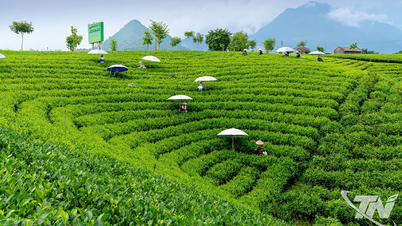
Thanks to proper guidance, the commune now has 184 farms and livestock facilities, an increase of 64 compared to 2020. Many areas of low-yield rice land or land with irrigation difficulties have been converted to tea and peanut cultivation, totaling over 100 hectares. Specifically for tea, concentrated production areas have been established in Phu Loi, Da Bac, and Dong Quan hamlets.
Every year, the People's Committee of the commune, in coordination with the Phu Binh District Agricultural Services Center, organizes 1-2 training courses to transfer scientific and technical knowledge, helping people grasp knowledge on disease prevention and control in livestock and poultry; techniques for planting and processing tea plants, etc. This knowledge is then applied to production to improve the efficiency of crops and livestock.
Ban Dat commune also facilitates its residents' access to production development support programs from the province and district. For example, in 2017, through a district-level production development project, the commune's People's Committee, in coordination with the District Department of Agriculture and Rural Development, provided tea seedlings to residents in Phu Loi, Dong Quan, and Da Bac hamlets, covering an area of 45 hectares.
Through provincial programs, the commune has two livestock farming models that received support, including 8,000 breeding chickens in 2020 and 9 breeding cows for poor households belonging to ethnic minorities in 2023.
 |
| Ban Dat commune encourages its residents to develop tea cultivation, contributing to increased income. |
Ms. Dao Thi Lan from Phu Loi hamlet shared: "My family owns more than 1 hectare of agricultural land and mixed gardens. Previously, I grew cassava and corn, but the yield was low. After receiving guidance from agricultural officials, my family improved the land to plant tea; we also received support from the district regarding seedlings and training on planting and processing according to VietGAP standards. Currently, our tea plantation is starting to yield a harvest, with a production of 1 quintal of dried tea buds per hectare, and an average selling price of 150,000 VND/kg. In the coming years, the harvest will certainly be higher, providing my family with a considerable income."
With appropriate economic development orientations and synchronized solutions, Ban Dat commune has exploited the potential and strengths of its land. In 2023, the value of agricultural, forestry, and fisheries production in the area reached 125 billion VND, an increase of 10 billion VND compared to 2020. The output of live meat for slaughter reached 2,034 tons.
Effective agricultural production has helped improve the lives of many households. In 2023, the average per capita income reached 48 million VND/year, an increase of 11.9 million VND compared to 2020.
Mr. Dang Khac Doan, Vice Chairman of the Commune People's Committee, said: The commune will continue to promote and guide people to develop livestock farming and cultivate crops suitable to the natural conditions, bringing high economic efficiency; strengthen coordination with specialized departments and units to open training courses on science and technology, improving the production level of the people. In addition, the commune also hopes that relevant levels and sectors will continue to pay attention to and support the implementation of production models and projects in the area.
Source







































































Comment (0)