

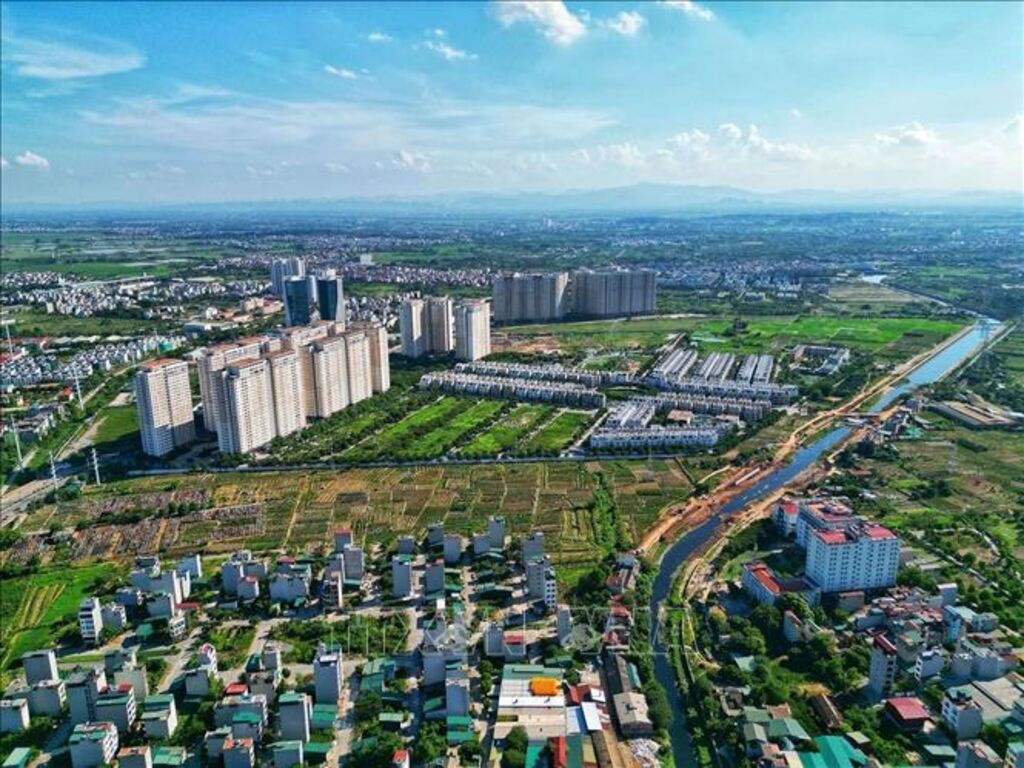
The Hanoi People's Council has just approved the new Land Price List, expected to be applied from January 1, 2026. This is an action to make land management transparent and bring land prices closer to the market according to the provisions of the 2024 Land Law. However, the sharp increase in suburban areas is creating a "double burden" on people and real estate businesses, making the possibility of settling down for low-income people even more distant and slowing down the market's recovery.
Rising costs, distant housing dreams
In general, people agree with adjusting the land price list closer to the market because this helps ensure people's rights in site clearance better, limits complaints, and contributes to speeding up site clearance progress and completing public investment projects.
However, with the significant increase in land price adjustment, especially in suburban communes and wards, the new land price policy not only changes financial obligations related to land but also has a profound impact on the lives, production, real estate market and housing accessibility of many groups of people.
Mr. Dang Van Nghiem, in Dong Anh commune (Hanoi) said: "The increase in land prices has caused taxes, fees, and charges when making red books, dividing plots or transferring them to increase accordingly. Now my family needs to divide the land for the children to live separately or inherit the property, so we have to apply for a certificate, which will cost a lot of money."
With the new land price being 2-6 times higher than the old land price list, many people in the suburbs are unable to fulfill their financial obligations. Mr. Dao Khac Trong in Soc Son commune (Hanoi) said, "I calculated that the land use fee I had to pay was about 80 million VND, but it has jumped to more than 400 million VND after applying the new land price list."
Not only Mr. Dao Khac Trong, but many people in other communes such as Hoai Duc, Dong Anh, Thanh Oai, Dan Phuong, Thanh Tri, Thuong Tin, Hong Van... also expressed their "shock" when they had to pay hundreds of millions of dong to complete procedures. People suggested that the city should consider a policy of reducing registration fees, exempting some certificate issuance fees or extending the payment time for poor households, near-poor households, workers, and young families living in suburban areas. This helps them avoid "cost shock" when needing to complete land procedures.
According to Lawyer Nghiem Thi Hang of Vu Linh Law Office (Hanoi Bar Association), the first is the increased financial burden when carrying out land procedures. That is the increase in land prices, especially in suburban areas (where it is expected to increase sharply from 25% to 26%, with some locations increasing by nearly 30% compared to the current price list), causing many people to worry about skyrocketing costs when carrying out procedures such as changing land use purposes, making red books (recognizing land use rights) or transferring. If the land price list increases, land use fees, taxes, fees, and charges that people have to pay will increase accordingly, directly affecting this large group of subjects.
In addition, agricultural households in the suburbs are also concerned about rising land prices, non-agricultural land use taxes, registration fees, or costs of converting land use purposes that may be higher. These expenses directly affect the ability to maintain production, especially for small-scale farmers - Lawyer Nghiem Thi Hang informed.
Capital team right from the starting line
Although it is considered necessary to bring land prices closer to market prices, the new price list also creates many concerns about cost burdens, the possibility of increasing real estate prices and pressure on businesses.
Explaining the “Double Burden”, Mr. Pham Gia Hiep, a real estate expert, said that real estate businesses have to bear increased investment costs (burden 1) while the ability to recover capital and sell products decreases (burden 2), leading to greater financial and operational risks. This decision itself brings great worry, putting them in a difficult situation, so it is called “double burden”.
For people, especially those with low incomes, the average income is getting further and further away from having a house to "settle down" when the new land price list comes into life.
The further increase in housing prices will further reduce the accessibility of housing for the majority of people, especially the middle and low income class. This leads to the risk of increased inventory and difficulties in the consumption of products of enterprises. Cash flow is blocked, the pressure to repay bank loans increases, slowing down the recovery of the entire real estate market in Hanoi - Mr. Pham Quang Hiep shared.
Sharing this view, Ms. Nguyen Ngoc Bich, Director of Nam Binh Real Estate Company, said that the first and most direct burden is the sharp increase in input costs for all real estate development projects in the city.
Specifically, the cost of compensation for site clearance has increased. The land price list is the legal basis for determining the compensation level for people when the State reclaims land to carry out commercial projects. When the land price list increases, the compensation price also increases, causing the total initial investment capital of the enterprise to increase significantly. This not only increases the financial burden but also risks prolonging the site clearance time if the compensation price still does not really satisfy the people, seriously affecting the progress of project implementation.
In addition, land use fees and land rents also increase according to the land price list. This is a financial obligation that businesses must pay when being allocated land or changing land use purposes to implement projects. This cost increases directly into product prices, reducing the expected profit margin of investors and posing a big challenge in balancing project finances, especially for commercial housing projects and urban areas.
The new land price list in Hanoi is an important step towards market transparency and more in line with actual prices. However, the high increase in many suburban areas has created concerns about the financial burden on people and businesses.
For the policy to be truly effective, there needs to be a reasonable roadmap, combined with solutions to support vulnerable groups, small businesses and agricultural producers. At the same time, it is necessary to increase information transparency and dialogue with the community to limit negative impacts and create social consensus.
Source: https://baotintuc.vn/bat-dong-san/ban-khoan-truoc-ganh-nang-kepkhi-gia-dat-moi-co-hieu-luc-20251201135603569.htm


![[Photo] Prime Minister Pham Minh Chinh receives President of Cuba's Latin American News Agency](/_next/image?url=https%3A%2F%2Fvphoto.vietnam.vn%2Fthumb%2F1200x675%2Fvietnam%2Fresource%2FIMAGE%2F2025%2F12%2F01%2F1764569497815_dsc-2890-jpg.webp&w=3840&q=75)
































































































Comment (0)