

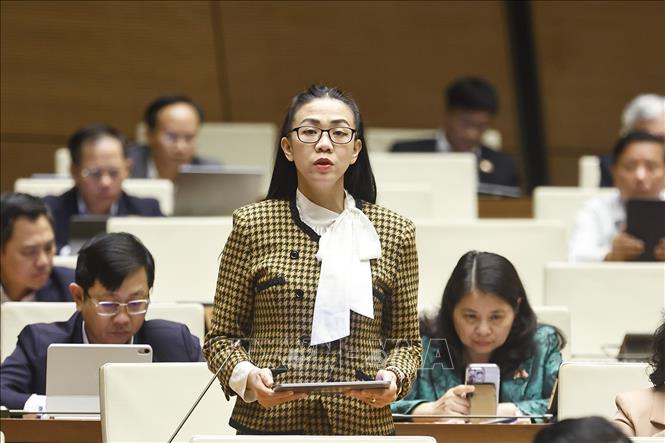
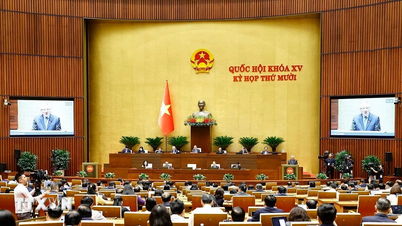
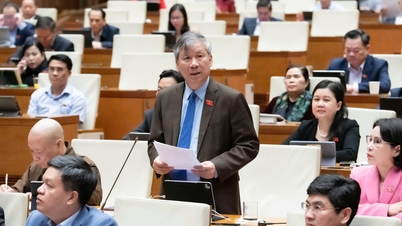
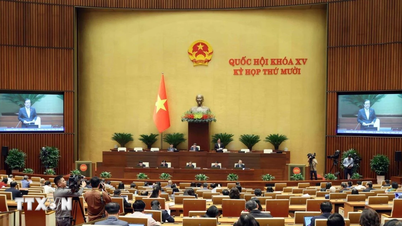
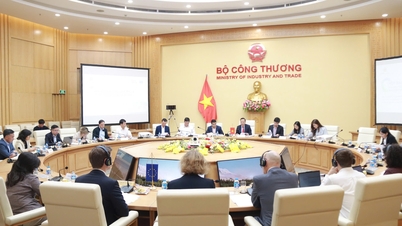
At the meeting, the majority of opinions expressed high agreement with the necessity of promulgating the Law on Digital Transformation to institutionalize Resolution 57 of the Politburo on breakthroughs in science, technology development, innovation and national digital transformation.
Commenting on the draft Law, delegate Trinh Thi Tu Anh (Lam Dong) emphasized that in the process of digital transformation in recent years, we have achieved many important results, but at the same time, we are also facing a long-standing reality: the information systems of ministries, branches, and localities are still fragmented, lack interconnectivity, and lack common standards.
Delegate Tu Anh analyzed that the same type of data but each agency applies a different structure; the same process but there are many parallel processing platforms, leading to the result that people have to declare many times, making it difficult for state agencies to have a complete and unified picture to serve operations. These "data zones" are not only technical issues, but also institutional and public administration issues. In that context, the delegate of Lam Dong province highly appreciated Article 18 of the draft Law regulating the principles of connection and interconnectivity of information systems serving the provision of online public services. This is a fundamental provision, not only a technical description, but also an institutional pillar to form a unified and transparent operating digital Government .
In addition to expanding connectivity, according to delegate Trinh Thi Tu Anh, the draft also strictly regulates the responsibility for ensuring network safety and security, protecting personal data and state secrets during the sharing process, which is a very important balance point. The delegate emphasized that connectivity cannot be traded for risk; interconnectivity cannot be traded for insecurity. As the amount of data shared increases, without unified security standards and effective monitoring mechanisms, the system will be vulnerable to attacks, leaks or abuse. These requirements contribute to ensuring people's trust - a core factor for sustainable development of online public services.
However, from the implementation perspective, delegate Tu Anh said that our biggest challenge does not lie in technology but in coordination discipline and compliance monitoring mechanism. In order for Article 18 to be put into practice, the delegate suggested that it is necessary to clearly identify the focal agency to issue standards and regulations for connection and interconnection; at the same time, publicize the implementation roadmap so that ministries, branches and localities can implement it uniformly; develop a mechanism to evaluate and rank the compliance level of each unit; and periodically publicize it so that the National Assembly, the Government and the people can monitor it together.
In addition, delegate Trinh Thi Tu Anh suggested that it is necessary to clearly define sanctions for systems that are intentionally designed in a closed direction, delay connection, or are built contrary to the overall architectural framework, because we cannot build a digital government with "pieces that do not want to connect".

Discussing at the meeting, delegate Nguyen Thi Viet Nga (Hai Phong) expressed her interest in the provisions on digital citizenship rights and responsibility for protecting personal data. According to the delegate from Hai Phong city, the draft does not clearly stipulate a number of contents related to the rights of individuals and organizations when participating in the digital space such as: Right to control personal data; right to be forgotten; right to transfer data between platforms; responsibility for compensation when the automatic digital system makes wrong decisions; protection of children in the digital environment, including classifying content by age.
Delegate Viet Nga said that with the trend of data-based management, automated systems will increasingly participate in administrative decisions. Current methods of management, collection, exploitation and use of data are fraught with many risks of violating privacy rights, data distortion, data leakage, etc. Therefore, the delegate proposed that the draft needs to be reviewed and continue to supplement strict and specific regulations on the rights to respect and protect people's information when participating in the digital space.
At the same time, delegates said that the draft Law needs to supplement regulations on complaint and compensation mechanisms; accountability of state agencies when citizens' right to personal information protection is violated; and more specific regulations on the protection of vulnerable groups - especially children in the context of strong digital transformation as today.
Also at the meeting, the National Assembly discussed in the hall the draft Resolution of the National Assembly stipulating a number of mechanisms and policies to remove difficulties and obstacles in organizing the implementation of the Land Law.
Source: https://baotintuc.vn/thoi-su/quy-dinh-ro-noi-dung-ve-quyen-cua-ca-nhan-to-chuc-khi-tham-gia-vao-khong-gian-so-20251201172613778.htm























![[Photo] Parade to celebrate the 50th anniversary of Laos' National Day](/_next/image?url=https%3A%2F%2Fvphoto.vietnam.vn%2Fthumb%2F1200x675%2Fvietnam%2Fresource%2FIMAGE%2F2025%2F12%2F02%2F1764691918289_ndo_br_0-jpg.webp&w=3840&q=75)
![[Photo] Worshiping the Tuyet Son statue - a nearly 400-year-old treasure at Keo Pagoda](/_next/image?url=https%3A%2F%2Fvphoto.vietnam.vn%2Fthumb%2F1200x675%2Fvietnam%2Fresource%2FIMAGE%2F2025%2F12%2F02%2F1764679323086_ndo_br_tempimageomw0hi-4884-jpg.webp&w=3840&q=75)





































































Comment (0)