

Under the green canopy of bamboo and the rows of hibiscus bushes, on a summer afternoon, several old people sat enjoying the breeze, some even sleeping soundly in hammocks. Over time and due to geological changes, the river has changed course many times, the riverbanks have shifted, sometimes depositing sand, other times eroded into deep, gaping holes. But strangely, in my childhood memories, the hibiscus bushes, the moss-covered stone steps, and the sound of the water lapping against the shore always evoke a vivid recollection.
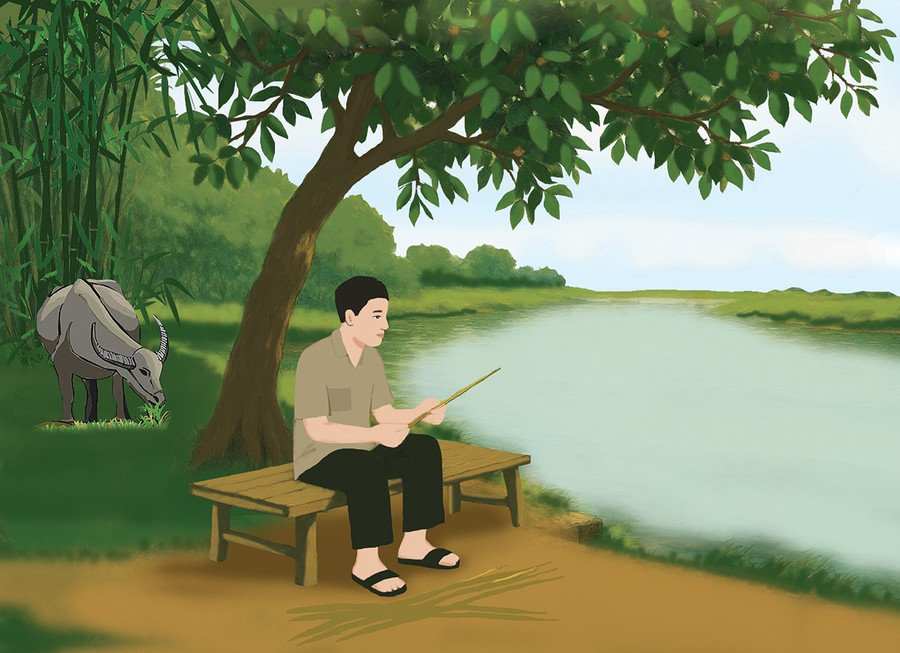
The riverside was always bustling during planting and harvesting seasons. I remember the bamboo stakes used to tie up my neighbor's buffaloes. The gentle animals lay chewing grass in the shade after a hard day of plowing. Under the cool bamboo grove was a weathered brown bed. I remember my father sitting on the riverbank, gazing at the water and the sky, meticulously whittling each bamboo strip to mend the broken sieves and winnowing baskets. The harvest season was also summer. The lychee trees along the riverbank were laden with fruit, and the cuckoos sang in the canopy of leaves...
When I'm far from home, the image of the riverside and the ferryman always comes to mind. My mother said that even though clean water has been brought to the village, the women here still maintain the habit of going to the riverside to wash clothes and chat. In the late afternoons, when the girls return from working in the fields, their laughter and chatter fill a stretch of the river.
From this riverside landing, people from my village board ferries to cross the river to go to the market, to the city, some carrying bags as they leave their hometown. And I, too, departed from this familiar stretch of river, carrying with me the aspiration for a better life. In the city at night, with its flickering green and red lights, I often longed for the moonlight to illuminate my homeland. I remember the moonlit night at the riverside landing. It was under that moonlight, by the riverbank, that my first love blossomed, a shy and hesitant youth...
Sitting on the riverbank, gazing at my hometown river, I suddenly heard a faint, indistinct call for a ferry... There was no one there, only a figment of my imagination. Not far away, a newly built bridge connected the village to the town, making transportation much easier. People no longer had to wait for or call for a ferry to cross to the other side. The riverbank, with its old ferryboat exposed to the sun and rain, listened to the rhythm of time passing, evoking feelings of nostalgia and longing.
Every time I think of a riverside landing, I remember the poem "My Lang Landing" by the poet Yen Lan. It's just an ordinary landing, but it became the pretext for the poet to express his longing and nostalgia. I also remember that in some places, especially in the Central Highlands, the riverside landing is the first and most representative image used to identify and affirm the existence and development of each ethnic group.
Therefore, the water-blessing ceremony has become one of the important activities expressing folk beliefs and cultural practices. Furthermore, as in the lowlands, within the village structure, the water source has traditionally been a place of interaction and unity among community members.
The riverside landing in my village now exists only in memories. Along both banks of the river, sturdy and spacious embankments have been built. Soon, the images that made up the riverside landing may gradually fade into oblivion, but I believe that the landing, which witnessed so much joy and sorrow, so many ups and downs of life, will remain in the hearts of everyone.
Source: https://baogialai.com.vn/ben-nuoc-ngay-xua-post327176.html

![[Photo] Commemorating the unwavering friendship between Vietnam and Laos](/_next/image?url=https%3A%2F%2Fvphoto.vietnam.vn%2Fthumb%2F1200x675%2Fvietnam%2Fresource%2FIMAGE%2F2026%2F01%2F27%2F1769518372051_ndo_br_1-jpg.webp&w=3840&q=75)

![[Photo] Announcement Ceremony of the Art Program “Light Concert – Welcoming the New Year 2026”](/_next/image?url=https%3A%2F%2Fvphoto.vietnam.vn%2Fthumb%2F1200x675%2Fvietnam%2Fresource%2FIMAGE%2F2026%2F01%2F27%2F1769514762857_le-cong-bo-ct-hoa-nhac-anh-sang-1772-9042-jpg.webp&w=3840&q=75)


![OCOP during Tet season: [Part 3] Ultra-thin rice paper takes off.](/_next/image?url=https%3A%2F%2Fvphoto.vietnam.vn%2Fthumb%2F402x226%2Fvietnam%2Fresource%2FIMAGE%2F2026%2F01%2F28%2F1769562783429_004-194121_651-081010.jpeg&w=3840&q=75)


![OCOP during Tet season: [Part 2] Hoa Thanh incense village glows red.](/_next/image?url=https%3A%2F%2Fvphoto.vietnam.vn%2Fthumb%2F402x226%2Fvietnam%2Fresource%2FIMAGE%2F2026%2F01%2F27%2F1769480573807_505139049_683408031333867_2820052735775418136_n-180643_808-092229.jpeg&w=3840&q=75)
![OCOP during Tet season: [Part 1] Ba Den custard apples in their 'golden season'](/_next/image?url=https%3A%2F%2Fvphoto.vietnam.vn%2Fthumb%2F402x226%2Fvietnam%2Fresource%2FIMAGE%2F2026%2F01%2F26%2F1769417540049_03-174213_554-154843.jpeg&w=3840&q=75)


Comment (0)