

(NLĐO) - An extremely complex tomb has concealed a series of mysterious mummies from the Ptolemaic dynasty of Egypt.
According to the Egyptian Ministry of Tourism and Antiquities, 13 mummies with golden tongues and some golden fingernails have been unearthed at the Oxyrhynchus site in the city of the same name in central Egypt, about 160 km from Cairo.
This series of mummies was hidden in a tomb as complex and mysterious as the way these ancient people were laid to rest.
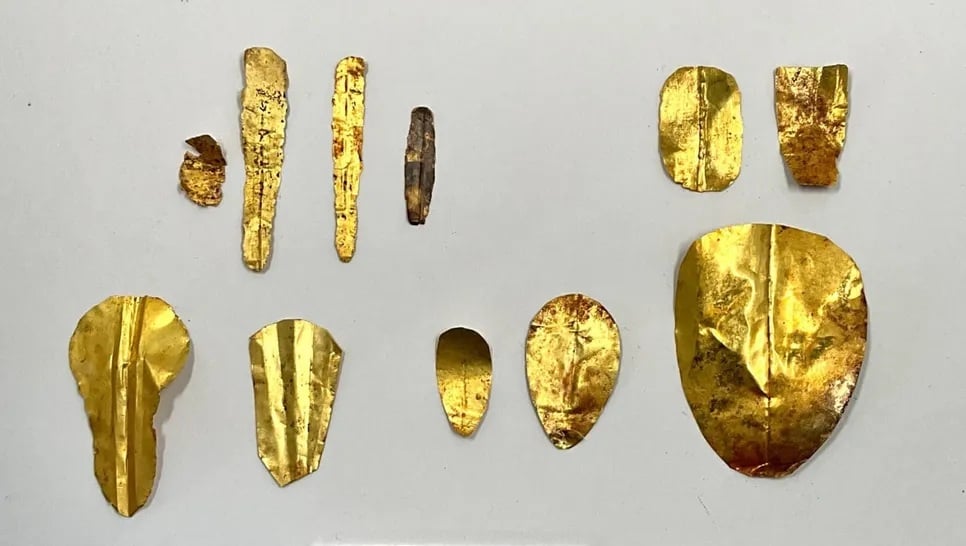
The number of gold tongues and gold fingernails that Egyptian archaeologists have collected from mummies at Oxyrhynchus - Photo: EGYPTIAN MINISTRY OF TOURISM AND ANTIQUES
According to Live Science, the research team found the mummies when they dug deep into the bottom of a known burial pit and discovered an underground corridor.
This corridor leads to three chambers containing dozens of mummies from the Ptolemaic dynasty (approximately 304 to 30 BC), a dynasty ruled by one of Alexander the Great's generals in Egypt.
These are not the first mummies with golden tongues unearthed at Oxyrhynchus. Sixteen similar mummies with golden tongues have been found at this site previously.
Scientists say there's a chilling belief behind this bizarre piece of jewelry.
Ancient Egyptians believed gold was "the flesh of the gods," according to archaeologists Esther Pons Mellado and Maite Mascort, co-directors of the Spanish-Egyptian archaeological mission at Oxyrhynchus.
Therefore, they fitted the tongues of the deceased with gold, believing that this would give these noble figures the privilege of speaking in the afterlife .
Previously, some mummies with golden tongues had been unearthed at other sites, but only sporadically and were identified as belonging to high-ranking officials of ancient Egypt.
Commenting on Live Science , Egyptologist Salima Ikram suggested that the unusually high number of yellow-tongued mummies at Oxyrhynchus may be due to it being a concentrated burial site for elite individuals associated with the temple and the animal-worshipping cults that once flourished there.
Alternatively, there's a simpler theory: the gold tongue may simply have been a fashionable trend in the region at that time.
Source: https://nld.com.vn/bi-an-rung-minh-ve-13-xac-uop-co-luoi-bang-vang-o-oxyrhynchus-196241220104804006.htm
![[Image] Leaked images ahead of the 2025 Community Action Awards gala.](/_next/image?url=https%3A%2F%2Fvphoto.vietnam.vn%2Fthumb%2F1200x675%2Fvietnam%2Fresource%2FIMAGE%2F2025%2F12%2F16%2F1765882828720_ndo_br_thiet-ke-chua-co-ten-45-png.webp&w=3840&q=75)
![[Photo] Prime Minister Pham Minh Chinh receives Lao Minister of Education and Sports Thongsalith Mangnormek](/_next/image?url=https%3A%2F%2Fvphoto.vietnam.vn%2Fthumb%2F1200x675%2Fvietnam%2Fresource%2FIMAGE%2F2025%2F12%2F16%2F1765876834721_dsc-7519-jpg.webp&w=3840&q=75)
![[Photo] Prime Minister Pham Minh Chinh receives the Governor of Tochigi Province (Japan)](/_next/image?url=https%3A%2F%2Fvphoto.vietnam.vn%2Fthumb%2F1200x675%2Fvietnam%2Fresource%2FIMAGE%2F2025%2F12%2F16%2F1765892133176_dsc-8082-6425-jpg.webp&w=3840&q=75)
![[Live] 2025 Community Action Awards Gala](/_next/image?url=https%3A%2F%2Fvphoto.vietnam.vn%2Fthumb%2F1200x675%2Fvietnam%2Fresource%2FIMAGE%2F2025%2F12%2F16%2F1765899631650_ndo_tr_z7334013144784-9f9fe10a6d63584c85aff40f2957c250-jpg.webp&w=3840&q=75)




















































































Comment (0)