

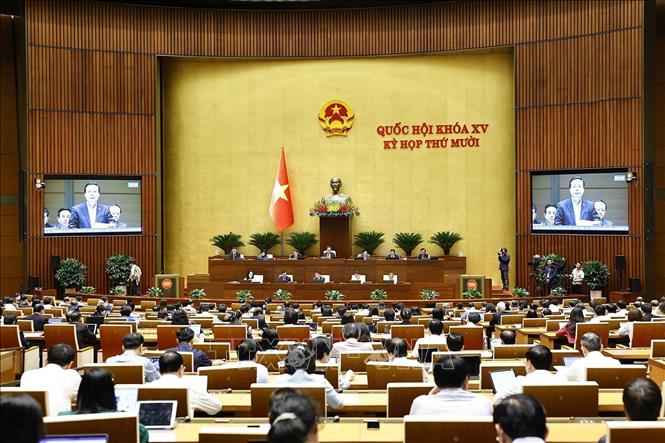
Make the work process transparent.
Recounting a story from over 10 years ago, when he took on the role of Chairman of the People's Committee of Tay Ninh town (formerly), during a visit to an important and sensitive department, he saw many completed files on a young employee's desk that had not yet been signed or signed by the leaders but not yet transferred to the next stage for delivery to citizens and businesses. When he asked, "Why is that?", he received the answer, "It's not time to transfer them yet, sir." The young employee explained that when he first arrived, he would immediately gather and transfer the completed files, but later realized that many colleagues looked at him as if he had "fallen from the sky with eyes full of suspicion," "they thought there must be something behind it for him to work so quickly and enthusiastically."
At that time, he realized that when good people don't dare to do good work, when the system can't distinguish between good and bad people, then that system has made a serious mistake and will certainly lead to stagnation and negativity. Therefore, despite many difficulties, the local leaders have made efforts to apply information technology to publicly disclose the work process of officials and civil servants, so that people, businesses, colleagues, and leaders can clearly see how each official handles their work, thereby having sufficient information to evaluate officials.
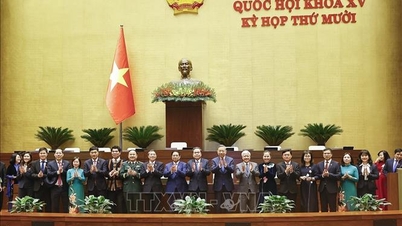
Delegate Tran Huu Hau expressed his strong agreement with the "three transparencies" action principle directed by General Secretary To Lam : "Progress, responsibility, and results must be made public so that the people and society can monitor and participate together." According to him, effectively implementing these "three transparencies," along with the implementation of the National Public Service Portal and the ongoing development and improvement of task assignment and personnel evaluation software, will provide us with effective tools to encourage good employees to improve their work and those with weaker performance to strive for better results within state administrative agencies.
Continuing to bring the story of a leading cashew industry enterprise with many companies in various localities to the parliamentary session, he recounted that since 2022, due to the impact of the COVID-19 pandemic, the enterprise had applied for and been approved to temporarily suspend operations of one restaurant business. However, after the management software of various sectors integrated data, the tax department's software detected that a company in the ecosystem had temporarily suspended operations and warned of risks to all other companies. Furthermore, local tax authorities refused to issue invoices despite knowing the capabilities of each company.
Companies have to spend a lot of effort and time presenting, explaining, and seeking intervention… Meanwhile, during this peak period, companies in the export system are exporting nearly $1 million USD per day. Besides the losses due to the disruption of goods and cash flow, there are enormous intangible losses such as damage to reputation regarding delivery schedules and suspicion of "problems" in operations, leading to warnings from the Tax authorities.
Based on the stories above, the delegates from Tay Ninh province stated that regulations that are detached from reality, mindless software created by unrealistic writers, and indifferent and robotic civil servants who only dare to follow regulations have led to significant losses for businesses, citizens, and the country.
According to delegate Hau, "the most difficult challenge remains self-renewal with new ways of thinking and new methods of operation." Reforming the organizational structure, institutional reforms, and digital transformation, along with other significant undertakings, will bring about tremendous changes. However, to quickly overcome the obstacles in every corner of society, the system, and each individual; to unleash even the smallest resources; to contribute to the nation's and people's progress… requires profound understanding and comprehensive, synchronized solutions.
Assigning the right person to the right job.
Pointing out that many bottlenecks still exist in various fields, delegate Le Huu Tri ( Khanh Hoa ) cited the example of public investment. He noted that since the beginning of the 15th National Assembly term, many laws and specific policy mechanisms have had to be amended to remove obstacles and create breakthroughs, yet the disbursement of public investment in 2025 is only expected to reach over 50%. The reasons identified include obstacles related to land procedures, compensation, resettlement support, limitations in investment preparation, capital allocation, and construction project management – a recurring issue that continues to be on the National Assembly's agenda.
Along with that come the difficulties and challenges faced by the non-state enterprise sector and household economy. In many large cities, many shops have had to close or scale back their operations. A large percentage of businesses have withdrawn from the market…
Representative Le Huu Tri argued that there are many reasons to explain the above issue, but administrative procedures and compliance costs remain major obstacles for citizens and businesses. Administrative procedures are still cumbersome and overlapping, increasing costs. The time from submitting an application to the Public Administrative Center to receiving the result involves many steps and complicated procedures, leading to delays. The business environment has not seen significant changes; administrative reforms over several terms have still not met the requirements and trust of the people.
"Where do the root causes of these shortcomings and limitations lie? What are the bottlenecks in the mechanisms, policies, and legal regulations? What are the bottlenecks in the implementation process? These need to be clearly and accurately identified in the process of building and perfecting the legal framework," the delegate questioned.
Representative Tri stated that the National Assembly and the Government have spent considerable time focusing on reviewing institutional bottlenecks and obstacles; strongly, decisively, and groundbreakingly reforming thinking in legislative work, addressing bottlenecks wherever they arise, even amending a single law multiple times in a short period, shortening the time for passing laws, but still have not overcome the bottlenecks, obstacles, and obstacles stemming from mechanisms, policies, and laws.
"I think what we are thinking is objective, but it lies within the subjective. We are innovating legislative work in a situational manner to resolve each bottleneck and obstacle, so our laws lack long-term vision and consistency, and overlaps and conflicts of law always occur," the delegate stated; arguing that, for this reason, we have had to enact many specific policies with short-term effectiveness to create breakthroughs.
The delegates also raised the question, "Could this also be one of the many reasons why a large number of officials and civil servants are overly cautious when implementing policies, avoiding responsibility when dealing with the affairs of citizens and businesses in order to ensure safety?"
Laws and policies will be difficult to implement effectively in practice if the officials and civil servants who formulate and implement them lack strategic vision, courage, responsibility, and a decisive, groundbreaking approach. We may have clear goals, a long-term vision, and a stable and open legal system, but if the leadership and management in implementing these laws and policies lack decisiveness, are half-hearted, and rely heavily on formal slogans, then achieving short-term goals will be difficult.
"This highlights the need for greater objectivity and responsibility in evaluating the qualifications, capabilities, responsibilities, and ethics of officials and civil servants in order to appoint leaders and managers who are competent and capable, and to place the right people in the right jobs," Representative Tri concluded.
Source: https://baotintuc.vn/thoi-su/bo-nhiem-can-bo-lanh-dao-quan-ly-du-tam-du-tam-20251029145556686.htm

























































































Comment (0)