

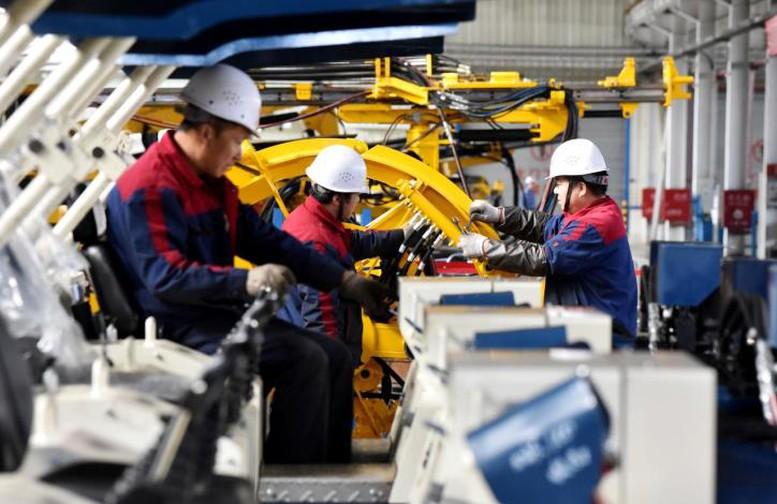
Since its reform and opening up, China has experienced the largest labor migration in its history. For a long time, the economy focused on developing labor-intensive manufacturing industries to absorb the surplus workforce in rural areas. The abundant and low-cost labor supply was once a key driver of rapid growth. However, as the advantage of cheap labor gradually diminished, China's economic growth environment underwent profound changes, making the need to improve labor productivity increasingly urgent.
Incorporate labor productivity into the measure of development.
Since 2021, labor productivity has been included in the system of indicators for evaluating enterprise performance, becoming one of the main criteria reflecting economic efficiency. China has identified four key factors to improve labor productivity.
First and foremost is improving the quality of human resources – a solution identified as a top priority by China. The focus of this solution is enhancing the skills and creative capacity of workers through the development of general and vocational education , promoting on-the-job training, strengthening healthcare, and implementing "learn while you work" models.
Secondly , optimizing the capital-to-labor ratio is demonstrated by increasing the level of machinery and equipment provided to each worker, thereby improving the utilization of production resources and production efficiency.
Thirdly , improve the efficiency of factor allocation. Ensuring that factors of production are properly valued and allocated flexibly is a crucial condition for increasing efficiency. Rational allocation of labor, capital, and resources helps improve the overall efficiency of the economy.
Fourth , promoting scientific and technological progress and institutional reform. China considers improving labor productivity as a core task of high-quality development. Investment in technological innovation, research and development (R&D), automation application, and smart equipment is being boosted to shorten operation time and accelerate production speed.
In 2024, the innovation capacity index reached 174.2 points, a 5.3% increase compared to 2023; the creative manufacturing growth index increased by 8.1%. In addition, China is promoting digital transformation, applying information technology and smart manufacturing in traditional industries to optimize processes, reduce resource consumption, and increase efficiency.
Unlocking resources through institutional reform
At the policy level, China is striving to remove institutional bottlenecks through deep and comprehensive reforms, thereby creating a favorable policy environment for the manufacturing sector. Key measures include further simplifying administrative procedures, strengthening decentralization and delegation of power to unleash market dynamics and enterprise vitality; establishing a diversified investment and finance system to direct capital flows into the manufacturing sector; reducing the tax burden on manufacturing enterprises ; and promoting reforms in the pricing of factors of production, gradually breaking down monopolies and establishing a rational pricing mechanism.
Furthermore, China is increasing investment in education and skills training to improve the quality of its workforce, especially in the context of an aging agricultural workforce and low educational levels. Optimizing income distribution and improving social security are also being implemented through tax adjustments, payments, and redistribution policies aimed at narrowing income gaps, increasing consumption capacity, and protecting workers' rights.
According to Mr. Bai Zhong'en, a member of the National Committee of the Chinese People's Political Consultative Conference and President of the Institute of Economic Management at Tsinghua University, to improve labor productivity, it is necessary to first focus on education and simultaneously improve the efficiency of labor resource allocation, including the development of the labor market.
He emphasized that workforce mobility is a crucial factor. Where there are better job opportunities, workers will tend to move there. Businesses need to make efforts to create better learning opportunities for their employees and need institutional adjustments to encourage businesses to proactively do this.
Simultaneously, China is promoting industrial transformation and upgrading, developing emerging and future industries, linking human resource training with supply chains, and creating high value-added jobs. The development of the digital economy and the green economy continues to be considered crucial directions for improving labor productivity and the quality of human resources.
Updated December 16, 2025
Source: https://laichau.gov.vn/tin-tuc-su-kien/chuyen-de/tin-trong-nuoc/bon-dong-luc-chinh-thuc-day-nang-suat-lao-dong-trung-quoc.html
![[Live] 2025 Community Action Awards Gala](/_next/image?url=https%3A%2F%2Fvphoto.vietnam.vn%2Fthumb%2F1200x675%2Fvietnam%2Fresource%2FIMAGE%2F2025%2F12%2F16%2F1765899631650_ndo_tr_z7334013144784-9f9fe10a6d63584c85aff40f2957c250-jpg.webp&w=3840&q=75)
![[Photo] Prime Minister Pham Minh Chinh receives Lao Minister of Education and Sports Thongsalith Mangnormek](/_next/image?url=https%3A%2F%2Fvphoto.vietnam.vn%2Fthumb%2F1200x675%2Fvietnam%2Fresource%2FIMAGE%2F2025%2F12%2F16%2F1765876834721_dsc-7519-jpg.webp&w=3840&q=75)
![[Image] Leaked images ahead of the 2025 Community Action Awards gala.](/_next/image?url=https%3A%2F%2Fvphoto.vietnam.vn%2Fthumb%2F1200x675%2Fvietnam%2Fresource%2FIMAGE%2F2025%2F12%2F16%2F1765882828720_ndo_br_thiet-ke-chua-co-ten-45-png.webp&w=3840&q=75)

![[Photo] Prime Minister Pham Minh Chinh receives the Governor of Tochigi Province (Japan)](/_next/image?url=https%3A%2F%2Fvphoto.vietnam.vn%2Fthumb%2F1200x675%2Fvietnam%2Fresource%2FIMAGE%2F2025%2F12%2F16%2F1765892133176_dsc-8082-6425-jpg.webp&w=3840&q=75)















































































Comment (0)