

The first Ho Chi Minh City Party Congress, for the 2025-2030 term, held on October 14th and the morning of October 15th, is a particularly significant congress following the merger of Ho Chi Minh City with Binh Duong and Ba Ria - Vung Tau, forming a new administrative and economic entity. This marks a turning point for Vietnam's first megacity, creating the momentum and strength to reach global prominence.
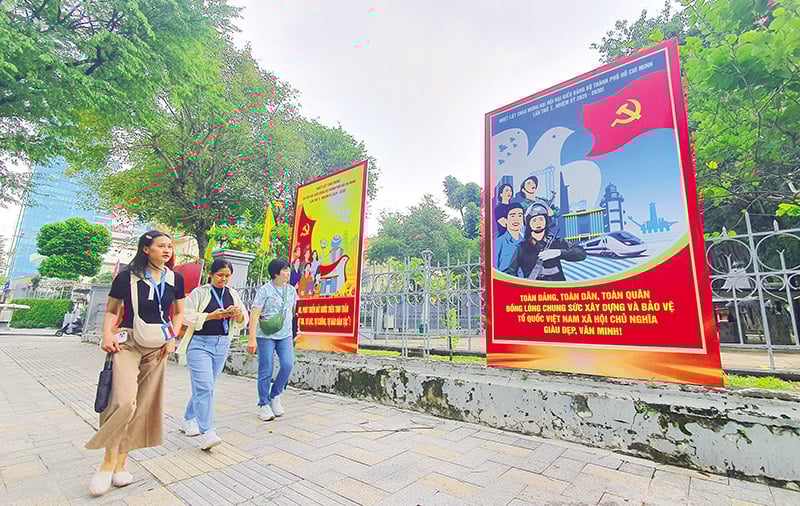 |
| The first Ho Chi Minh City Party Congress, for the 2025-2030 term, is a particularly significant congress for Ho Chi Minh City after its merger. Photo : Le Toan |
Creating momentum and a desire for innovation.
The theme of the First Congress of the Ho Chi Minh City Party Committee, for the 2025-2030 term, clearly reflects the strategic vision: “Building a clean and strong Party Committee and political system; promoting the strength of national unity; making breakthroughs in the development of science, technology, innovation, and the private economy; strengthening national defense, security, foreign relations, and international integration; mobilizing and effectively utilizing all resources so that Ho Chi Minh City can lead the country in the new era.”
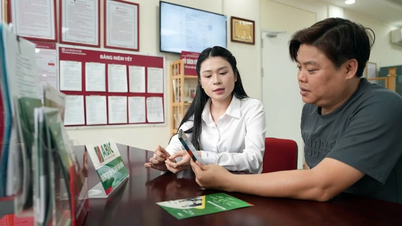
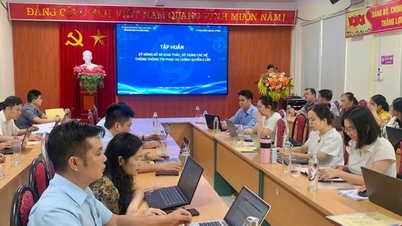
Just before the opening ceremony, 550 delegates attending the Congress visited and experienced firsthand many exemplary models in industry, port services, finance, high technology, education , healthcare, and innovation – key areas outlined in the Draft Political Report of the Ho Chi Minh City Party Congress for the 2025-2030 term. This helped delegates grasp practical information for discussion at the Congress.
This activity was assessed as not only practical but also a profound political and ideological exercise, helping delegates better understand the scale, structure, identity, and potential of the merged city, as well as the dynamic role of the private sector in implementing Resolution 68-NQ/TW.
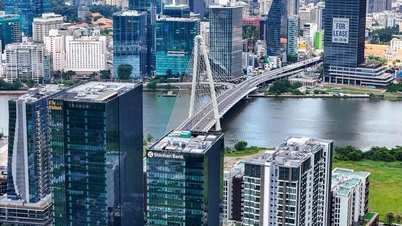
The delegations were divided into several groups, visiting key landmarks such as Metro Line 1 – a symbol of efforts to modernize urban transportation – and the VNG Campus headquarters – a showcase of the dynamism of Vietnamese technology companies.
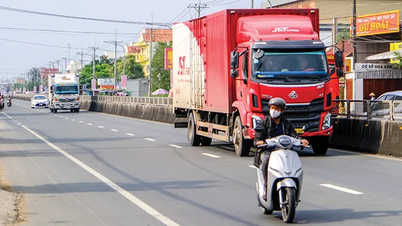
The delegates also visited the former Binh Duong province to learn about the region's transportation system and industrial infrastructure, with successful models such as VSIP Industrial Park, My Phuoc Industrial Park, and the Binh Duong Industrial, Urban, and Service Complex; and visited Becamex Group - a leading state-owned enterprise in the fields of transportation infrastructure, industry, and urban development.
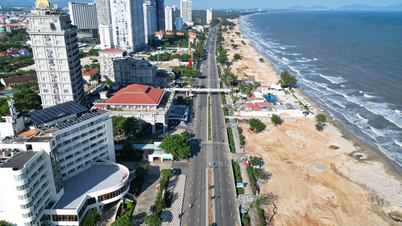
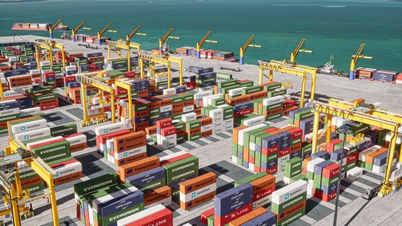
In the former Ba Ria - Vung Tau province, the delegation witnessed firsthand the operations of Gemalink Port - a leading modern deep-water port in the region, a key link in the global logistics chain, and Phu My 3 Intensive Industrial Park - a bright spot attracting global investment.
Through this field trip, delegates gained valuable practical information, fostering enthusiasm and confidence in the strong development of Ho Chi Minh City in the new era, contributing to the overall success of the City Party Congress for the 2025-2030 term.
The foundation for the megacity era.
If "position" refers to geographical location and spatial scale, then "strength" refers to superior socio-economic internal strength, the impetus to reach regional and global prominence. The new Ho Chi Minh City possesses a powerful combination of resources, where the three most dynamic growth poles in the country converge.
By 2025, Ho Chi Minh City's economy is estimated to reach 3.03 trillion VND (equivalent to 123 billion USD), accounting for 23.5% of the national GDP. If oil and gas in Ba Ria - Vung Tau is excluded, the figure still exceeds 2.821 trillion VND, representing 22.3% of the national total. This demonstrates that Ho Chi Minh City's economic strength is the result of the combined and synergistic effects of three dynamic economic regions.
Regarding state budget revenue, this year, Ho Chi Minh City is expected to achieve 737,000 billion VND, accounting for 36.7% of the total national budget revenue, while budget expenditure is expected to reach 248,000 billion VND, accounting for 10.9% of the total expenditure. This shows the fiscal importance of the newly established Ho Chi Minh City in the national budget.
 According to the Draft Political Report at the First Congress of the Ho Chi Minh City Party Committee, term 2025-2030, Ho Chi Minh City is aiming for a new vision of becoming an "international megacity" of Southeast Asia. Specifically, by 2030, the city aims to have a prominent position in Southeast Asia, ranking among the top 100 most livable cities globally; and by 2045, Ho Chi Minh City strives to be among the top 100 best cities in the world, becoming an international megacity in the region, and a center of economy, finance, services, education, and healthcare in Asia.
Foreign trade activities were also very vibrant, with total import and export turnover reaching US$181.5 billion, accounting for 23.1% of the country's total turnover. The city's total social investment capital is estimated at VND 640,700 billion, accounting for 17.4% of the country's total social investment capital. Retail sales of goods and services are estimated at VND 1,679 trillion, equivalent to 26% of the national total, reflecting strong purchasing power and a well-developed distribution system.
Thus, the merger of Ho Chi Minh City with Binh Duong and Ba Ria - Vung Tau provinces is an unprecedented turning point in the history of urban development in Vietnam, thereby opening up opportunities to expand markets, increase investment attractiveness, connect infrastructure, connect production chains, and elevate international standing, accessing finance and advanced technology.
This represents a comprehensive reconfiguration of the development space, where the three most dynamic economic hubs in the country converge, with a new vision of becoming an "international megacity" of Southeast Asia, and one of the top 100 most livable cities in the world, aiming to fulfill the mission of pioneering, leading, and spreading development throughout the country.
“Today, Ho Chi Minh City is at a completely different level, position, and strength than before. After its expansion, the city is not only the largest economic center in the country, but also a symbol of pioneering spirit, innovation, and the aspiration to reach international standards,” observed Associate Professor Dr. Tran Dinh Thien, a member of the Prime Minister's Policy Advisory Council.
According to Mr. Thien, Ho Chi Minh City is currently harnessing the combined strength of three major economic pillars: services - trade - industry; urban - seaport - tourism; and a high-tech industrial innovation city. Each of these economic complexes plays a unique role: from a logistics and international trade center to an innovation city, attracting foreign direct investment (FDI) and developing high technology. All of these combine to create a Ho Chi Minh City with exceptional scale, potential, and influence – a true "megacity."
An opportunity to reach global heights.
Having witnessed Ho Chi Minh City's transformation over more than half a century, Associate Professor Dr. Tran Hoang Ngan said he understands the city's very essence. Therefore, every time he visits developed cities, he secretly hopes that Ho Chi Minh City will one day achieve the same stature. "It's gratifying that many of those dreams are gradually becoming a reality," said Professor Tran Hoang Ngan.
Mr. Tran Hoang Ngan cited that Ho Chi Minh City is currently ranked 102nd out of 156 global cities, 101st out of 146 smart cities, 133rd out of 173 livable cities, and 95th out of 120 international financial centers, even surpassing Bangkok – a sign that the city is heading in the right direction.
According to Mr. Ngan, Ho Chi Minh City has all the necessary conditions for remarkable development, from its people to its geographical location, infrastructure, and economic potential. "This is a favorable arrangement of the universe," he said, adding that Ho Chi Minh City possesses a high-quality workforce with hundreds of universities, hospitals, research centers, and leading healthcare facilities – this is the core element, the most valuable resource for development.
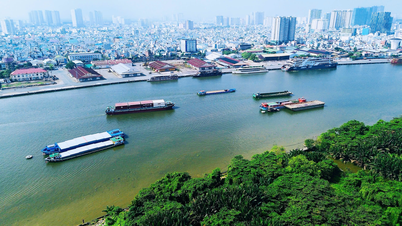
Furthermore, industry and logistics are two strong pillars of growth, with nearly 100 industrial parks and export processing zones contributing approximately 35% of Ho Chi Minh City's GRDP. The logistics system is developing rapidly and is modern, with major ports such as Cai Mep - Thi Vai and the upcoming Can Gio International Transshipment Port, helping the city move closer to becoming a leading logistics hub in the region.
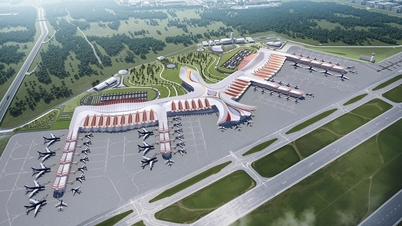
In terms of transportation infrastructure, the city has a rare advantage with two airports, Tan Son Nhat and Con Dao, and soon Long Thanh airport, although located in Dong Nai province, has strategic significance for the Southeast economic region, with Ho Chi Minh City playing a central role in the region.
According to Associate Professor Dr. Tran Dinh Thien, "reaching new heights" is something Ho Chi Minh City can certainly achieve. The goal must be to "surpass existing levels," to break through its current standards and affirm its role as a globally competitive megacity. Dr. Thien believes that to "surpass existing levels in the right way," several key factors are needed.
That is, empowering and assigning sufficient responsibility to Ho Chi Minh City. When given genuine decentralization accompanied by clear accountability mechanisms, the city will have the motivation to proactively choose the optimal solution and act effectively.
Ho Chi Minh City needs to define a vision "looking from the future to the present." The city's development space cannot be confined solely to land. It needs to expand strongly into "ocean space" encompassing the maritime economy, international transshipment ports, energy, and marine resources; and "sky space" encompassing the low-level economy, urban air transport, and unmanned aerial vehicles/flying taxis.
Ho Chi Minh City also needs to make breakthroughs in the "digital space." The digital economy opens up almost unlimited growth potential; if it takes the lead in digital infrastructure, data, AI, and open platforms, the city will multiply productivity and restructure public services, logistics, and urban industries according to modern standards.
Simultaneously, these directions must be closely linked to international financial centers, innovation hubs, logistics centers, and free trade zones. These "major coordinates" are consistent with the city's existing capabilities. The core issue is designing a strategy that is large enough to create synergy between these priority axes, rather than prioritizing them in a fragmented manner.
Source: https://baodautu.vn/buoc-ngoat-moi-cua-sieu-do-thi-tphcm-d409962.html
![[Photo] My Son at night: A thousand-year-old heritage site amidst the Milky Way](https://vphoto.vietnam.vn/thumb/1200x675/vietnam/resource/IMAGE/2026/04/15/1776261039184_ndo_br_chon6-jpg.webp)
![[Photo] National Assembly Chairman Tran Thanh Man attends the opening session of IPU-152](https://vphoto.vietnam.vn/thumb/1200x675/vietnam/resource/IMAGE/2026/04/16/1776277863731_ctqh5-jpg.webp)

![[Photo] Mrs. Ngo Phuong Ly meets and exchanges views with Mrs. Peng Li Yuan](https://vphoto.vietnam.vn/thumb/1200x675/vietnam/resource/IMAGE/2026/04/16/1776277858080_phu-nhan-1-jpg.webp)
![[Photo] The General Secretary, President and his wife meet with Vietnamese-Chinese friendship leaders.](https://vphoto.vietnam.vn/thumb/1200x675/vietnam/resource/IMAGE/2026/04/15/1776264829725_vna-potal-tong-bi-thu-chu-tich-nuoc-to-lam-gap-mat-nhan-sy-huu-nghi-viet-nam-trung-quoc-8703641-3130-jpg.webp)














































Comment (0)