

According to the Vietnam Coffee and Cocoa Association, coffee exports for the 2023-2024 crop year reached US$5.43 billion, marking the highest export value ever recorded.
Export volume decreased, but value increased.
Report on export turnover Vietnamese coffee According to the Vietnam Coffee and Cocoa Association (VICOFA) report for the 2023-2024 crop year (October 2023 to October 2024), Vietnam exported approximately 1.46 million tons of coffee, a decrease of more than 12.1% compared to the 2022-2023 crop year.
According to VICOFA, despite the quantity coffee Exports decreased but their value still increased sharply by over 33%, the reason being Coffee prices have risen sharply. As a result, coffee exports in the past crop year contributed more than $5.4 billion to Vietnam's total export revenue.
Over the past crop year, Vietnamese coffee prices have consistently reached record highs, the highest in the past 30 years. On October 30th, according to a survey by Tien Phong newspaper, the price of raw coffee in the Central Highlands was 105-109 million VND/ton. In contrast, on October 30th, 2023, the highest price for raw coffee in the same region was only 58-59 million VND/ton.
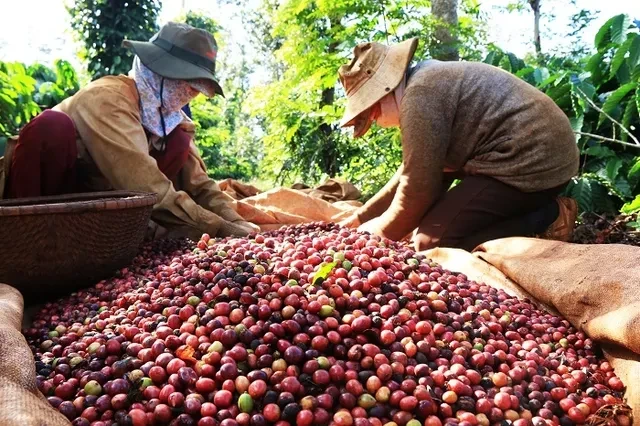
VICOFA forecasts that Vietnamese coffee prices will continue to remain high in the 2024-2025 crop year.
According to data from the General Department of Customs, Vietnam's coffee exports in the first half of October this year reached 21.5 thousand tons, worth 125.8 million USD, an increase of 0.4% in volume and 7.5% in value compared to the first half of September; and an increase of over 20% in volume and 98% in value compared to the first half of October 2023.
The export market is highly volatile.
In spite of coffee export value While production has increased sharply, Vietnam's coffee output is on a downward trend.
Mr. Nguyen Nam Hai, Chairman of VICOFA, stated: “The area under coffee cultivation is shrinking due to low coffee prices in previous years, which affected people's incomes, leading them to switch to other crops. Increasing the area and production of coffee in the future will be very difficult. We should find a suitable solution for long-term development rather than relying too much on the market.”

Recently, global coffee prices have risen sharply due to several factors, including the impact of climate change and the El Niño phenomenon causing droughts across coffee-growing regions worldwide, leading to reduced supply.
Furthermore, military conflicts around the world have also driven up transportation costs and other expenses in exports. In addition, many financial speculators worldwide are choosing coffee for investment purposes, which also significantly impacts its price.
According to Mr. Nguyen Nam Hai, the key factor driving up coffee prices is the EU's Anti-Deforestation Regulation (EUDR). Currently, Vietnamese coffee is exported to over 80 countries and territories worldwide.
The European Union's Anti-Deforestation Regulation (EUDR) stipulates that, from December 30th, companies cannot export certain agricultural products (including coffee) to the EU market unless they can prove that their products are not linked to deforestation. However, for smaller companies, the effective date of the EUDR has been postponed until July 2025. Therefore, many European businesses are actively purchasing coffee.
In the future, the implementation of this regulation will have a significant impact on Vietnam's coffee export market.
Source
































































































Comment (0)