

Representatives from many arts and culture schools have spoken out about the recent controversy surrounding the proposal that the title of "People's Artist" should be equivalent to a doctorate.
Difficult to recruit students.
Associate Professor Dr. Nguyen Dinh Thi, Rector of the Hanoi University of Theatre and Film, stated that due to its unique position as an arts training institution, the number of new doctoral students recruited annually is not large. Furthermore, it is not easy for artists and lecturers with master's degrees to pursue doctoral degrees and access advanced, in-depth scientific research. Therefore, the university finds it very difficult to fill the full faculty positions to meet the criteria in the Ministry of Education and Training's training regulations.
That is why the university proposes that the title of People's Artist be equivalent to a master's or doctoral degree. This will only apply to enrollment quotas and when opening new majors for specialized fields in the arts. This proposal "does not apply to all People's Artists as many people mistakenly believe" and does not completely replace doctoral degrees in master's and doctoral training.

Mr. Nguyen Dinh Thi (on the right) at the graduation ceremony of the University of Theatre and Film.
Mr. Thi stated that opening new university programs and determining annual enrollment quotas involves the entire faculty, and "if there aren't enough full-time lecturers with master's and doctoral degrees, it will be difficult to determine the enrollment quota."
" In some art training institutions, the participation of People's Artists in the training process is necessary. The Ministry of Education and Training should also acknowledge the participation of People's Artists, as they have a lot of experience in their profession; their teaching students professional skills is very good ," Mr. Thi added.
The difficulties faced by the Hanoi University of Theatre and Film are also common difficulties for art training institutions nationwide. Dr. Do Xuan Phuc, Rector of the University of Arts (Hue University), said that some state regulations are currently making things difficult for cultural and art schools. In particular, the requirements regarding the number of master's and doctoral degree holders when admitting students to undergraduate and postgraduate programs, and when opening new majors, are problematic.
"There are no institutions in the country that offer doctoral programs in the arts, yet regulations still require arts and culture schools to have doctoral-level qualifications to participate in training, management, or to open new programs for enrollment. We hope that this inadequacy will be considered and adjusted soon so as not to disadvantage arts and culture schools," Mr. Phuc said.
Proposing a specific mechanism
Professor Dr. Tu Thi Loan, Chair of the Science and Training Council of the Vietnam National Institute of Culture and Arts, believes that the arts sector needs specific policies. She argues that those who have been awarded the titles of People's Artist and Meritorious Artist should prioritize their professional expertise over scientific research.

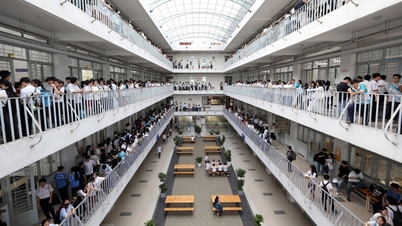
The number of full-time lecturers with master's and doctoral degrees in art schools is low. (Illustrative image: TN)
"In fact, when considering the titles of associate professor and professor, special circumstances such as those of People's Artists have been taken into account, with awards being converted into equivalents instead of research works, for example. That has been updated. So there's no reason why some art schools shouldn't be given special consideration, through conversion as proposed by the art schools; it could be a viable approach," she said.
In the long run, Ms. Loan believes that relevant authorities need to continue improving and raising the standards for doctoral training. She argues that without encouragement, even entry-level programs in the arts will fail to attract students, let alone doctoral candidates.
Mr. Pham Nhu Nghe, Deputy Director of the Higher Education Department, Ministry of Education and Training, said that in the regulations on the conditions, procedures, and processes for opening training programs, the Ministry has taken into account the specific characteristics of art schools (Circulars 02 and 03 of 2022).
Specifically, for university programs or new programs in the arts, only 3 full-time lecturers with PhDs and relevant expertise are required, instead of 5 as in other general fields. At the same time, the Ministry has allowed visiting lecturers in arts to undertake a maximum of 40% of the training workload; while for non-specialized fields, this figure is 30%.
The Ministry also allows universities, when opening new training programs, to consider lecturers with the title of People's Artist and a master's degree as equivalent to lecturers with a doctoral degree. Or, lecturers with a doctoral degree can replace lecturers with the title of associate professor. " Thus, compared to other fields, the conditions for opening new programs and enrolling students have been lowered by one level," he said.
The deputy director also emphasized that the proposal by schools to equate the title of "People's Artist" with master's or doctoral degrees is not yet regulated and is unlikely to be feasible. This matter will be further researched and considered by the Ministry of Education and Training and relevant units.
Associate Professor Bui Hoai Son, Standing Member of the National Assembly's Committee on Culture and Education, also disagreed with the above proposal.
According to Mr. Son, doctoral and master's degrees, along with the titles of People's Artist and Meritorious Artist, are two different standards that cannot be applied interchangeably. Doctoral training is theoretical training, requiring the ability to apply theory and use research methods. Writing a dissertation is the execution of a scientific project, where theory and scientific methods are applied to analyze a practical problem. Meanwhile, the titles of People's Artist and Meritorious Artist are more focused on practical application.
Ha Cuong
Beneficial
Emotion
Creative
Unique
Source
![[Photo] Prime Minister Pham Minh Chinh receives the Chinese Ambassador to Vietnam](https://vphoto.vietnam.vn/thumb/1200x675/vietnam/resource/IMAGE/2026/04/05/1775397481797_ndo_br_dsc-5512-jpg.webp)



































Comment (0)